
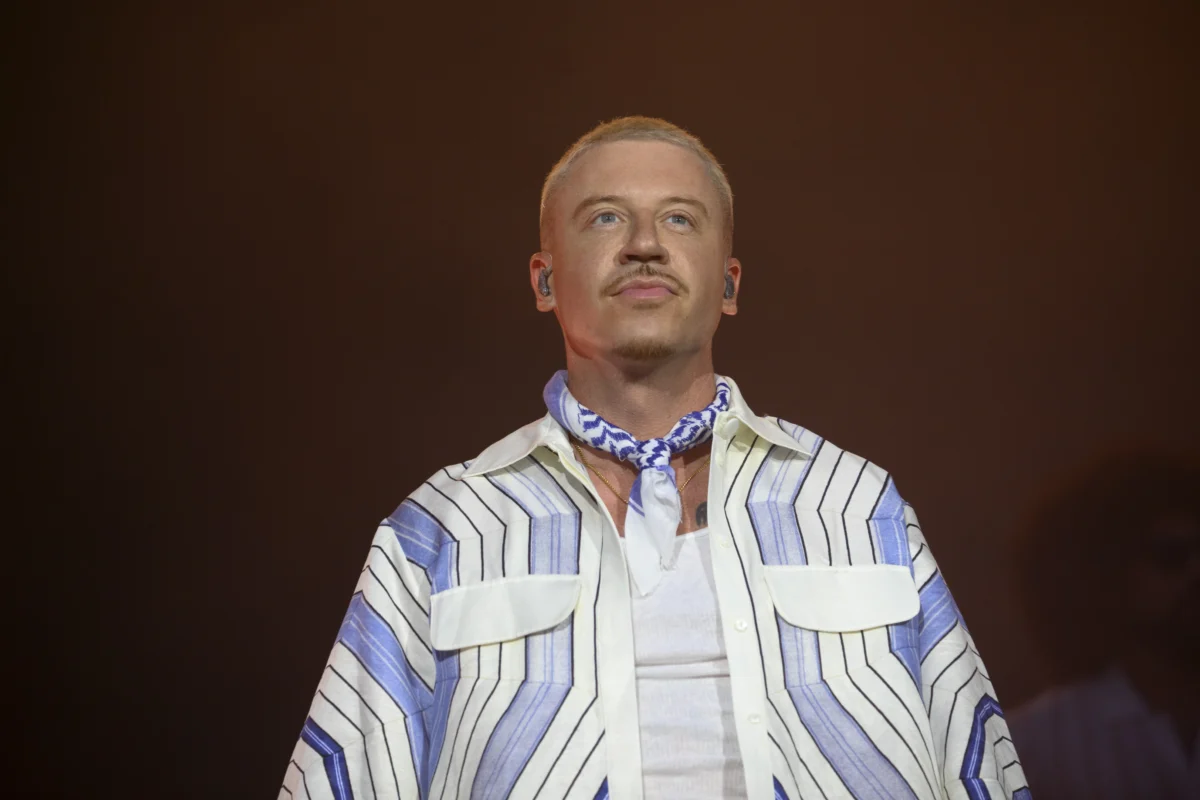
The Grammy-winning artist Macklemore, born Benjamin Haggerty, officially commenced a three-show international trek in Dublin, Ireland, this week, a series of performances explicitly centered on advocacy for Palestine. This tour follows a turbulent period for the rapper, who was removed from Ed Sheeran’s North American "Loop" tour in September 2026 after utilizing his platform at New Jersey’s MetLife Stadium to deliver impassioned political commentary regarding the ongoing conflict in Gaza and the West Bank.
The Dublin performance, which featured appearances by Irish musician Hozier and the hip-hop group Kneecap, served as both a musical event and a focal point for the artist’s humanitarian message. Addressing the crowd, Macklemore framed his recent professional challenges within a broader context of global discourse and the struggle for human rights.
Chronology of the Controversy
The series of events that led to the current tour began in early September 2026. During consecutive performances on September 4 and 5 at MetLife Stadium, Macklemore, acting as an opening act for Ed Sheeran, used his stage time to voice support for the Palestinian people. The rapper explicitly stated, "Free Palestine," framing the sentiment as a call for human dignity and the right to exist without fear.
The immediate aftermath of these speeches triggered a polarized response. The Israeli American Council (IAC) issued a formal call for the artist’s removal from the tour, arguing that his comments were inappropriate for a mainstream entertainment venue. The organization stated that the concerts were intended to be musical experiences rather than political protests, characterizing his remarks as an encroachment on the boundaries of a performance space.
By September 12, the situation reached a breaking point. The Messina Touring Group, the promoter managing Sheeran’s tour, announced that Macklemore would no longer participate in the remaining support dates. The decision was attributed to pressure from venue operators, who expressed concerns that the presence of the rapper would lead to protests, security complications, or potential cancellations, ultimately threatening the feasibility of the tour for the thousands of fans who had purchased tickets.
The Ripple Effect: Industry-Wide Solidarity
The removal of Macklemore from the tour did not occur in a vacuum; it triggered a cascade of professional repercussions. In a show of solidarity, several other opening acts—including Finneas, Lukas Graham, and Aaron Rowe—opted to withdraw from the tour. Additionally, a significant portion of Sheeran’s backing band reportedly stepped down.
This mass withdrawal underscored a growing tension within the music industry regarding the intersection of celebrity, corporate-managed tours, and political advocacy. The incident highlighted the fragility of large-scale touring logistics, where the political stance of a single performer can impact the contractual stability of an entire multi-city, multi-million-dollar production.
Official Responses and the Ed Sheeran Stance
Ed Sheeran, whose tour was directly affected by the departures, faced significant public scrutiny. In an attempt to address the confusion surrounding the decision-making process, Sheeran released a formal statement clarifying that the removal of Macklemore was a decision made by the tour promoters, not himself.
Sheeran’s statement emphasized his preference for maintaining his professional platform as a "neutral" space. He explained that his audience consists of diverse age groups and backgrounds, and he expressed a desire to avoid creating a forum that might alienate segments of his fan base. However, this stance initially drew criticism from those who viewed his silence as a failure to protect his peers’ right to expression.
In a notable shift, Sheeran addressed the conflict directly during a concert in Philadelphia on September 19. Departing from his previous reticence, he condemned the violence associated with the October 7 attacks in Israel while simultaneously labeling the humanitarian crisis in Gaza as "catastrophic" and "disproportionate." This nuanced acknowledgment represented a pivot in how the headliner chose to navigate the issue, reflecting the immense pressure performers face when managing a global brand in the midst of a volatile geopolitical climate.
Humanitarian Commitments and Financial Implications
Beyond the stage, the fallout has been defined by a significant redistribution of financial resources. Macklemore, in an effort to maintain his advocacy, pledged his $1 million salary from the Sheeran tour to charitable causes supporting Palestine. The current three-show tour, which spans Dublin, Paris, and London, has been organized with the explicit goal of donating all proceeds to humanitarian organizations operating in the region.
The financial scope of the controversy also involved high-profile figures such as Robert Kraft, the owner of Gillette Stadium. Following reports that Kraft had pressured stadium owners to remove the rapper from their lineups, the businessman announced a $2 million donation to aid in the region. This competitive philanthropy highlights how individual stakeholders in the entertainment industry are increasingly using financial contributions to exert influence or mitigate the PR damage caused by political controversy.
Contextualizing the Debate
The core of the dispute rests on a fundamental question: Should major concert stages function as arenas for political speech?
Advocates for the performer, such as those who support the "Free Palestine" movement, argue that music has historically served as a vehicle for social change, from the anti-Vietnam War movement to the fight against apartheid in South Africa. From this perspective, the stage is an extension of the artist’s personal identity and conscience.
Conversely, critics and corporate entities involved in live music production point to the commercial nature of stadium tours. They argue that the primary obligation of the promoter is to ensure the safety and continuity of the event. When an artist’s rhetoric potentially disrupts the operation of a multi-million-dollar business, the promoter is contractually and operationally compelled to intervene.
Implications for the Future of Live Music
The case of Macklemore and the "Loop" tour acts as a bellwether for the music industry in 2026. As political polarization increases globally, the "neutrality" of entertainment venues is becoming increasingly difficult to maintain.
- Contractual Clauses: Future touring contracts may include more rigorous language regarding political statements made by supporting acts, specifically designed to protect promoters from the financial fallout of venue cancellations.
- Venue Power: The incident confirmed the significant influence venue owners hold over the content of performances. If venue owners view certain political statements as a liability, they effectively become the final arbiters of acceptable speech within their facilities.
- Artist Autonomy vs. Corporate Branding: Performers are finding it increasingly difficult to reconcile their personal advocacy with the requirements of corporate-backed tours. This may lead to a rise in independent, artist-run tours where the performer maintains total control over the environment and the message.
As Macklemore continues his tour in Paris and London, the legacy of his removal from the Ed Sheeran tour remains a central topic in the conversation surrounding artistic freedom. Whether this marks a temporary cooling of political expression on major stages or the beginning of a more restrictive era for touring artists remains to be seen. For now, the rapper continues to leverage his audience as a mechanism for both fundraising and vocal advocacy, proving that even within the constraints of a high-pressure industry, the intersection of music and activism remains a potent, if contentious, force.

