
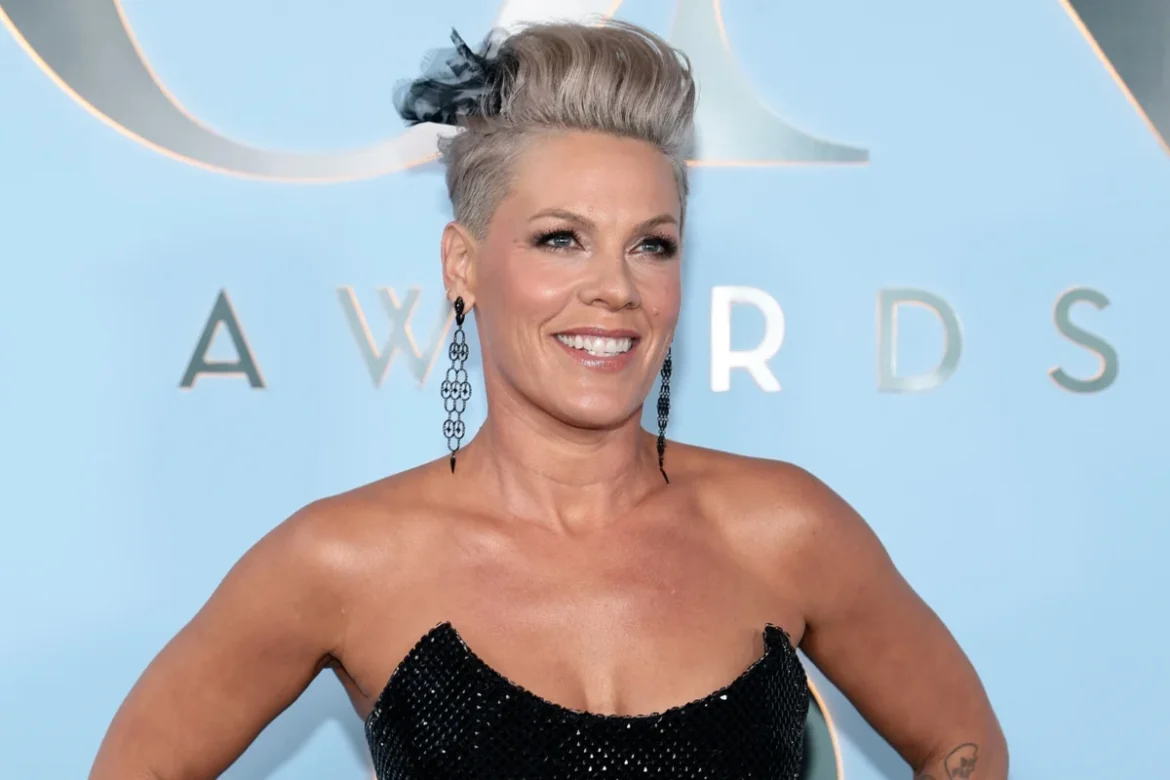
Pop star Pink has broken her silence to address a widespread wave of public criticism following her social media reaction to Macklemore’s pro-Palestine remarks during a recent live concert performance. The controversy, which has sparked intense debate across the music industry and social media platforms, centers around the intersection of celebrity activism, geopolitical conflict, and the responsibilities of artists performing on global stages.
The incident has reignited conversations regarding how public figures navigate sensitive foreign policy issues while entertaining massive audiences, drawing responses from advocacy groups, fellow musicians, and fans alike.
Chronology of the Controversy
The sequence of events began during the opening weekend of Ed Sheeran’s ongoing stadium tour, specifically on September 4 and 5, 2026. Ed Sheeran was performing at MetLife Stadium in East Rutherford, New Jersey, as part of his high-profile Loop Tour. Macklemore, known for hits like Thrift Shop, served as the opening act for the concert dates.
During his sets on both consecutive nights, Macklemore used his platform to deliver spoken-word remarks advocating for the Palestinian cause, featuring phrases such as free Palestine, alongside visual displays and imagery related to the ongoing Middle East conflict. The demonstrations immediately divided the stadium crowd and quickly spilled over into digital spaces.
Shortly after the New Jersey concerts concluded, Pink—whose legal name is Alecia Moore—interacted with the controversy online. She shared a post from the digital watchdog account StopAntisemitism, which sharply criticized Macklemore’s onstage comments and formally called for his removal from the remainder of Ed Sheeran’s stadium tour.
The social media share instantly generated significant backlash from pro-Palestinian supporters and other observers, who interpreted the repost as an endorsement of censorship and an anti-Palestinian stance. In response to the wave of criticism, Pink initially engaged with commentators by posting satirical memes and sharp remarks online before deleting her initial interactions and stepping back to compose a comprehensive statement.
On Friday, September 11, the Just Give Me a Reason singer published a detailed, multi-part statement via Instagram to clarify her position, address the nuances of her initial online reaction, and contextualize her long-standing humanitarian work.
Pink’s Official Statement and Clarification
In her detailed Instagram statement, Pink acknowledged that her initial approach to the digital discourse was counterproductive and fueled by emotional defensiveness. She admitted that relying on a quick social media repost and sarcastic memes was a mistake that simplified an intensely complicated situation.
A repost is not a statement, and a meme isn’t a spine, Pink wrote, expressing regret over how digital platforms reduce complex geopolitical issues into brief, polarizing soundbites.
The artist, who is Jewish, emphasized that her identity has frequently been weaponized by online commentators who assumed her personal beliefs without examining her public record or direct statements. She stated clearly that she has never spoken on behalf of the Israeli government or any other state administration. Furthermore, she unequivocally condemned Hamas as a terrorist organization while firmly asserting that Palestinian civilians deserve a future that respects their fundamental humanity and aspirations.
Protecting innocent life comes first, everywhere, and nobody should ever celebrate the death of a child. Anybody’s child, Pink wrote in her statement.

To support her humanitarian commitments, Pink highlighted her decade-long tenure as a UNICEF ambassador. Throughout her work with the international organization, she has consistently advocated for children affected by armed conflict across various global zones, emphasizing that her empathy extends to young victims on all sides of geopolitical divides. She noted that her grief over casualties of war has been demonstrated through direct field visits rather than behind the safety of a computer screen.
Underlying Tensions and Historical Context
Pink’s statement also referenced a prior historical incident involving Macklemore that contributed to her reaction at MetLife Stadium. In May 2014, the rapper faced widespread condemnation after wearing a costume during a surprise performance in Seattle that critics identified as featuring antisemitic caricatures, including a prosthetic nose and beard. Macklemore subsequently issued a lengthy public apology, stating that he respected all cultures and communities, an apology that many in the Jewish community accepted at the time.
However, the singer argued that Macklemore’s decision to blend political messaging, graphic war imagery, and direct appeals to a stadium audience during a family-friendly music concert crossed a line. She expressed discomfort at what she perceived as an environment where Jewish attendees were forced to navigate polarizing political rhetoric under the guise of general unity.
What I need is to be able to say, as a Jewish mom, that scared me, and it scared people I love, without being told our fear is just propaganda, and without being told I’m somehow cool with genocide because I noticed, Pink stated. She reiterated that she has never advocated for the professional silencing of fellow artists, nor is she demanding that Macklemore be terminated from his tour commitments or that ticket holders receive refunds.
Responses from Macklemore and Advocacy Groups
Macklemore has stood firmly by his artistic choices and political statements in the wake of the backlash. Responding directly to critics on social media platform X (formerly Twitter), the rapper defended his onstage chants and shared video footage of his September 5 speech at MetLife Stadium.
Wanting all humans to be treated equal should never be controversial, Macklemore wrote, reinforcing his commitment to speaking out on international humanitarian issues during his live performances.
The controversy has also drawn institutional involvement. The Israeli-American Council (IAC) mobilized quickly following the New Jersey concerts, launching a formal petition demanding Macklemore’s immediate removal as the opening act for the remaining eight stadium dates on Ed Sheeran’s U.S. itinerary, which are scheduled to run through early November. The IAC argued that utilizing large-scale musical concerts for politically charged geopolitical messaging creates a divisive and hostile environment for concertgoers.
Broader Implications for Live Music and Celebrity Activism
The clash between Pink and Macklemore highlights an increasingly prominent challenge within the modern entertainment industry: the blending of mainstream commercial music tours with high-stakes geopolitical activism. As artists increasingly use their global platforms to voice opinions on complex international conflicts, concert venues—traditionally viewed as neutral spaces for shared cultural experiences—are frequently transforming into flashpoints for ideological debate.
Industry analysts note that high-profile public disagreements among major pop stars complicate public relations management for major touring acts. When multi-platinum artists publicly clash over international crises, fan bases fracture along ideological lines, placing pressure on tour organizers, promoters, and venue operators to balance freedom of expression with audience safety and comfort.
Furthermore, the incident underscores the pitfalls of digital discourse among celebrities. In an era where complex geopolitical crises are filtered through short-form social media posts, instantaneous reactions by public figures often lead to accelerated polarization, misinterpretation, and intense public scrutiny. Pink’s subsequent decision to issue a detailed, long-form clarification reflects the limitations of rapid social media engagement when addressing deeply sensitive historical, cultural, and political identities.
As Ed Sheeran’s Loop Tour continues its scheduled trajectory across the United States, the ongoing dialogue surrounding artist expression, community safety, and accountability remains at the forefront of public discourse within the global music community.
