
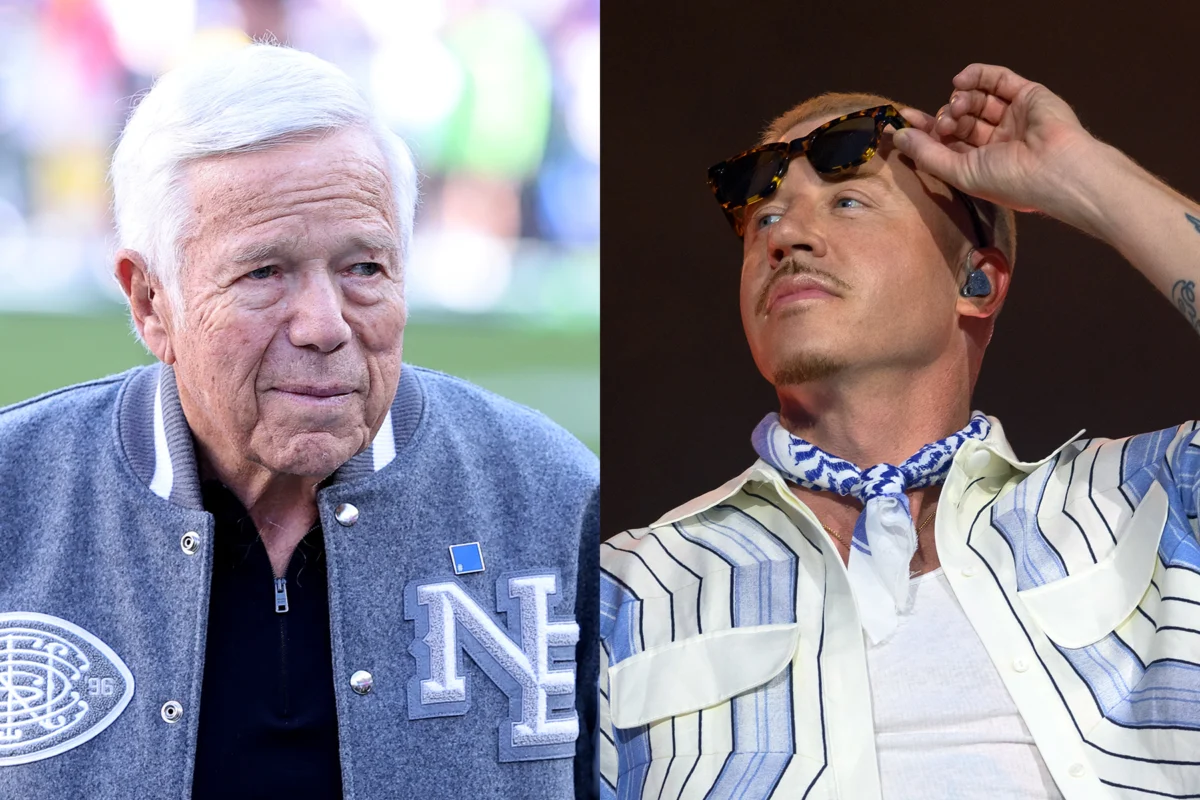
The intersection of major professional sports venue management, global geopolitics, and contemporary popular music has once again sparked intense public debate following a high-profile tour cancellation. New England Patriots owner and billionaire businessman Robert Kraft has formally confirmed that he intervened to bar Seattle-born rapper Macklemore from performing as an opening act for Ed Sheeran at Gillette Stadium. The decision followed the artist’s vocal and visible public expressions of solidarity with Palestinians, chants of "Free Palestine," and a broader history of controversy surrounding cultural and political commentary.
The controversy highlights the complex and often polarizing nature of public figures using high-capacity entertainment platforms to address international conflicts. As stadium owners increasingly police the boundaries of acceptable speech within privately managed, publicly accessible entertainment complexes, the fallout from this cancellation raises profound questions regarding free expression, corporate responsibility, corporate philanthropy, and the delicate line between political protest and identity-based animus.
The Origin of the Conflict: MetJersey and the Onstage Protests
The friction between event organizers and the Grammy Award-winning rapper crystallized in early September when Macklemore joined Ed Sheeran’s ongoing Loop Tour as a supporting act. During the initial performances of the leg at MetJersey’s MetLife Stadium just outside New York City, the rapper utilized his stage time to deliver explicit political commentary regarding the ongoing Israel-Hamas war.
In front of tens of thousands of concertgoers, Macklemore shouted "Free Palestine," expressed deep solidarity with civilians suffering in Gaza and the occupied West Bank, and projected vivid imagery illustrating the widespread destruction resulting from military operations in the region. Furthermore, he performed his politically charged protest anthem "Hind’s Hall," a track dedicated to student-led pro-Palestine demonstrations at Columbia University.
Addressing the audience directly, the rapper emphasized the intentionality of his platform. "A big part of the reason why I wanted to do this tour in the first place is so I could stand up in stadiums like this and say two words that are very near and dear to my heart: ‘Free Palestine,’" Macklemore told the crowd. "I said, ‘Free Palestine!’ I want those words to be loud and clear, so that people all the way in Gaza to the occupied West Bank know that we have not forgotten about them."
These remarks, amplified by social media and captured by thousands of fans, immediately triggered alarms among venue executives and advocacy organizations. For major stadium operators, the integration of charged geopolitical messaging into pop music concerts presents significant operational, security, and public relations challenges, particularly when venues are closely associated with prominent public figures who maintain deep personal and financial ties to specific cultural and religious communities.
Robert Kraft and Gillette Stadium’s Official Stance
Following widespread speculation regarding why the rapper was subsequently dropped not only from the Gillette Stadium dates but from the remainder of Ed Sheeran’s tour itinerary, Robert Kraft issued a definitive statement to the press. Kraft, who is Jewish, a prominent philanthropist, and a long-standing supporter of Israeli causes and anti-hate initiatives, detailed the reasoning behind the venue’s decision.
"The decision was based on Macklemore’s recent actions, material shared from the stage during Ed Sheeran’s shows in New Jersey, and a broader history of antisemitic rhetoric and imagery that we believe has been deeply offensive and hurtful to the Jewish community," Kraft stated.
The reference to a "broader history" alluded to a well-documented 2014 incident in which Macklemore faced heavy criticism after wearing a costume featuring a prosthetic nose and beard during a surprise performance in Seattle. Critics argued the costume closely mirrored traditional antisemitic caricatures. Although the rapper issued a public apology at the time—insisting that his intent was merely to disguise himself for a random costume party rather than to propagate hate speech—the incident has continued to shadow his career and resurfaced prominently during discussions among venue operators.
Kraft emphasized that Gillette Stadium maintains a strict code of conduct regarding public safety and community inclusivity. "Gillette Stadium is committed to providing a welcoming environment for all guests and ensuring that all events held at our venue do not provide a platform for hate speech," Kraft continued. "We decided that Macklemore’s participation in Sheeran’s upcoming shows at Gillette would cross that line."
Allegations of Venue Collusion and Industry-Wide Pressure
The narrative surrounding the cancellation took a contentious turn when Macklemore released his own public statement addressing his removal from the tour. According to the rapper, the censorship went beyond a localized decision by a single venue owner. Macklemore alleged that Robert Kraft personally contacted Ed Sheeran to inform him that the rapper would be barred from performing at Gillette Stadium.
Moreover, Macklemore claimed that Kraft exerted influence across the broader live entertainment sector. The rapper asserted that Kraft "rallied some of the other stadium owners and collectively they gave [Sheeran] an ultimatum: If Macklemore stays on the tour, you will not be allowed to play in our venues."
While representatives for Robert Kraft promptly addressed the core reasons for banning the artist from Gillette Stadium, they did not immediately issue a public response to the specific allegation regarding coordinated industry-wide ultimatums given to Ed Sheeran. The absence of a denial on the collusion claim has fueled intense industry debate concerning the behind-the-scenes power dynamics between mega-stadium owners, major tour promoters, and headlining musical acts.
The Debate Over Humanitarian Advocacy Versus Antisemitism
The public exchange between Kraft and Macklemore underscores a broader, highly volatile ideological battleground regarding how the war in Gaza is discussed within Western cultural spaces. The core of the disagreement centers on the linguistic and conceptual boundary separating legitimate criticism of state actions from systemic prejudice against ethnic or religious groups.
In his clarifying statements, Kraft took pains to separate humanitarian concern for Palestinian civilians from the rhetoric utilized by political factions such as Hamas. He asserted that his opposition to Macklemore’s platform was "not about diminishing the suffering of innocent Palestinians or denying anyone the right to advocate on their behalf."
However, Kraft argued that such advocacy must be balanced and contextualized. "That advocacy should not come at the expense of the Jewish community or obscure the responsibility of Hamas," he noted. "Too many lives have been lost and there has been too much suffering, but only sharing selective information and ignoring the actions of Hamas is not honest and only advances more divisiveness and hate."
To substantiate his humanitarian credentials, Kraft highlighted his decades-long philanthropic record in the Middle East. He pointed out that he has consistently directed resources toward Palestine, fostering athletic and entrepreneurial opportunities for Palestinians whom he deeply admires and respects. "Standing with the Palestinian people and standing against Hamas, antisemitism, and hate should not be mutually exclusive," Kraft concluded.
Conversely, Macklemore and his supporters have steadfastly rejected the notion that advocating for Palestinian rights or criticizing the State of Israel constitutes antisemitism. In his post-removal statement, the rapper argued that conflating political critique with bigotry ultimately undermines the fight against genuine prejudice.
"Antisemitism is real," Macklemore wrote. "And that is exactly why the word matters too much to be used as a shield against criticism of the Israeli state. When criticizing Israel, opposing Zionism, or saying ‘Free Palestine’ gets conflated with hatred of Jewish people, it doesn’t protect Jewish people. It protects Israel from accountability."
Philanthropic Background and Broader Implications
Robert Kraft’s intervention reflects his extensive, lifelong engagement with Jewish communal advocacy and philanthropy. Through the Kraft Family Philanthropies and the Foundation to Combat Antisemitism (which Kraft launched with a substantial personal financial commitment), the billionaire businessman has spearheaded numerous national and international campaigns aimed at raising awareness about rising hate speech and discrimination. His deep ties to Israeli civic, educational, and athletic institutions have made him one of the most prominent figures advocating for pro-Israel interests within the American corporate and sports landscapes.
The clash between Kraft’s foundational mission to combat hate speech and Macklemore’s insistence on exercising political free speech illustrates a growing trend within major entertainment venues. As cultural events increasingly intersect with geopolitical flashpoints, venue owners, who bear ultimate liability for safety, crowd control, and community relations, are showing an increased willingness to draw hard lines regarding what constitutes acceptable discourse on their stages.
At the same time, civil liberties advocates and artists’ rights organizations are closely monitoring such incidents, expressing concern that coordinated boycotts or venue bans could establish a chilling precedent for artists seeking to use their public platforms to address human rights crises, foreign policy decisions, and humanitarian disasters.
Conclusion and Prospects for Reconciliation
Despite the high-stakes public disagreement and the disruption to a major international concert tour, Robert Kraft concluded his public remarks by extending an olive branch to the artist. Expressing "tremendous respect" for Ed Sheeran and his unique ability to foster joy and unity through music, Kraft indicated that the door remains open for personal dialogue.
"I would welcome the opportunity to sit down with Macklemore and discuss the facts," Kraft stated, "because ultimately our goal is the same—peace for all people, an end to suffering, and an end to all hate."
As of press time, representatives for Macklemore have not responded to requests for comment regarding Kraft’s invitation for dialogue, leaving the status of any potential reconciliation uncertain. Meanwhile, Ed Sheeran’s Loop Tour continues without its supporting act, leaving the broader entertainment industry to grapple with the shifting boundaries of political expression in commercial performance spaces.

