The landscape of modern education is currently undergoing a fundamental shift in its primary objective, moving away from the traditional mastery of content toward the cultivation of sophisticated inquiry skills. For decades, the success of a student was measured by their ability to provide correct answers to pre-determined questions, a model that prioritizes information retrieval and response strategies. However, contemporary pedagogical research suggests that if the ultimate goal of education is to foster independent thought, the focus must shift from the answers students provide to the questions they are capable of formulating. This transition represents a significant evolution in how educators view intelligence, comprehension, and the student-teacher dynamic.
The ability to ask the right question at the right time is increasingly recognized as the most authentic indicator of deep understanding. In a classroom setting, a well-timed, insightful question acts as a bridge between known facts and the vast unknown, serving as a tangible artifact of critical thinking. Educational theorists argue that asking a question is not a sign of ignorance but rather a sophisticated cognitive act that requires both a firm grasp of existing knowledge and the intellectual humility to recognize what remains to be discovered.
The Conceptual Ecology of Inquiry
To understand why questions are becoming the centerpiece of modern curricula, one must examine the "conceptual ecology" of learning. When a student encounters a subject—whether it is a biological specimen, a historical event, or a mathematical theorem—they are often presented with isolated fragments of information. Without the ability to ask questions, these fragments remain static. For instance, in a biology lab, a student observing a drop of water might see it merely as a chemical compound (H2O). However, through the lens of inquiry, that drop of water becomes infinitely plural: a vessel for microscopic life, a symbol of environmental health, a tool for industry, and a miracle of physics.
Expert educators, including Terry Heick, posit that for a student to truly "know" water, they must understand what is potentially inside it, how to investigate its contents, and what that water signifies both within and beyond the scientific field. This level of understanding is rarely achieved through rote memorization; it requires the student to look both backward at what has been taught and forward at what can be imagined.
The Efficiency Paradox: Teacher vs. Student Questioning
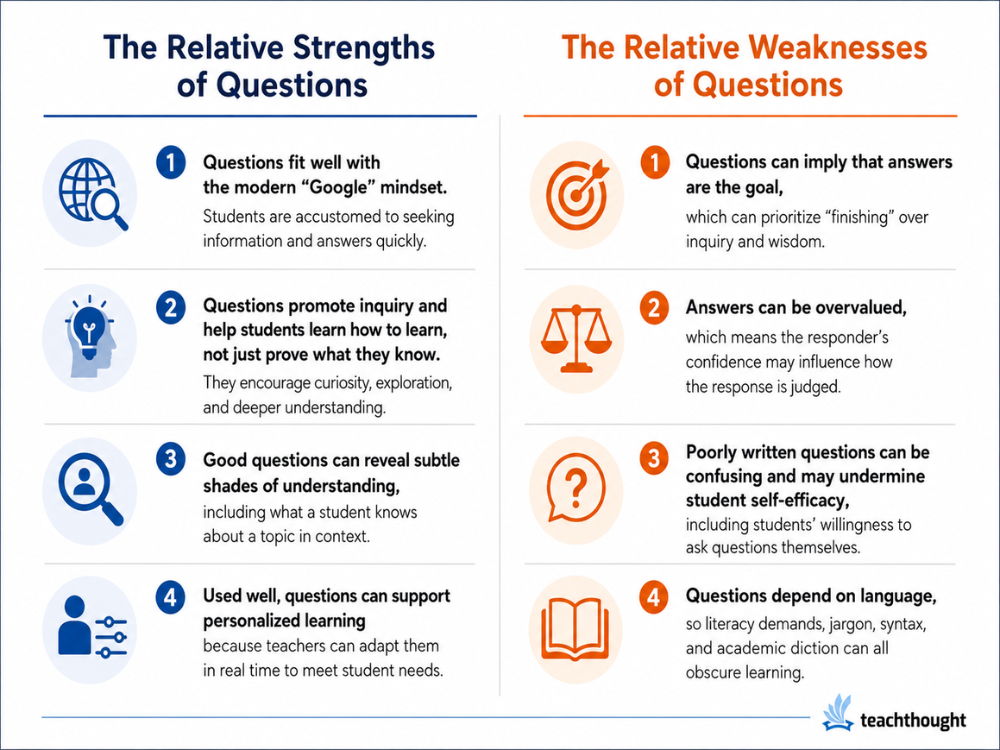
A primary challenge in the modern classroom is the "bottleneck" created by traditional teacher-led questioning. In a standard class of 30 students, teachers often sacrifice personalization for efficiency. Faced with aggressive curriculum maps and the pressure of standardized testing, instructors tend to use broad, sweeping questions designed to elicit specific, universal answers. This "guess-what-the-teacher-is-thinking" model often fails to ignite genuine curiosity because it ignores the individual student’s background knowledge, literacy level, and personal interests.
In contrast, when the pattern is reversed and the student becomes the primary questioner, learning becomes inherently personalized. An authentic student question is a reflection of that individual’s unique cognitive gaps and fascinations. Pedagogical experts liken this to the "spring-loading of a Venus flytrap." As a topic moves through a student’s mind, they survey their own thinking, spot inconsistencies, and—when the time is right—snap shut on a question that bridges the gap. This process ensures that the learning is not a "trick" but a meaningful pursuit of clarity.
A Spectrum of Purpose: From Traditional to Self-Directed Inquiry
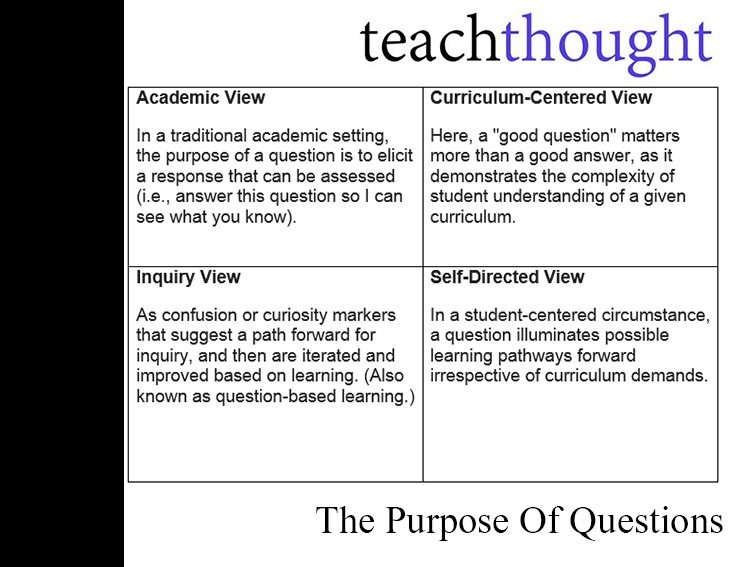
The role of questioning can be viewed through a spectrum of four distinct educational philosophies, ranging from traditional academic views to progressive, self-directed models.
- The Academic View (Traditional): In this model, the question is a tool for assessment. Its primary purpose is to elicit a response that can be graded to determine what the student has memorized.
- The Curriculum-Centered View: Here, a "good question" is valued more than a "good answer," as it demonstrates the student’s ability to navigate the complexities of a specific curriculum.
- The Inquiry View (Progressive): Questions serve as markers of curiosity and confusion. They are used to suggest a path forward for investigation and are iterated upon as the student learns more. This is often referred to as question-based learning.
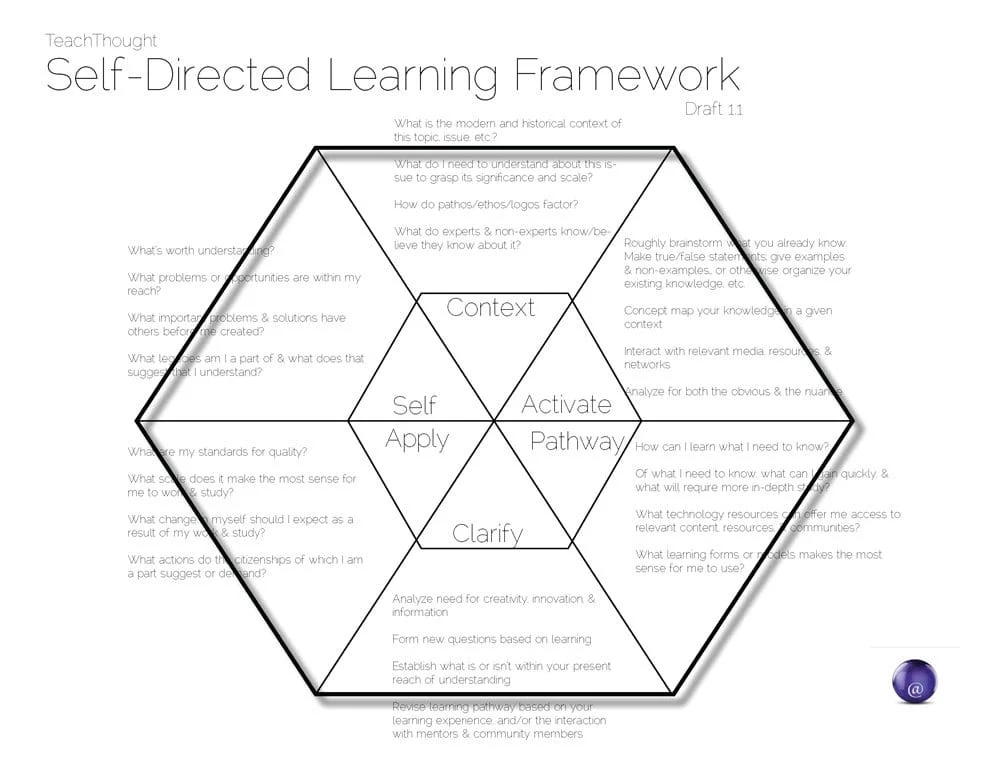
- The Self-Directed View: In this student-centered model, questions illuminate learning pathways that may exist entirely outside the standard curriculum. The student’s own need for knowledge catalyzes the entire educational experience.
Research suggests that while "bad" questions can stop thinking by causing confusion or doubt, "good" questions clarify, reveal, and foster hope by opening new doors for exploration.
Re-evaluating Cognitive Hierarchies and Bloom’s Taxonomy
A common misconception in education is the segregation of "lower-level" and "higher-level" thinking. Historically, "lower-level" questions—those involving recall, definitions, and dates—have been dismissed as remnants of a factory-model education system designed to produce compliant workers rather than innovators. However, a nuanced analysis of Bloom’s Taxonomy reveals that these levels are not meant to be hierarchical in terms of value, but rather integrated strands of a complex cognitive process.
The late educational researcher Grant Wiggins noted that the terms "higher-order" and "lower-order" do not actually appear in Bloom’s original taxonomy. Instead, the framework was intended to show how simple behaviors (recalling facts) are integrated to form complex behaviors (evaluating and creating). For example, a student cannot engage in high-level analysis of the American Civil War if they do not first know the foundational facts: the dates, the geographic locations, and the cultural-industrial tensions of the 1800s. In this context, "lower-level" questions provide the necessary foothold for more sophisticated inquiry.
The Role of Cognitive Dissonance in the Classroom
One of the most powerful functions of questioning is its ability to induce cognitive dissonance—the psychological discomfort of holding two competing beliefs simultaneously. When a teacher uses Socratic-style questioning to present a perspective that challenges a student’s existing worldview, the student is forced to either adjust their belief or evaluate the validity of the question itself.
This intersection of questioning and self-reflection is critical for developing intellectual maturity. A well-crafted question can change a student’s mind or, at the very least, instill a lifelong tendency to examine their own biases. This cognitive friction is where true growth occurs, moving the student beyond the passive acceptance of facts toward the active construction of a personal value system.
Implementing Inquiry: Essential Questions and Collaborative Strategies
To facilitate this shift toward inquiry, many schools are adopting the use of "Essential Questions." As defined by Grant Wiggins, an essential question is broad, timeless, and perpetually arguable. Unlike a standard quiz question, an essential question—such as "What is justice?" or "Is science compatible with religion?"—provokes deep thought, requires the weighing of evidence, and naturally recurs across different subjects and life situations.
Furthermore, specific classroom strategies are being deployed to democratize the asking of questions:
- Think-Pair-Share: This collaborative strategy allows students to process a thought-provoking prompt individually before discussing it with a partner and eventually sharing it with the class. This reduces the "performance anxiety" of questioning and allows for the refinement of ideas.
- Wonder Walls: These are dedicated physical or digital spaces where students can post questions that arise during lessons. By reviewing these questions weekly, teachers ensure that student curiosity directly influences the direction of the curriculum, making the learning experience more dynamic and responsive.
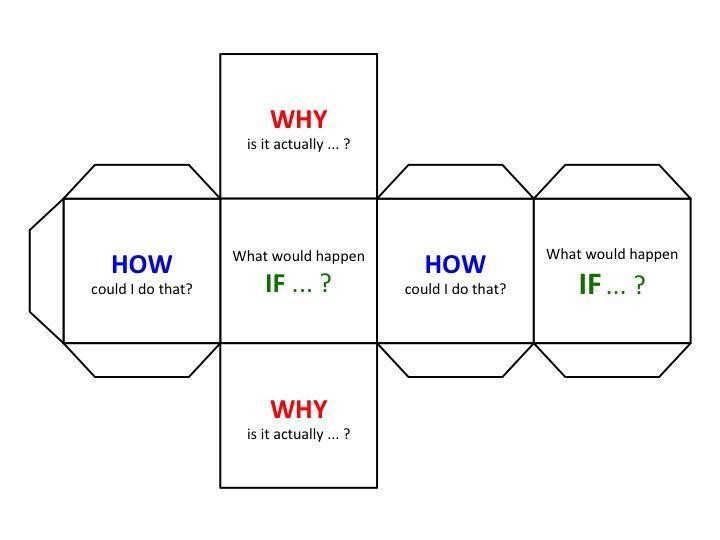
- Question Formation Technique (QFT): This is a rigorous process where students are given a "Question Focus" and tasked with generating as many questions as possible without judgment, then refining and prioritizing them to guide their own research.
Broader Impact and Global Implications
The move toward an inquiry-based educational model has significant implications for the future workforce and global citizenship. In an era where information is ubiquitous and artificial intelligence can provide answers to almost any factual query in seconds, the value of human intelligence is increasingly found in the ability to ask what the AI cannot.
Economists and social scientists suggest that the next generation of leaders will not be those who have memorized the most data, but those who can identify the most pressing problems and formulate the questions necessary to solve them. By centering the classroom on the art of the question, educators are not just teaching a subject; they are equipping students with the cognitive tools necessary to navigate an increasingly complex and unpredictable world. The transition from a "culture of answers" to a "culture of inquiry" is, therefore, not merely a pedagogical trend, but a necessary evolution in the preparation of the human mind for the challenges of the 21st century.