
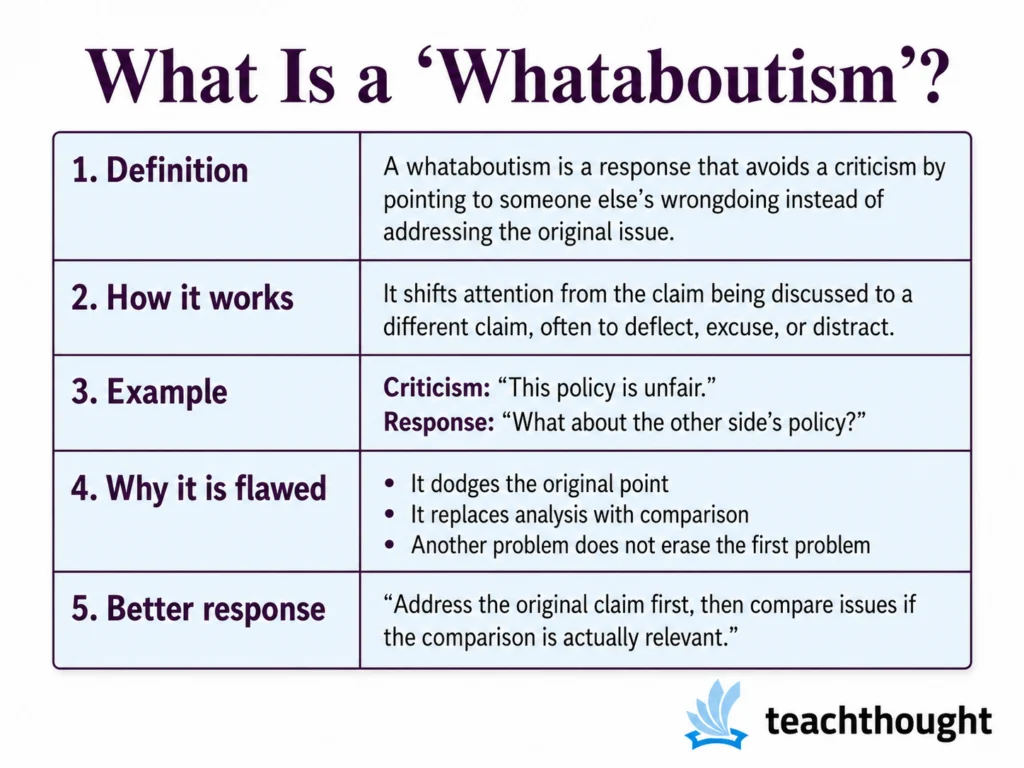
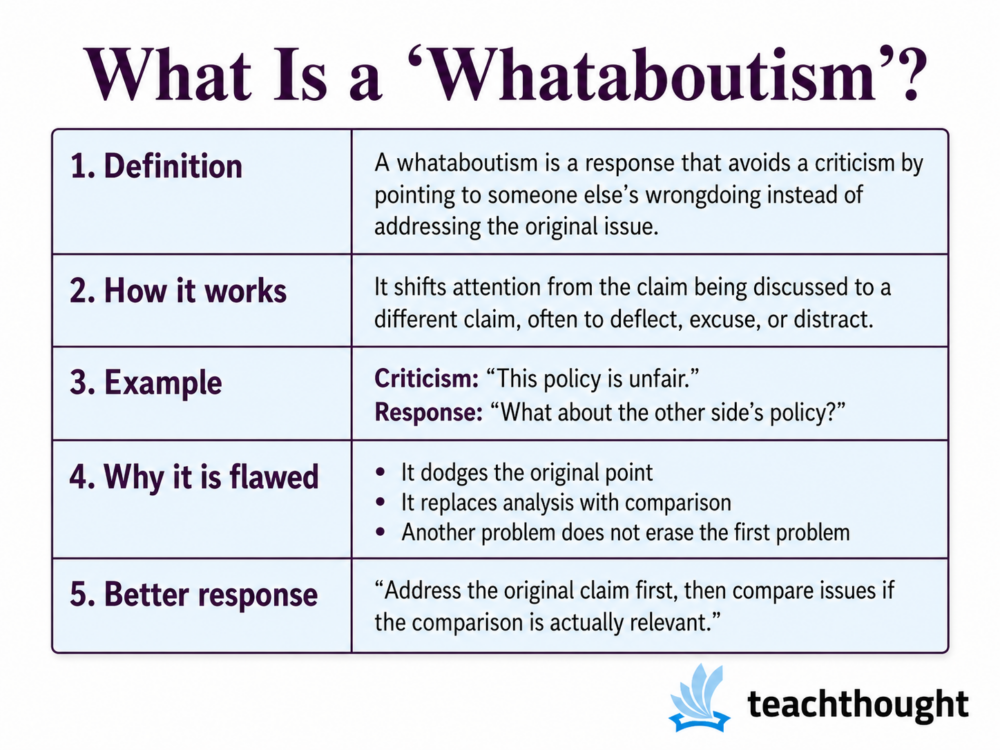
The term whataboutism describes a rhetorical strategy where an individual avoids addressing a criticism or difficult question by redirecting the focus toward a different problem, typically one associated with the accuser or a third party. While it often mimics the appearance of a quest for fairness or consistency, whataboutism functions primarily as a mechanism for avoidance. Instead of engaging with the evidence or logic of a specific claim, the practitioner of whataboutism shifts the goalposts, effectively stalling the conversation and preventing accountability. This maneuver has moved from the fringes of propaganda into the mainstream of political debate, social media interaction, and even corporate communication, fundamentally altering how modern society processes information and resolves disagreements.
The Mechanics of Deflection: Defining the Logical Framework
At its core, whataboutism is a variant of the tu quoque (Latin for "you also") logical fallacy. It operates on the premise that a person’s message is invalidated if they have ever committed a similar or related offense. However, in a logical sense, the hypocrisy of the speaker does not necessarily negate the truth of their argument. For example, if a smoker tells a child that smoking is unhealthy, the smoker is a hypocrite, but the statement "smoking is unhealthy" remains factually accurate.
Beyond tu quoque, whataboutism integrates elements of the red herring fallacy—introducing an irrelevant topic to distract from the original issue—and false equivalence, which treats two distinct situations as identical despite significant differences in scale, intent, or context. In an educational or professional setting, this manifests as "deflection," a refusal to engage with evidence-based reasoning. Experts in critical thinking distinguish between "useful comparisons" and "whataboutism" based on intent: a useful comparison seeks to clarify the original issue by providing context, whereas whataboutism seeks to replace the original issue with a new one.
A Chronology of Whataboutism: From the Cold War to the Digital Age
The history of whataboutism is deeply rooted in international diplomacy and state-sponsored propaganda. While the tactic is as old as human argument, its formal recognition and naming followed a specific historical trajectory:
- The 1940s and 50s: Soviet Origins. During the early years of the Cold War, Soviet diplomats frequently responded to Western criticisms regarding human rights violations or political purges by citing racial segregation and lynchings in the American South. This "and you are lynching Negroes" response became the archetypal example of the tactic.
- The 1970s: The Term Emerges. The specific term "whataboutism" began to appear in Western journalism. In 1974, a letter to the editor in The Irish Times used the term to describe the rhetorical style of Northern Irish sectarian politics.
- The 2000s: Resurgence in Modern Russia. Following the collapse of the Soviet Union, the tactic saw a resurgence in the 2000s under the administration of Vladimir Putin. It was frequently used to deflect Western criticism of domestic policies by pointing toward the 2003 invasion of Iraq or other Western military interventions.
- 2016–Present: Domestic Proliferation. Whataboutism transitioned from a tool of international statecraft to a staple of domestic political discourse in the United States and Europe. The rise of social media platforms like X (formerly Twitter) and Facebook provided the perfect environment for whataboutism to flourish, as the platforms’ algorithms prioritize high-engagement, confrontational content over nuanced deliberation.
Supporting Data: The Psychological and Societal Impact
The prevalence of whataboutism is not merely a linguistic trend; it is supported by psychological phenomena that make it highly effective in polarized environments. According to cognitive psychologists, whataboutism exploits "confirmation bias" and "cognitive dissonance." When a person is presented with information that challenges their worldview or group identity, they experience mental discomfort. Whataboutism provides an immediate "off-ramp" for this discomfort by allowing the individual to attack the source of the criticism rather than processing the criticism itself.
Data from the Pew Research Center regarding political polarization in the United States indicates that "cross-partisan" animosity has reached record highs. In such an environment, whataboutism serves as a defensive shield for tribal identity. A 2021 study on digital discourse found that comments employing "whataboutist" frameworks received 30% more engagement in partisan forums than those attempting to provide evidence-based rebuttals. This suggests that the tactic is not only a psychological defense mechanism but also a socially rewarded behavior in digital spaces.
Related Terms and Conceptual Distinctions
To understand the full scope of whataboutism, it is necessary to examine the related rhetorical moves that often accompany it:
- Tu Quoque: As noted, this is the "appeal to hypocrisy." It focuses on the character of the speaker rather than the content of the speech.
- Red Herring: A broader category of distraction. While whataboutism always uses a comparison, a red herring can be any irrelevant topic introduced to change the subject.
- False Equivalence: This occurs when a whataboutist response suggests two things are "just as bad" when they are not. For instance, comparing a minor clerical error to a massive financial fraud.
- Gaslighting: In extreme cases, whataboutism is used to make the accuser question their own reality or the validity of their original concern by overwhelming them with counter-accusations.
Case Studies in Modern Communication
The impact of whataboutism can be seen across various sectors of society. In corporate ethics, when a company is accused of environmental negligence, a common whataboutist response is to point to the charitable donations the company makes or to highlight the larger carbon footprint of a competitor. While the charitable work is real, it does not mitigate the environmental damage, yet it successfully shifts the media narrative from "pollution" to "corporate responsibility."
In the classroom, educators observe whataboutism during group projects and peer reviews. A student criticized for missing a deadline might respond by pointing out that another student was late to a meeting. Educational experts at organizations like TeachThought argue that this weakens a student’s ability to engage in evidence-based reasoning. If a student can always point to someone else’s failure to excuse their own, they never develop the critical thinking skills necessary for self-reflection and growth.
Official Responses and Expert Analysis
Communication experts and linguists have expressed growing concern over the "circularity" that whataboutism introduces to public debate. Merriam-Webster, which officially added the word to its dictionary as its usage spiked, notes that the term characterizes a specific type of defensive posture that "reverses the roles of accuser and accused."
Political analysts argue that the widespread use of whataboutism has led to a "post-accountability" era. When every criticism is met with a counter-criticism, the public often becomes fatigued and cynical, eventually concluding that "everyone is corrupt" or "no one is telling the truth." This cynicism is a primary goal of state-sponsored whataboutism, as it discourages citizens from demanding higher standards from their leaders.
From an educational perspective, the Socratic Seminar and other questioning strategies are being promoted as "antidotes" to whataboutism. These methods encourage students to stay with a single question until it is fully explored, teaching them to recognize when a comparison is being used as a tool for clarity versus when it is being used as a tool for evasion.
Broader Implications: The Future of Productive Dialogue
The long-term implication of whataboutism is the degradation of shared reality. For a society to solve problems—whether they are climate change, economic inequality, or local school board disputes—there must be a consensus on the facts at hand. Whataboutism prevents this consensus by ensuring that no fact is ever considered in isolation; it is always weighed against a perceived grievance elsewhere.
To combat this, analysts suggest a three-pronged approach:
- Acknowledge and Pivot: In a discussion, one can acknowledge the other person’s point ("That is a separate issue worth discussing") but immediately pivot back to the original topic ("…but right now, we are talking about this specific claim").
- Demand Specificity: Ask the person how their comparison helps answer the current question. If they cannot explain the relevance, the whataboutism is exposed as a distraction.
- Media Literacy: Improving the general public’s ability to identify logical fallacies in real-time can reduce the effectiveness of these tactics in political advertising and social media.
Conclusion
Whataboutism is more than just a frustrating habit in online arguments; it is a sophisticated rhetorical tool that undermines the foundations of logical debate and accountability. By shifting the focus from "Is this true?" to "Who else is bad?", whataboutism prevents the resolution of problems and deepens social divisions. For students, professionals, and citizens, the challenge lies in maintaining the discipline to stay with a question long enough to find an answer, refusing to let the "what about" distract from the "what is." As discourse continues to evolve in the digital age, the ability to distinguish between a valid comparison and a deceptive deflection will remain one of the most critical components of modern literacy.

