
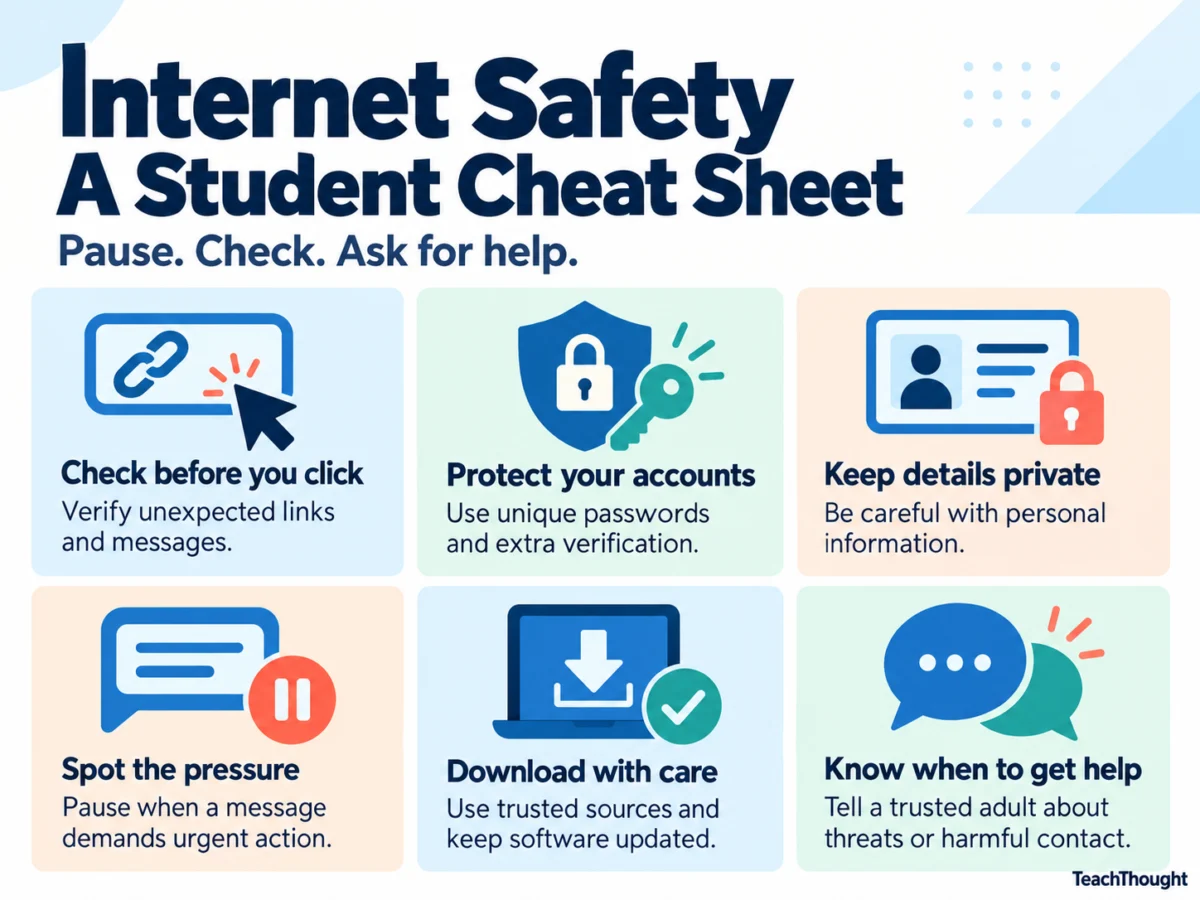
The digital landscape has transformed from a static, desktop-bound environment into an omnipresent, immersive ecosystem where students interact through school accounts, multiplayer gaming platforms, encrypted group chats, and advanced artificial intelligence tools. While modern educational technology offers unprecedented opportunities for collaborative learning and global connectivity, it simultaneously exposes young people to sophisticated online risks. Internet safety is no longer merely about restricting access or enforcing broad prohibitions; it is the vital cognitive ability to recognize a risky situation, make a safer, informed choice, and effectively secure help when unexpected vulnerabilities arise. As cyber threats evolve—ranging from targeted phishing campaigns and account takeovers to algorithmic manipulation and generative AI exploits—educators, parents, and school administrators face an urgent mandate to move beyond abstract rules. They must cultivate active critical thinking and practical resilience in students across all developmental stages.
The Evolution of Digital Risk and the Shift in Educational Strategy
Over the past decade, the nature of digital threats targeting school-aged children has shifted dramatically. Historically, internet safety initiatives focused primarily on stranger danger and basic web filtering, assuming that restricting access to specific URLs would protect students. However, the proliferation of mobile devices, 1:1 laptop programs in schools, and decentralized communication platforms has rendered perimeter-based security obsolete. Today’s threats originate from within trusted networks, peer groups, and seemingly benign applications.
According to recent cybersecurity telemetry from educational technology watchdogs, student accounts are increasingly targeted not just for data theft, but as vectors for broader network infiltration. Concurrently, social dynamics have migrated to digital forums where harassment, exclusion, and coercion can occur continuously, transcending the physical boundaries of the school day. In response, pedagogical frameworks have evolved to integrate internet safety as a core component of digital citizenship. Rather than treating online safety as an isolated IT compliance issue, modern frameworks emphasize that technical literacy does not inherently equate to situational awareness. Knowing how to operate an application does not protect a student from trusting a deceptive message, falling victim to social engineering, or mismanaging personal data within that same application.
Core Pillars of Student Digital Protection and Situational Awareness
To build enduring resilience, educational institutions and families must institutionalize a systematic approach to digital hygiene and threat recognition. This strategy relies on several actionable pillars designed to address everyday vulnerabilities without stifling legitimate technological exploration.
1. Advanced Phishing Awareness and Verification Protocols
Cybercriminals routinely exploit institutional branding, familiar logos, and professional styling to deceive users. A fraudulent message can masquerade as a notification from a teacher, a school administration service, or a popular gaming platform. Correct spelling and the presence of recognizable graphic assets no longer establish authenticity.
Educators must teach students to scrutinize the action requested by a message rather than focusing solely on the identity of the sender. High-risk prompts include demands for immediate password resets, urgent requests for verification codes, unsolicited file downloads, or financial transactions tied to artificial deadlines.
- The Safer Response: Students should be instructed to bypass links embedded in communications entirely. Instead, they should access services through established native applications or manually entered browser bookmarks. Verification of suspicious claims must occur via an independent, trusted channel—never by replying to or calling numbers provided within the questionable message itself.
- Practical Classroom Application: Presenting students with a hypothetical scenario—such as an urgent email claiming a school portal account will be terminated unless credentials are updated—allows educators to guide the class through independent verification methods without exposing actual data.
2. Proactive Account Defense and Credential Management
Account security forms the baseline defense against unauthorized access and identity compromise. Guidance from organizations such as the Cybersecurity and Infrastructure Security Agency (CISA) underscores the importance of multi-layered protective measures, including robust password creation and multifactor authentication (MFA).
- Credential Hygiene: Students must learn that sharing passwords with peers, regardless of the perceived closeness of a friendship, introduces unacceptable risk. Passwords should be long, unique to each platform, and managed utilizing approved password management tools where applicable.
- MFA Compliance: Enabling multifactor authentication prevents unauthorized access even if a primary password is compromised. Students must understand that approving an unsolicited sign-in prompt or disclosing a verification code directly facilitates a breach.
3. Contextual Data Minimization and Personal Privacy
Absolute prohibitions such as "never share anything online" fail to prepare students for the realities of modern learning management systems, which legally and functionally require certain data points to operate. A more effective pedagogical approach shifts the inquiry from absolute restriction to functional necessity: Does this person or service genuinely require this specific information to accomplish the authorized task?
- Granular Assessment: Students should evaluate data collection requests critically. A casual gaming platform requesting a home address or a study application demanding access to unrelated device files exhibits indicators of over-collection.
- Institutional Responsibility: Educators share this burden by vetting software tools meticulously prior to classroom adoption, ensuring that student data exposure is minimized and that assignments can be completed without harvesting excessive personally identifiable information (PII).
Recognizing Behavioral Manipulation and Social Coercion
Unsafe digital interactions rarely begin with overt threats. More frequently, exploitation initiates through grooming behaviors characterized by unwarranted attention, flattery, artificial scarcity, or in-game rewards designed to lower a student’s defensive barriers.
Navigating Coercion and Sextortion Risks
As students enter adolescence, peer pressure and digital intimacy introduce severe risks, including financial and image-based extortion (commonly known as sextortion). Perpetrators often manipulate victims into sharing sensitive images and subsequently threaten public distribution to extort money or additional content.
- Immediate Intervention: Educational frameworks supported by organizations like the National Center for Missing & Exploited Children (NCMEC) emphasize that students must be explicitly informed that if they fall victim to coercion, they must seek adult help immediately. Crucially, prior voluntary participation or misplaced trust does not invalidate their right to immediate institutional support and protection.
- Shifting Focus from Strangers to Behaviors: Safety curricula must train students to identify behavioral red flags—such as demands for secrecy, sudden shifts in emotional intensity, or requests to isolate from peer groups—rather than relying on the antiquated and ineffective heuristic of identifying a "stranger."
Managing Harassment, Retaliation, and Digital Conflict
Group chats and social platforms frequently amplify interpersonal conflicts, converting private disagreements into persistent, scalable harassment. The mechanics of modern social media encourage passive participation in bullying through algorithmic amplification, sharing humiliating screenshots, or participating in "pile-ons."
Responsible Bystander and Response Protocols
Students must be taught concrete de-escalation strategies that prevent the accidental spread of harmful material.
- Non-Retaliation: Retaliating or redistributing defamatory content compounds the underlying harm and can implicate the responding student in disciplinary or legal infractions.
- Documentation and Preservation: When harassment occurs, students should utilize platform-level blocking and reporting tools. Where appropriate and safe, they should preserve verifiable metadata—such as exact usernames, timestamps, and direct message links—to aid administrative or law enforcement investigations. Under no circumstances should students be asked to download, view, or forward illicit visual material involving minors as a method of evidence collection.
Evaluating Downloads, Permissions, and AI Integration
The proliferation of browser extensions, mobile modifications, and generative artificial intelligence tools introduces complex authorization vectors that bypass traditional perimeter defenses.
Software Permissions and System Integrity
- Granting Access: Students frequently click through installation prompts without reviewing requested permissions. A utility tool, such as a study timer or a cosmetic game modification, should not request access to system microphones, webcams, location services, or full web-browsing histories unless those capabilities are integral to its function.
- Bypassing Controls: Students must be counseled against bypassing school-enforced device management profiles or utilizing unauthorized virtual private networks (VPNs) to circumvent institutional safety filters.
The Artificial Intelligence Dimension
The integration of generative AI into daily workflows presents novel safety challenges, including algorithmic bias, data privacy concerns, and the generation of hyper-realistic synthetic media (deepfakes).
- Synthetic Media Impact: The creation and dissemination of fabricated or altered images of classmates can cause profound psychological and social harm. Institutions must establish zero-tolerance policies for synthetic harassment and ensure that targeted students receive immediate support without being forced to bear the burden of proving the falsity of the media.
Institutional Response Frameworks and Post-Incident Protocols
Preventative education remains incomplete without an operational response plan that activates immediately when a security breach or safety violation occurs. Educational institutions must maintain transparent, accessible pathways for students to report incidents without fear of arbitrary punitive action for incidental mistakes.
| Incident Classification | Recommended Immediate Response Protocol |
|---|---|
| Credential Compromise | Promptly notify school IT personnel or a trusted adult. Initiate official account recovery procedures through verified portals to secure the compromised profile. |
| Suspicious Downloads / Malware | Cease interaction with the file or installer immediately. Contact technical support; avoid engaging with subsequent pop-ups or advertised "fix" utilities. |
| Coercion, Extortion, or Threats | Secure immediate adult intervention. Refuse demands for financial transfer or supplementary media; preserve communication logs and report through designated channels. |
| Exposure to Distributive / Harmful Content | Immediately exit the platform or content stream and report the incident to a trusted adult. Continued viewing is unnecessary to validate the harmful nature of the material. |
Conclusion: Practicing Decisions, Not Just Memorizing Rules
Ultimately, effective internet safety instruction requires moving away from passive absorption of static rules and toward active, scenario-based rehearsal. By embedding brief, five-minute diagnostic exercises into routine curricula—where students analyze fictional messages, evaluate permission requests, or strategize responses to group-chat conflicts—schools can bridge the gap between theoretical compliance and real-world behavioral resilience. Ensuring student safety in an increasingly complex digital ecosystem demands vigilance, open communication, and an unwavering commitment to equipping young people with the analytical tools necessary to protect themselves and their peers.

