

Recent findings in educational research have shifted the ongoing discourse surrounding artificial intelligence in classrooms from abstract speculation to measurable reality. A comprehensive working paper titled The Generative AI Learning Penalty: Evidence from Chinese Secondary Education, published in June 2026 by researchers David Strömberg, Victor Lei, and Yanhui Wu, has provided the first large-scale, empirical analysis of how self-directed generative AI use affects long-term student learning. Tracking approximately 27,000 students in grades seven through 12, the study concludes that regular reliance on generative AI for homework and out-of-school assignments leads to substantial cognitive decline.
The research introduces what scholars are describing as the "Generative AI penalty." The data reveals that roughly half of all students who adopt AI tools regularly outsource their homework entirely, bypassing the foundational cognitive processes necessary for academic retention. Rather than acting as a force multiplier for education, unrestricted access to conversational agents appears to accelerate a dangerous cycle of cognitive automation, threatening academic foundations on a global scale.
Background Context and the Evolution of Ed-Tech Assessment
To understand the weight of the 2026 findings, educational analysts point to the historical difficulties of measuring educational technology efficacy. In 2024, researcher Laurence Holt popularized the concept of "The 5 Percent Problem" within the educational technology zeitgeist. Holt’s framework demonstrated that the vast majority of online math programs yielded measurable learning gains for only the 5 percent of students who used them precisely as intended, while the remaining 95 percent experienced minimal benefits due to lack of dosage or engagement.

However, generative AI diverged sharply from this historical trend. Following the commercial deployment of ChatGPT in late 2022, student adoption rates soared globally without requiring institutional mandates or structured pedagogical frameworks. By 2026, educational surveys indicated near-universal student utilization of AI tools for homework assistance and out-of-school problem solving.
Despite this massive "dosage," empirical research regarding the actual impact on student learning lagged significantly behind commercial adoption. A Stanford University landscape analysis conducted in the mid-2020s evaluated over 800 studies on AI in education, finding that only 20 produced credible causal evidence. The field remained clouded by small-scale lab evaluations, short-term point-in-time assessments, and occasional retractions of high-profile meta-analyses. The Strömberg, Lei, and Wu study directly addresses this empirical deficit by examining longitudinal outcomes across tens of thousands of real-world students over multiple academic cycles.
Chronology of the Empirical Study
The research framework utilized by Strömberg, Lei, and Wu established a rigorous longitudinal design to isolate the impact of generative AI adoption from other variables. The study evaluated students across a timeline extending from 2023 through June 2025.
The analytical methodology segmented students into three distinct cohorts:
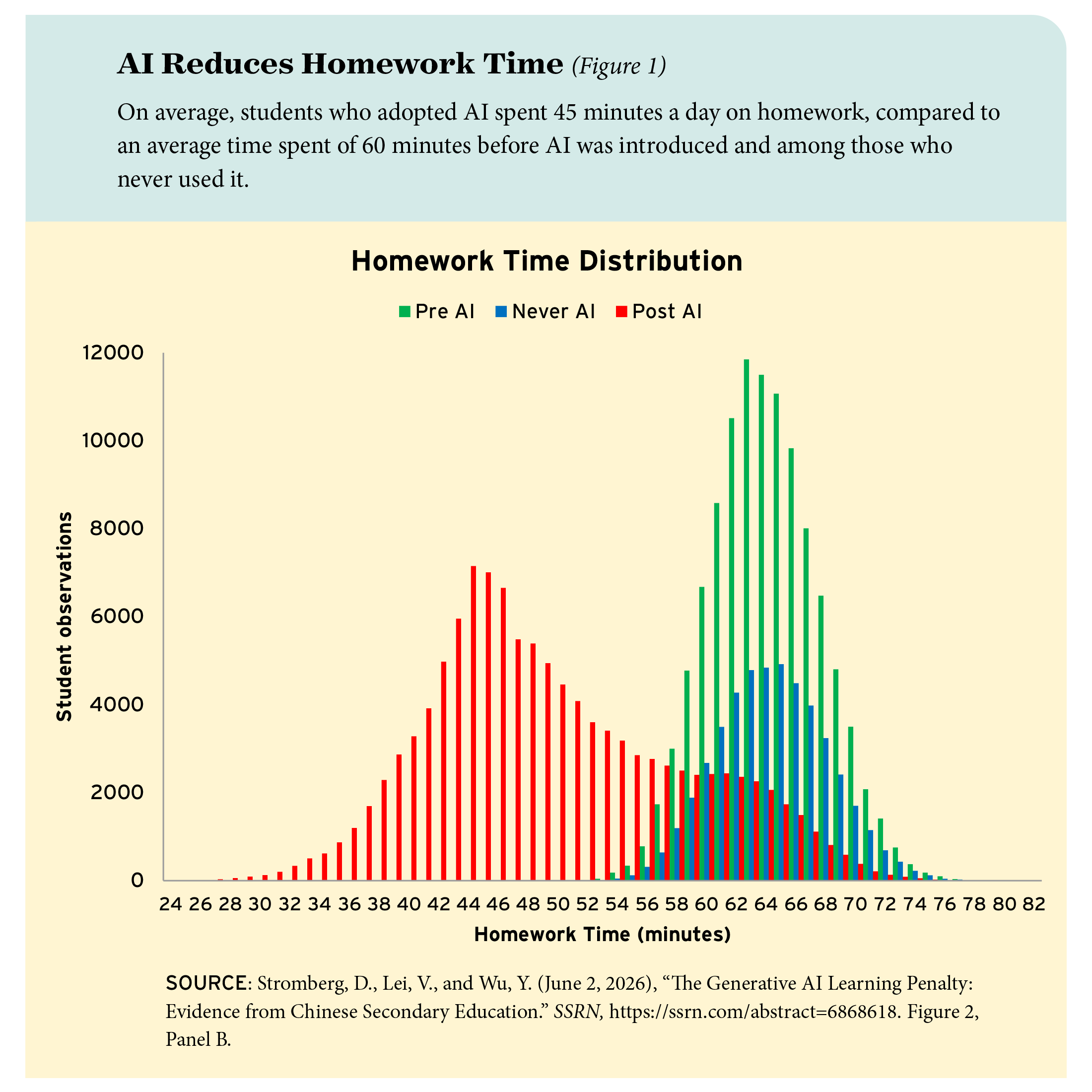
- Pre-AI Baseline: Data capturing the academic performance and habits of the 81 percent of students who eventually adopted generative AI, measured strictly during the period prior to their adoption of the technology.
- Never-AI Cohort: A control group comprising 19 percent of students who did not use generative AI at any point during the two-year study period.
- Post-AI Cohort: The performance metrics of AI-adopting students following their registration and consistent use of AI tools, tracked via student-month observations.
By analyzing the precise timestamp of when students registered tool usage on their personal devices, the researchers mapped a clear chronological trajectory of declining academic performance following AI integration.
Detailed Findings and Supporting Data
The empirical data compiled in the study challenges optimistic assumptions about productivity gains, illustrating a stark divergence between short-term task completion and long-term knowledge retention.
Homework Time Reduction
Because assignments required students to log in online to download and upload coursework, researchers accurately tracked the time dedicated to homework completion. While Pre-AI and Never-AI students spent an average of 50 to 80 minutes daily on assignments, Post-AI students completed identical workloads in approximately 45 minutes, with some completing tasks in as little as 25 minutes—the estimated minimum time required to copy and paste responses from a chatbot.
Homework Score Inflation
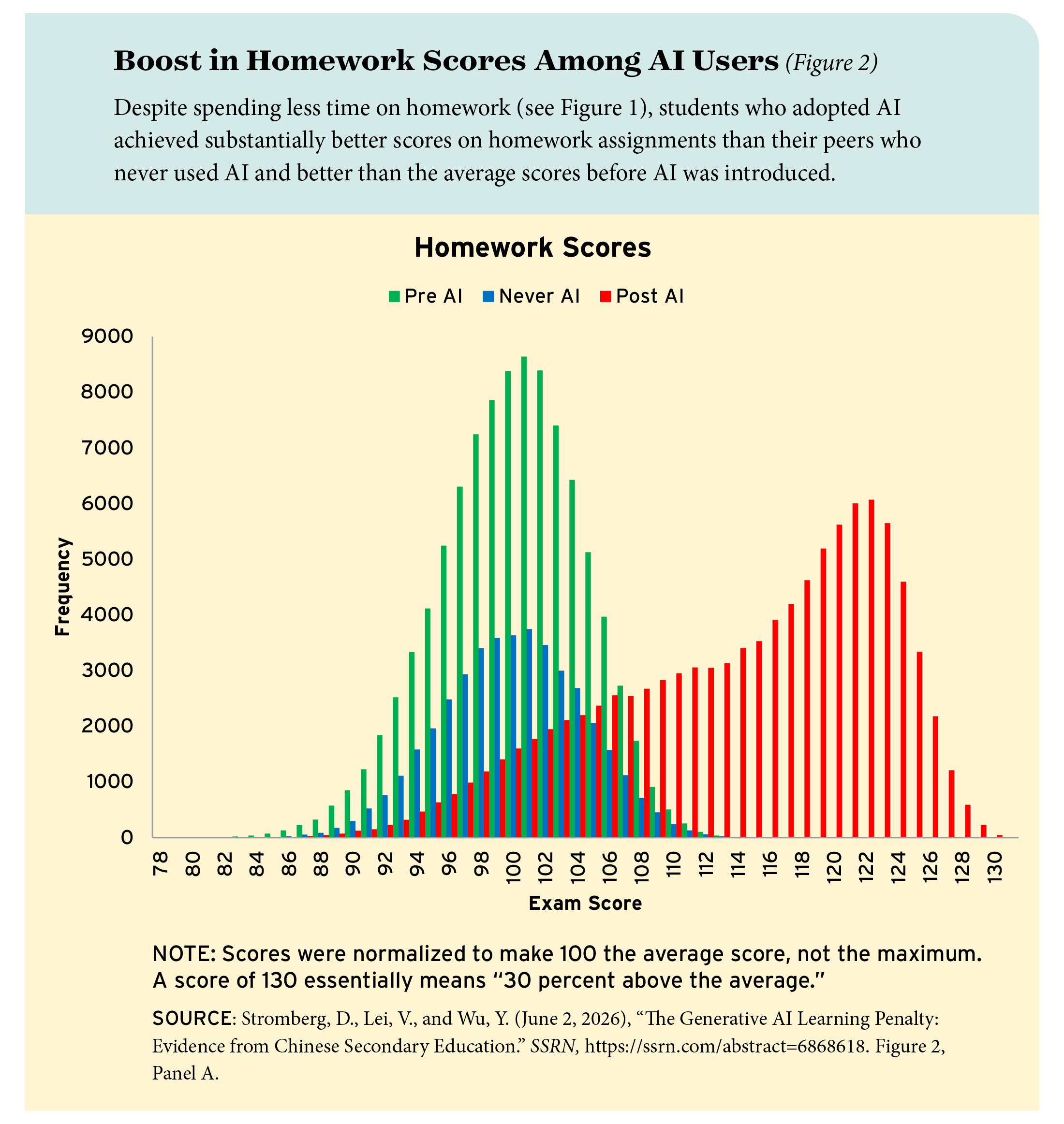
Paradoxically, students who spent less time on homework achieved significantly higher scores. When normalized against class averages, Post-AI students routinely scored up to 30 percent above baseline performance metrics. This inflation created intense peer pressure, driving even resistant students to adopt AI tools merely to maintain competitive grades in school ranking systems.
Closed-Book Exam Performance
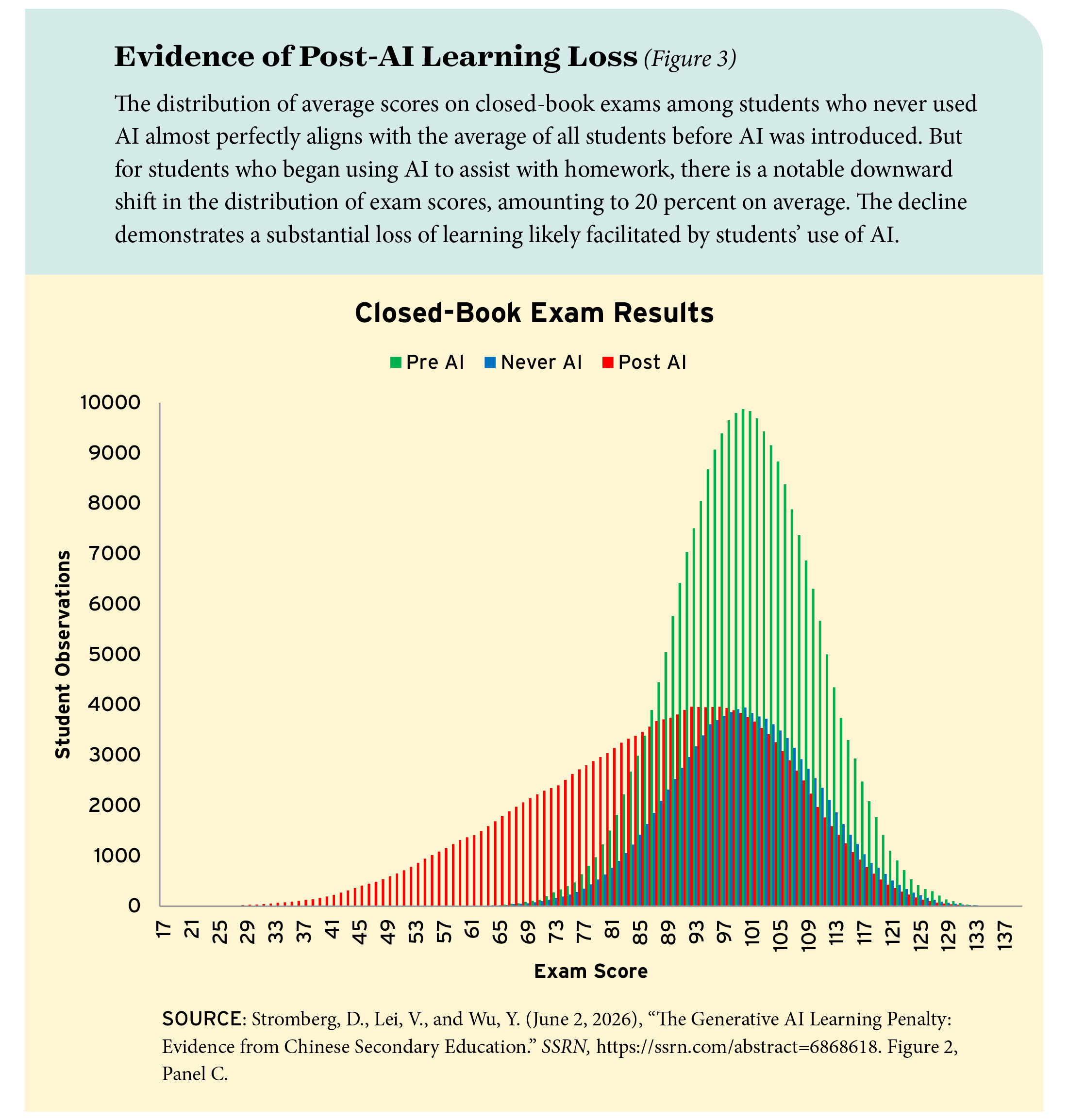
The illusion of high academic achievement shattered when researchers analyzed monthly closed-book exams. While Pre-AI and Never-AI student performance remained closely aligned, Post-AI students experienced a drastic downward shift in exam scores. The average decline reached 20 percent, representing a 1.4 standard deviation drop.
Long-Term High-Stakes Consequences
The long-term repercussions were most pronounced on China’s comprehensive high-stakes entrance examinations for high school and university placement. Students who relied on generative AI for two or more years prior to testing suffered an estimated 24 percent decline (1.5 standard deviations) on high school entrance exams and an 18 percent decline (1.3 standard deviations) on college entrance examinations.
Official Responses and Counterarguments
The publication of the study prompted immediate debate among technologists, economists, and educational theorists. Critics of the study’s pessimistic conclusions have pointed to alternative interpretations of the data.
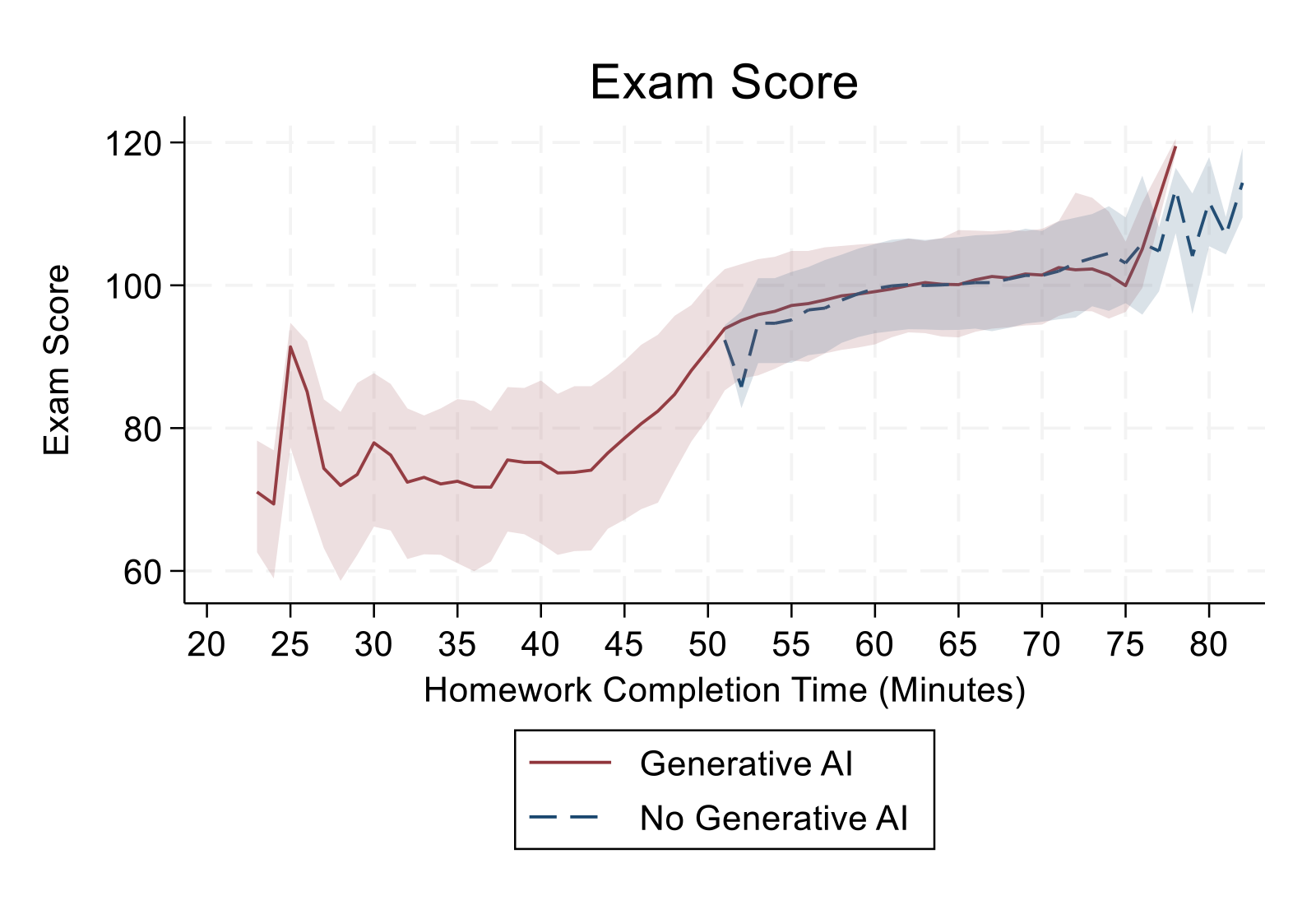
Representatives from machine learning research sectors and technology advocates have argued that the learning penalties stem from misuse rather than the medium itself. Some analysts suggested that when researchers statistically control for the total time students spend studying, performance gaps between AI users and non-users narrow significantly. Proponents of this view maintain that intelligent, guided use of AI can still support cognitive productivity.
However, the study’s lead researchers quickly dismissed these counterarguments. Data analysis revealed that the subset of AI users who maintained traditional study durations of 75 minutes represented an infinitesimally small fraction of the sample—affecting only 20 students out of 27,000 for a single month, and disappearing entirely within five months of adoption. Consequently, researchers concluded that pointing to isolated instances of studious AI users failed to justify the widespread systemic damage observed across the broader student population.
Institutional reactions to high-stakes testing vulnerabilities have also varied globally. While international technology firms frequently market conversational agents and autonomous homework-completion "agents" directly to students during academic terms, regional authorities have taken defensive measures. Notably, major technology conglomerates in regions with high-stakes testing ecosystems, such as Alibaba and Tencent in China, implemented total freezes or functional blocks on generative AI tools during national testing periods to preserve academic integrity and prevent cognitive reliance.
Implications and Future Outlook
The empirical confirmation of the "Generative AI learning penalty" has forced a reevaluation of ed-tech integration policies among policymakers and educational leaders. The findings suggest that unrestricted cognitive automation circumvents the fundamental mechanisms of human learning.
Cognitive scientists emphasize that the primary value of academic assignments lies in the mental effort required for their completion. When generative AI assumes this burden, students experience what researchers term "Deadweight Learning Loss," a phenomenon exceeding the estimated academic setbacks documented following pandemic-related school closures.
As educational institutions navigate the ongoing proliferation of AI agents, experts argue that policy frameworks must shift from accommodating uncritical technological integration to enforcing strict pedagogical boundaries. Without institutional intervention, the widespread automation of cognition threatens to diminish the academic capability and long-term economic prospects of an entire generation of students.

