
The landscape of American urban education remains a battleground of competing philosophies, systemic challenges, and desperate searches for viable solutions. At the center of this ongoing debate is the tension between traditional neighborhood public schools struggling under the weight of historical inequities and high-performing charter networks demonstrating unprecedented academic outcomes in the very same underserved communities. A stark illustration of this educational crossroads emerges from the choices faced by parents, educators, and public intellectuals navigating the labyrinth of New York City’s school system.
The conversation surrounding educational options often highlights the difficult compromises made within traditional public institutions. For prominent figures like Nikole Hannah-Jones, navigating educational choices for their own children brings abstract systemic critiques into sharp, personal focus. Yet, in weighing the available paths for her daughter, Najya, a third option often exists in the periphery of such discussions, rarely spoken of yet profoundly impactful: the modern public charter school.
The Realities of Traditional Public School Classrooms
To understand the appeal and the controversy of alternative educational models, one must examine the daily realities inside traditional urban public schools. A poignant window into these struggles is found in Bedford-Stuyvesant, Brooklyn, at Unison School. A tearful exchange between a parent and Unison’s principal, Emily Paige, encapsulates the immense burdens placed upon educators striving to implement progressive pedagogical frameworks within a legacy system marked by chronic underfunding and societal neglect.
Paige and her staff wrestled daily with formidable hurdles, most notably the severe academic knowledge gaps of incoming students and the relative inexperience of early-career teachers. In a profound gesture designed to honor her commitment to antiracism and equity, Paige made the difficult decision to eliminate homework entirely. She observed that too many of her students arrived so far behind grade level that they were physically and intellectually unequipped to complete the assignments independently.
However, this compassionate adaptation carried unintended consequences. As Paige painfully acknowledged, lowering academic requirements inadvertently harmed the very students the policy was designed to protect by depressing academic expectations.
"It’s very, very hard," Paige reflected during a candid discussion about the school’s trajectory. "There’s no model out there for holding all of these truths, these complex truths, all at once. We are working within the system that we know is not working, while trying to recreate and reimagine a new system, while working with young people who have all this potential, who’ve not been given the opportunities for that potential to thrive and be unleashed. And they understand all of it, and they understand none of it, all at once."
The Charter School Model: Proximity and Proven Results
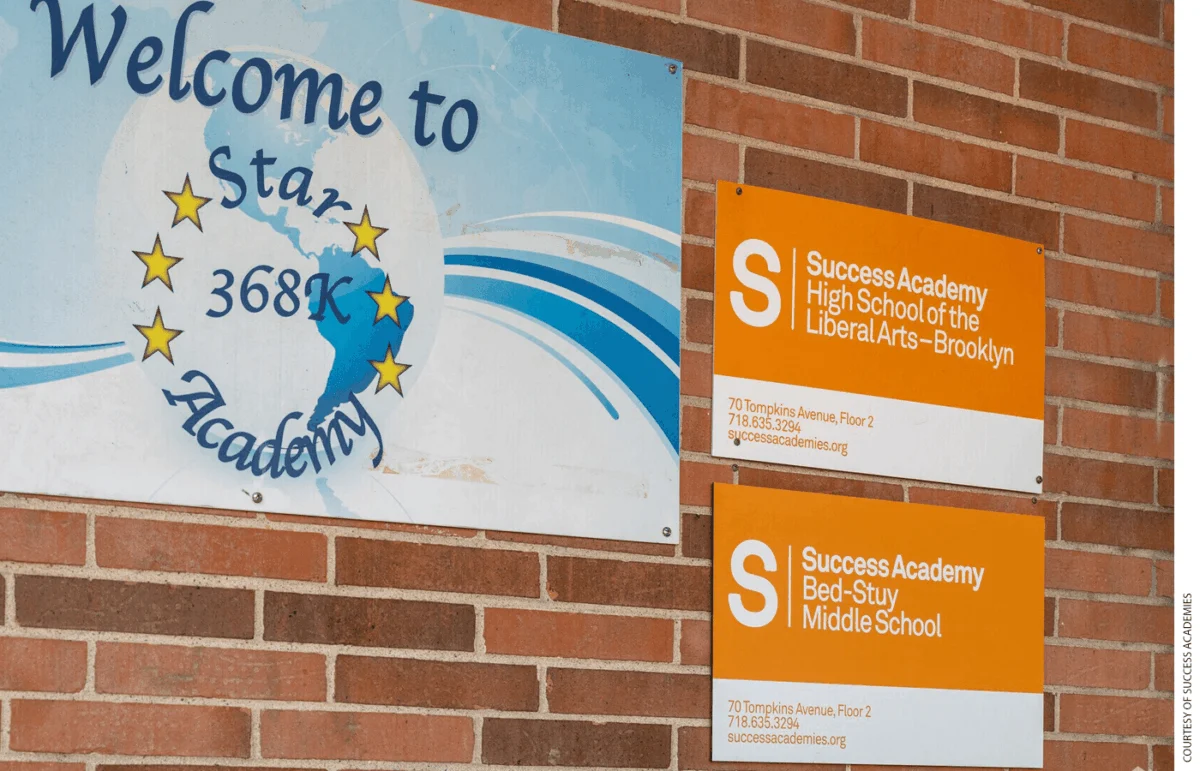
The assertion that no model exists to successfully reconcile these complex truths overlooks a growing body of evidence operating just blocks away from traditional institutions like Unison. Had Paige walked a short distance northeast from her Bedford-Stuyvesant school, she would have encountered a tangible counter-model in action: Success Academy Bed-Stuy.
During the 2024–2025 academic year, this single charter facility enrolled nearly a thousand students, reflecting the racial and socioeconomic demographics of the surrounding neighborhood. Only 26 of its enrolled students were white, and roughly 70 percent came from economically disadvantaged households. Despite serving a population historically underserved by traditional municipal systems, the school achieved extraordinary academic outcomes: 97 percent of its students performed at or above grade level in English Language Arts, and 99 percent demonstrated proficiency in mathematics, with an astounding 77 percent scoring at the highest possible level established by the state.
Success Academy is far from an isolated anomaly within New York City. Across the five boroughs, particularly concentrated within historically under-resourced neighborhoods, a robust network of high-performing charter schools consistently educates predominantly Black and Latino children from low-income families with remarkable success.
The contrast with the broader municipal school district is stark. In traditional New York City Public Schools, recent state data indicates that fewer than half of Black and Latino students perform on grade level in foundational subjects like English and math. Conversely, urban charters are increasingly reporting near-universal student proficiency.
Consider Classical Charter Schools in the South Bronx. According to data compiled by the New York City Charter School Center, 98 percent of students tested proficient in mathematics and 96 percent tested proficient in English during the 2025 academic year. Notably, four out of the network’s five schools are situated directly within what federal designations classify as the poorest congressional district in the entire United States. Meanwhile, Success Academy—now the city’s largest charter network, operating 57 schools and serving over 22,000 students—replicates these high-achieving metrics on a much broader scale.
A Chronology of Reform: The Evolution of New York Charters
To fully appreciate the current landscape of charter education, it is necessary to examine the historical trajectory that brought these institutions into existence. The debate over school choice in New York is rooted in legislative action taken nearly three decades ago.
- 1998: The New York State Legislature passed the state’s inaugural Charter School Law, making New York the 34th state in the nation to authorize charter schools. The legislation aimed to foster innovation, create distinct educational options for parents, and improve overall student performance through increased accountability.
- Early 2000s: The first wave of charter schools opened their doors across New York City, often facing intense skepticism from municipal unions, traditional school boards, and community activists who viewed the privately managed, publicly funded model as a threat to public education funding.
- 2010s: As networks like Success Academy, KIPP, and Democracy Prep expanded rapidly, empirical studies began to emerge evaluating their long-term efficacy. Early longitudinal studies demonstrated significant academic gains among low-income minority students enrolled in charter lotteries compared to their peers who remained in traditional public schools.
- Present Day: Charters have evolved from an experimental fringe policy into an integral component of the urban educational ecosystem, serving tens of thousands of families while remaining a focal point of intense political and ideological debate.
Dispelling Common Misconceptions and Systemic Myths
Despite nearly thirty years of operational history, public charter schools continue to contend with widespread misconceptions regarding their funding, admissions policies, and operational structures.
The most persistent myth is that charter schools selectively admit high-performing students or engage in covert screening processes to exclude students with learning disabilities or behavioral challenges. In practice, New York City charter schools are legally mandated to be open to all children, regardless of academic ability, special education needs, or prior achievement. When applications exceed available capacity, schools must utilize a blind, randomized public admissions lottery.
Another common critique centers on financial resources. Detractors frequently argue that charter schools drain vital funding away from traditional public school districts. However, fiscal analyses—including research from the University of Arkansas’s Department of Education Reform—consistently show that public charter schools receive lower per-pupil funding allocations from state and local sources than traditional district public schools, largely due to disparities in facilities funding. Furthermore, charter schools are strictly prohibited from charging tuition or mandatory fees.
Crucially, charter schools operate under a strict accountability framework that traditional neighborhood public schools rarely face in the same manner. While traditional schools can remain open indefinitely despite chronic underperformance, charter schools operate under a renewable operating charter granted by authorized state bodies (such as the State University of New York or the New York State Board of Regents). If a charter school fails to meet established academic, financial, and organizational benchmarks, the state holds the ultimate authority to revoke its operating license and mandate closure.
Addressing the Motivated Parent Critique
A more sophisticated argument advanced by critics of the charter movement is that these institutions do not genuinely solve systemic educational failure, but rather "skim off" the most highly motivated parents from surrounding neighborhoods. According to this theory, the success of charter schools is merely a byproduct of self-selection: families who possess the social capital, awareness, and drive to apply for a charter lottery would likely see their children succeed in any environment.
Rigorous educational research, however, has repeatedly challenged and discredited this hypothesis. Researchers frequently utilize a "lottery design" methodology, comparing the academic performance of students who narrowly won admission to a charter school through a random lottery against the outcomes of students who applied but lost the lottery and remained in traditional public schools. Because both groups of families took the proactive step of applying, researchers are able to isolate the independent effect of the school itself. These studies consistently find that students who attend the charter schools outperform their lottery-control peers, demonstrating that the school environment is the primary catalyst for achievement.
Furthermore, sociologists and educational economists argue that viewing "parental motivation" as a finite, exhaustible commodity—something that can be extracted and hoarded by charter networks—fundamentally misunderstands human behavior. Motivation is rarely an innate, fixed trait possessed exclusively by a privileged few; rather, it is dynamically forged and cultivated in response to institutional culture. Effective, high-expectation schools do not merely tap into pre-existing motivation; they actively generate, nurture, and expand it by creating a secure, predictable, and academically rigorous community where students and parents alike feel invested in a shared future.
Broader Implications for the Future of Urban Education
The persistent divergence in academic outcomes between traditional district schools and high-performing charter networks presents profound implications for policymakers, civil rights advocates, and urban communities nationwide.
For decades, the civil rights framing of education reform focused primarily on integration and equitable funding within unified school districts. However, the glacial pace of systemic reform within many large municipal districts has forced a pragmatic realignment among many low-income families of color. For these parents, waiting for bureaucratic institutions to reinvent themselves is a luxury their children cannot afford. The immediate necessity of grade-level proficiency, college readiness, and social mobility often supersedes ideological debates over structural governance models.
At the same time, the existence of two parallel publicly funded systems—one struggling with legacy inefficiencies and the other achieving near-universal proficiency under strict accountability mandates—forces a reckoning among educational leaders. Rather than viewing charter schools as an existential threat to public education, a growing cohort of analysts argues that traditional districts must examine the operational components driving charter success: robust teacher training, structured curricula, rigorous academic pacing, and an uncompromising institutional culture of high expectations.
As urban school districts across the United States grapple with declining enrollment, post-pandemic learning recovery, and persistent achievement gaps, the lessons of the charter sector cannot be easily dismissed. The complex truths articulated by educators like Emily Paige—caught between the desire for systemic equity and the immediate need for academic competence—will continue to define the American educational debate. Until traditional public systems can reliably replicate the universal proficiency demonstrated in urban charter classrooms, parents will continue seeking out alternative paths to ensure their children’s potential is fully unlocked.

