
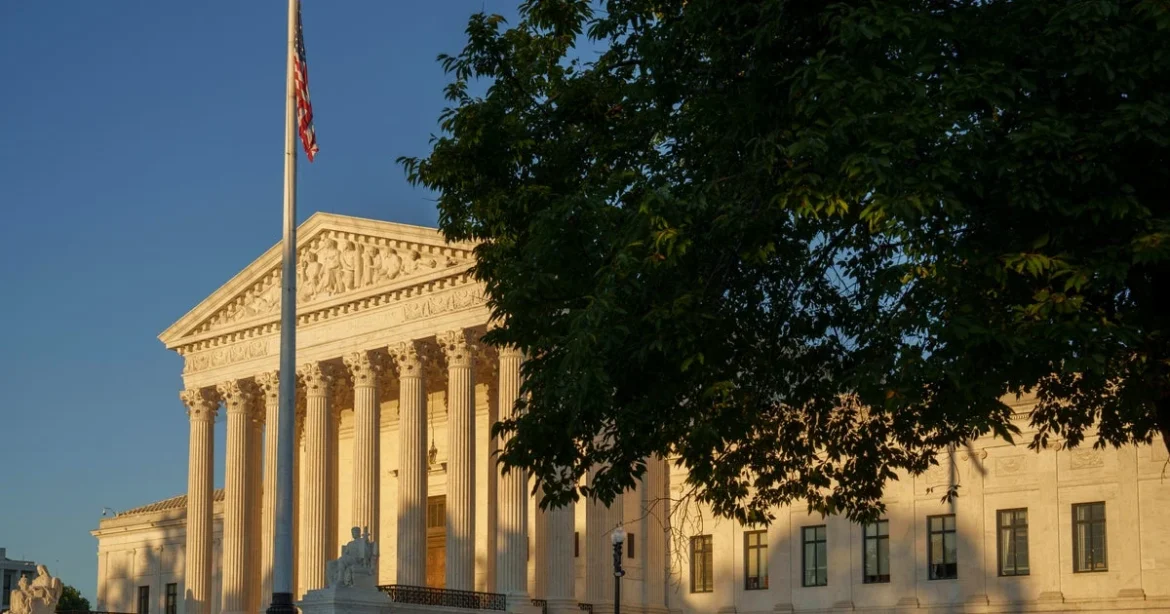
The Supreme Court of the United States issued an unsigned order blocking Missouri from implementing a newly redrawn congressional map for the upcoming midterm elections, preserving the state’s older district boundaries established in 2022. The high court’s intervention arrives amid an escalating procedural standoff that has bounced between federal and state judiciaries, raising urgent questions regarding the administrative feasibility and constitutional integrity of conducting contemporary American elections under shifting legal frameworks.
The decision guarantees that Missouri will conduct its November 3 general election utilizing the congressional boundaries established four years prior. Ballots reflecting those historical lines have already been printed, securely transmitted to military personnel and overseas citizens, and made available to domestic voters participating in early absentee and mail-in voting protocols.
The Supreme Court Rationale: Preventing Electoral Chaos
In an uncompromising unsigned opinion containing no noted dissents, the nation’s highest judicial body underscored the practical impossibility of altering election administration while voting is actively underway. The court reasoned that because the electoral process had already commenced, ordering a sudden reversion to the contested 2025 redistricting map would inevitably introduce severe administrative disruption.
"The election is not merely upcoming; it has already started," the justices wrote, noting that at this advanced stage of the electoral calendar, judicial intervention of that magnitude would "usher in electoral chaos."
The ruling explicitly directs lower tribunals to refrain from interfering with the administration of the vote. Specifically, the Supreme Court mandated that lower courts should not enjoin or prohibit the use of the 2022 map, nor should they compel state authorities to implement the 2025 configurations for the 2026 congressional contest.
Chronology of a Legal Tug-of-War
The convoluted journey of Missouri’s congressional map through the judicial system highlights the fraught nature of mid-decade redistricting efforts. The controversy stems from a strategic legislative initiative undertaken last year by the Republican-controlled Missouri General Assembly. Urged on by former President Donald Trump, GOP-led legislatures across multiple states sought to redraw congressional maps outside the traditional decennial cycle to secure a more favorable partisan advantage ahead of the 2026 midterms, which will determine control of the closely divided U.S. House of Representatives.
The resulting 2025 map drastically reconfigured the political terrain by dividing the Kansas City metropolitan area. This structural alteration effectively diluted Democratic voting strength and shifted the partisan balance of the state’s congressional delegation, giving Republicans a structural edge in seven of Missouri’s eight districts. The state’s current congressional delegation is split evenly between six Republicans and two Democrats.
The protracted courtroom struggle unfolded through a dizzying sequence of filings and injunctions:
- August 2026: Missouri utilizes the newly redrawn 2025 map during the state’s congressional primary elections.
- Early September 2026: The Missouri Supreme Court issues a ruling blocking the state from utilizing the new House lines for the general election, concluding the mid-decade map violated state constitutional standards. Justice Brett Kavanaugh subsequently declines to intervene, leaving the state court’s block intact.
- Mid-September 2026: A federal district court issues an emergency ruling ordering the state to adopt the 2025 map. The Supreme Court quickly halts that directive, momentarily restoring the 2022 boundaries.
- Late September 2026: The U.S. Court of Appeals for the 8th Circuit reverses course on September 24, ruling that utilizing the 2022 boundaries violates the U.S. Constitution and federal law. A federal district judge promptly issues a permanent injunction instructing the Missouri secretary of state to enforce the 2025 map.
- September 25, 2026: The Supreme Court steps in for the third time, issuing its emergency stay to halt the 8th Circuit’s injunction and securing the use of the 2022 map for the imminent general election.
Conflicting Arguments: Voter Rights Versus Administrative Realities
The emergency appeal reviewed by the Supreme Court exposed a profound philosophical and practical divide between voting rights advocates and state election administrators.
The anti-redistricting coalition People Not Politicians spearheaded the emergency application to the high court, arguing that the 8th Circuit Court of Appeals had deliberately circumvented previous judicial signals. The organization contended that allowing the last-minute implementation of the 2025 map would create widespread disarray.
"The result is chaos on both sides of Election Day: confusion over how to conduct the election now, and uncertainty over the rules governing its results," attorneys for the group stated in court filings.
Conversely, Missouri state officials presented a grim assessment of the operational hurdles facing local election boards. Representing the state’s executive and administrative apparatus, officials warned that enforcing a switch back to the 2022 map after millions of voters had already participated in primaries under the new boundaries would trigger severe constitutional concerns, including the potential disenfranchisement of hundreds of thousands of citizens.
State lawyers pointed out that complying with federal statutory deadlines required Missouri to transmit ballots to military and overseas voters by September 19 using the 2022 lines to avoid federal compliance violations. Yet, they simultaneously argued that implementing the older map would force candidates to campaign in entirely unfamiliar territory and sow deep confusion among the electorate.
Election directors across the state repeatedly cautioned that reprinting, verifying, and distributing a fresh set of ballots while polling stations were open and mail-in voting was active was practically impossible from a logistical standpoint, carrying prohibitive financial and operational costs.
National Implications for the 2026 Midterms
The resolution of Missouri’s redistricting litigation provides a crucial data point for the broader national landscape governing congressional elections. Mid-decade redistricting initiatives, pursued aggressively by both major political parties in various states, have increasingly transformed state judiciaries and federal district courts into battlegrounds for control of the federal legislature.
While Missouri avoids immediate administrative gridlock for the upcoming November contest, the underlying legal questions regarding the permissible scope of mid-decade redistricting remain largely unresolved on the merits. Constitutional scholars note that the Supreme Court’s intervention was narrowly tailored to address the exigencies of an active election rather than establishing a permanent, definitive doctrine on partisan map-redrawing outside the standard ten-year census cycle.
For the voters of Missouri, the immediate outcome is clear: ballots submitted for the November 3 general election will be tabulated according to the district lines established in 2022. However, the bitter partisan dispute underscores the growing friction between legislative authority, judicial oversight, and the administrative realities of managing modern democratic elections.
