The human experience of reality is remarkably seamless. When we navigate a dimly lit room, catch a fleeting glimpse of a shadow that mimics a human silhouette, or momentarily mistake a coat rack for a standing person, our visual system rapidly corrects these initial misinterpretations. Within milliseconds, the ambiguous shape resolves into a coherent, accurate perception of the physical environment. For decades, neuroscientists have sought to understand the underlying computational processes that allow the brain to synthesize fragmented sensory data into a unified, stable picture of the world. Now, groundbreaking research suggests that the brain achieves this perceptual harmony through a dynamic process of neural "consensus building," wherein different specialized regions actively compare, negotiate, and ultimately filter out conflicting interpretations before they reach conscious awareness.
In a landmark study recently published in the esteemed scientific journal Nature Neuroscience, researchers have shed new light on the intricate communicative loops operating within the mammalian visual cortex. Led by Dr. Mitra Javadzadeh, a Cynthia R. Stebbins Fellow at the Cold Spring Harbor Laboratory, in close collaboration with academic teams at the University of Cambridge and University College London, the research provides empirical evidence of how distinct functional areas within the brain reconcile sensory disagreements. By examining the real-time interactions between neighboring visual processing centers in mice, the scientific team discovered that when neural activity patterns across these regions align, the shared signal is amplified and prolonged. Conversely, when the regions produce contradictory interpretations of the same visual stimulus, the discord is actively suppressed and fades into obscurity within a mere fraction of a second.
This discovery addresses one of the most enduring enigmas in modern cognitive science: the binding problem. While the brain is organized in a highly modular fashion—with specialized networks dedicated to processing color, motion, form, spatial orientation, and depth independently—human beings do not perceive the world as a disjointed array of isolated features. Instead, specialized sensory streams are woven together instantly into a cohesive whole. The new findings offer a mechanistic explanation for how this integration is achieved, moving beyond traditional hierarchical models of perception to highlight the importance of reciprocal, peer-to-peer communication across cortical landscapes.
The Architecture of Perception: Specialized Processing and Cortical Loops
To appreciate the significance of the recent study, it is necessary to examine the traditional frameworks of visual neuroscience. For generations, textbook models of the visual system depicted processing as a strictly hierarchical, feed-forward conveyor belt. In this classical view, light entering the retina is converted into electrical signals that travel first to the primary visual cortex (V1), which acts as a low-level feature detector identifying basic elements like edges, lines, and simple contrasts. From there, the signal is purportedly relayed upward to secondary and higher-order cortical areas—such as the lateromedial visual area (LM) and beyond—which extract increasingly complex properties, such as object recognition and motion dynamics.
However, modern neuroimaging and electrophysiological techniques have decisively dismantled this strictly unidirectional paradigm. Neuroscientists now understand that feedback and horizontal connections vastly outnumber feed-forward projections within the neocortex. Higher-order brain regions constantly send predictive signals backward to lower-level areas, while neighboring regions engage in continuous, bidirectional dialogues.
Dr. Javadzadeh and her colleagues focused their investigation on the reciprocal circuit linking the primary visual cortex (V1) and the lateromedial visual area (LM) in the mouse neocortex. These two regions are anatomically interconnected, yet they possess distinct functional characteristics and receptive field properties.
"We are trying to understand how you can have such a high level of specialization between these different blocks, yet always have a consistent holistic outcome," Javadzadeh explains, highlighting the core paradox that motivated the research team. The brain must balance the computational efficiency of specialized segregation with the absolute necessity for global integration. When these systems disagree—such as when low-level sensory inputs suggest one feature while higher-order contextual expectations suggest another—a neurological arbitration must take place.
Experimental Design: Tracking Neural Disagreements in Real Time
To observe this arbitration process in action, the research team designed a sophisticated behavioral and electrophysiological experiment. The investigators trained mice to perform a rigorous visual discrimination task. The animals were exposed to visual patterns consisting of gratings tilted in opposite orientations and were trained to provide a behavioral response—and consequently receive a water reward—only when recognizing a specific target orientation.
While the mice engaged in the task, the researchers utilized advanced recording techniques to monitor simultaneous neural activity across both the V1 and LM regions. To uncover the causal nature of the interactions between these two areas, the team employed targeted optogenetic or pharmacological silencing methods. By temporarily and reversibly shutting down either V1 or LM, the researchers could observe how the remaining, intact region behaved in the absence of its usual cortical partner.
By cataloging the normal and perturbed states of the V1-LM circuit, the research team gathered a massive dataset detailing the precise timing and correlation of neural firing patterns. To test various hypotheses regarding how these signals interact, the scientists translated their biological observations into an advanced artificial neural network model that accurately simulated the biophysical properties of the V1-LM circuit. This computational modeling allowed the team to manipulate individual artificial neurons and test how the broader network would theoretically respond to various forms of conflicting visual data.
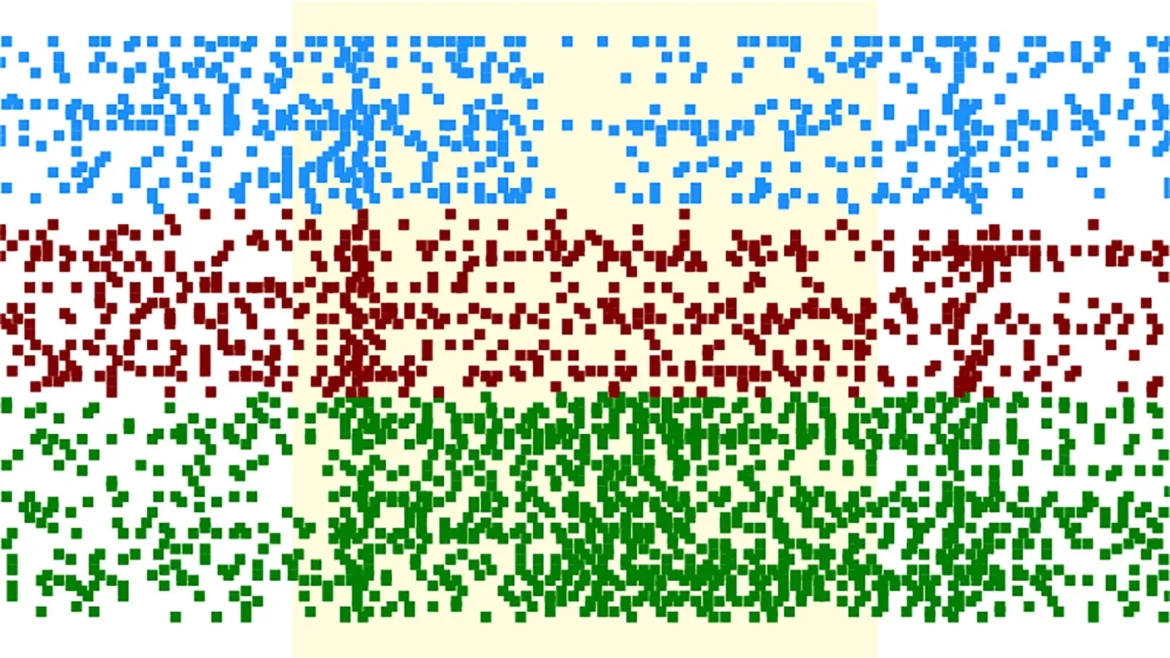
The empirical data and the computational models converged on a remarkably consistent and striking conclusion. When the neural activity patterns generated in V1 and LM matched—signifying that both regions had independently arrived at a similar interpretation of the visual stimulus—the shared signal persisted across the cortical network, gaining strength and duration. However, when the two regions produced conflicting patterns of activity, the disagreement was not allowed to propagate. Instead, the conflicting signals rapidly degraded and vanished within a fraction of a second.
"We find that over time, these types of connections between areas implement a mechanism we call consensus building," Javadzadeh elaborates. Rather than operating as a master-slave hierarchy where a higher region dictates terms to a lower one, the V1 and LM regions appear to engage in a collaborative negotiation. They compare their respective interpretations of the sensory environment, filter out anomalies and discrepancies, and settle upon a mutually agreeable narrative that is then forwarded to the rest of the brain for conscious processing.
Broader Implications Across the Neocortex and Sensory Modalities
While the scope of the published study focused specifically on the V1-LM circuit within the mouse visual system, the implications of the research extend far beyond early visual processing. The neocortex shares a remarkably uniform anatomical and functional blueprint across different sensory domains and higher-order cognitive areas. Consequently, neuroscientists are eager to investigate whether dynamic consensus building represents a universal computational motif utilized throughout the entire mammalian brain.
"For example, when what you see contradicts with what you hear, do you still use the same kind of mechanisms to reconcile these two?" Javadzadeh asks, pointing toward future avenues of research.
Multisensory integration—the brain’s ability to seamlessly combine visual, auditory, tactile, and olfactory information into a unified perceptual experience—presents an even more complex version of the binding problem. When a ventriloquist speaks, our brains effortlessly bind the auditory words coming from the theater speakers to the visual movements of the puppet’s mouth, even though the physical locations of the signals differ. If dynamic consensus building turns out to be a brainwide phenomenon, it could provide the missing framework for understanding how disparate sensory modalities negotiate conflicts to create a stable, reliable model of the external world.
Furthermore, understanding the mechanics of neural consensus building could shed crucial light on clinical conditions where these integrative processes fail. In various neuropsychiatric and neurological disorders—ranging from schizophrenia and autism spectrum disorders to certain types of agnosia and perceptual hallucinations—the brain’s ability to properly weight sensory evidence and suppress conflicting or erroneous internal signals is frequently compromised. When different brain regions fail to arrive at the same conclusion and instead persist in broadcasting contradictory interpretations, the result can be a profound distortion of reality, delusions, or a fragmentation of conscious experience. Pinpointing the exact neurobiological circuits responsible for consensus failure may eventually open new pathways for targeted therapeutic interventions.
Beyond Biology: Informing Artificial Intelligence and Machine Learning
The impact of this discovery is not confined to the biological sciences; it also holds significant potential for the fields of artificial intelligence (AI) and machine learning. Modern deep learning architectures have achieved extraordinary feats in computer vision, natural language processing, and pattern recognition. However, contemporary AI systems often struggle fundamentally when confronted with ambiguous, noisy, or conflicting streams of information. Unlike the human brain, which can rapidly evaluate conflicting signals and discard improbable interpretations in milliseconds, artificial neural networks are frequently vulnerable to adversarial attacks—imperceptible alterations to input data that cause an AI system to radically and erroneously misidentify objects.
By reverse-engineering the consensus-building mechanisms discovered in biological neural circuits, computer scientists and AI researchers may be able to design more robust, fault-tolerant architectures. Incorporating cross-regional validation loops—where different specialized subnetworks actively negotiate, compare interpretations, and filter out contradictory signals before reaching a final classification—could lead to AI systems that mimic human perceptual stability. Such systems would be better equipped to handle uncertainty, manage multi-modal data streams, and make reliable decisions in high-stakes environments such as autonomous driving, medical diagnostics, and robotics.
As the scientific community continues to map the dense interconnectivity of the mammalian brain, studies like the one led by Javadzadeh and her collaborators mark a critical transition in neuroscience. Moving past the initial phase of cataloging the brain’s individual cellular building blocks and specialized regions, researchers are now tackling the ultimate challenge of systems neuroscience: deciphering the systemic glue that binds them all together.
"While we understand individual building blocks of the brain, what is the glue that puts them together?" Javadzadeh concludes. "Knowing that can finally help us understand how the brain works as a whole." As ongoing research expands to test these consensus models across larger cortical networks and diverse sensory modalities, science moves one step closer to demystifying the most complex computational organ known to existence.