
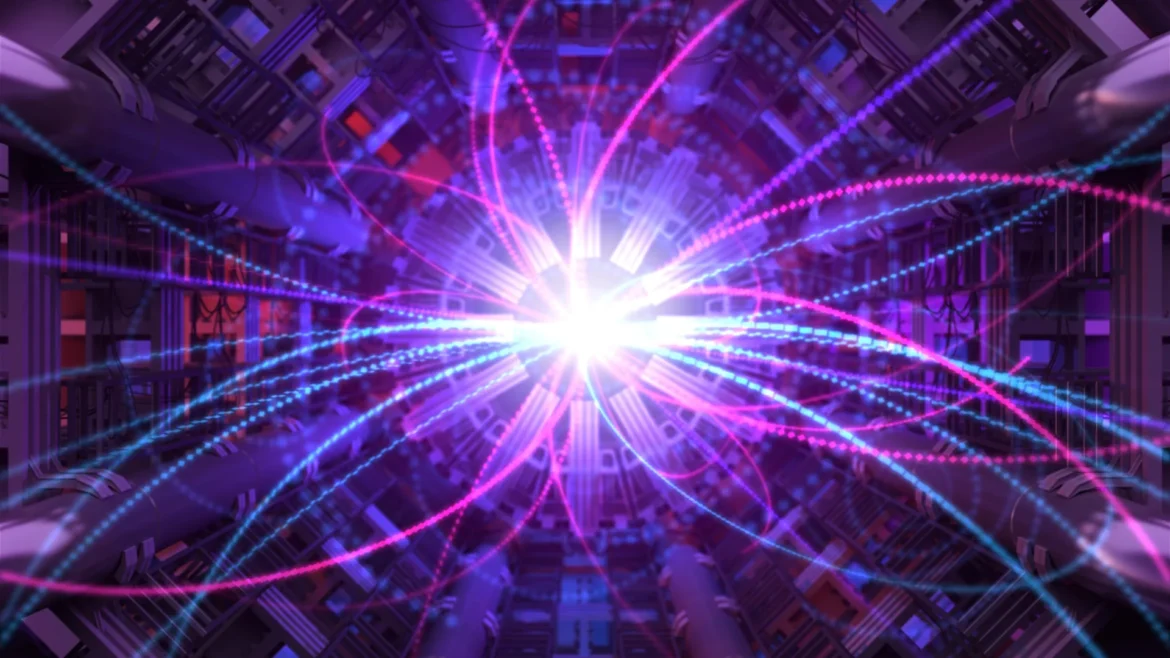
After more than forty years of rigorous theoretical and experimental pursuit, researchers at the European Organization for Nuclear Research (CERN) have achieved a landmark breakthrough in particle physics. Working with the LHCb (Large Hadron Collider beauty) experiment, a global team of scientists has detected the first compelling evidence of one of the rarest processes in the subatomic world: the decay of the B-sub-d particle into a pair of muons. This elusive event, predicted to occur only once in approximately 10 billion beauty particle decays, provides a vital new window into the fundamental laws of nature and the potential existence of particles currently beyond the reach of human technology.
The announcement, delivered during a high-profile seminar at the CERN headquarters in Geneva, represents a triumph of modern detector engineering and statistical analysis. While the Standard Model of particle physics—the mathematical framework that governs the behavior of fundamental particles—has successfully predicted this decay for decades, the sheer rarity of the event meant it remained elusive through successive generations of collider experiments. The new results confirm that the B-sub-d particle, which consists of a beauty quark and a down antiquark, can indeed transform into a muon and an antimuon. This process is of intense interest to the physics community because it acts as a "golden channel"—a high-precision probe where the influence of "new physics" could manifest as a deviation from theoretical predictions.
A Chronology of the Hunt
The quest to observe this specific decay has been a generational endeavor. In the 1980s, when the Standard Model was still being rigorously tested, the theoretical possibility of the B-sub-d decay into two muons was identified as a critical test of the theory’s consistency. However, the technology of the time was insufficient to isolate such a rare signal from the chaotic background noise generated by particle collisions.
By the early 2000s, the Tevatron at Fermilab in the United States pushed the boundaries of the search, though it lacked the luminosity required for a definitive observation. The focus then shifted to the Large Hadron Collider (LHC), specifically the LHCb detector, which was designed to specialize in the physics of beauty quarks. In 2015, a significant milestone was reached when a joint analysis between the LHCb and CMS collaborations confirmed the observation of a related, slightly more common process: the decay of the B-sub-s particle into two muons. That same 2015 study provided the first faint hints of the B-sub-d decay, but subsequent data collected through 2018 remained inconclusive, leaving the scientific community in a state of suspense.
The turning point arrived with the 2024 data-taking cycle. Following a series of comprehensive upgrades to the LHCb detector, the experiment began collecting data at five times the rate of the 2010–2018 period. These technical enhancements, paired with sophisticated machine learning algorithms capable of filtering out "background" noise—the millions of mundane particle interactions that occur every second—allowed the team to finally extract the signal with a statistical significance of 3.0 standard deviations from the 2024–2025 data alone. When integrated with historical datasets, the significance rose to 3.2 standard deviations, meeting the formal criteria for scientific "evidence."
Technical Challenges and the "Golden Channel"
The difficulty of this measurement cannot be overstated. Muons are heavier cousins of electrons, and their detection requires precise tracking through layers of silicon detectors and muon chambers. The B-sub-d decay is roughly 30 times rarer than the B-sub-s decay, which itself only occurs three times per billion beauty particle decays. Because the signal is so infrequent, the "background" of other particles appearing in the detector—which can mimic the signature of the desired muons—is overwhelming.
To overcome this, the researchers utilized a combination of high-granularity hardware and advanced neural networks. By training models on simulated decay patterns, the LHCb team was able to refine their search, focusing on the specific angular distribution and energy signatures of the resulting muon pairs. Marco Santimaria, a co-leader of the analysis team, noted that the precision required to isolate these muons from the background was the culmination of decades of incremental improvements in instrumentation and software.
The term "golden channel" is applied to this decay because it is theoretically "clean." In quantum field theory, the decay rate is sensitive to the exchange of virtual particles. If there are heavy, undiscovered particles in the universe—such as those predicted by Supersymmetry or other extensions of the Standard Model—they would effectively act as intermediate players in this decay, slightly accelerating or decelerating the rate at which it occurs. By measuring this rate with extreme precision, physicists can "see" the shadow of these massive particles, even if the LHC lacks the energy to create them directly.
Broader Implications for Fundamental Physics
The Standard Model has remained remarkably resilient since its inception, yet it is known to be incomplete. It fails to account for gravity, the nature of dark matter, and the observed matter-antimatter asymmetry of the universe. The B-sub-d decay serves as a high-sensitivity barometer for new physics. Any discrepancy between the observed rate of this decay and the theoretical prediction would be a "smoking gun" for physics beyond the Standard Model.
Currently, the experimental findings are consistent with the Standard Model, which is a significant result in its own right, as it constrains the parameter space for exotic new theories. However, the current measurement still carries statistical uncertainty. To reach the gold standard of "discovery"—a 5.0 standard deviation threshold—the team will need significantly more data.
Harry Cliff, the LHCb Rare Decays Convener and Analysis Co-lead, emphasized that this is only the beginning. "Seeing evidence of this rare decay is incredibly exciting, opening up new possibilities to probe beyond the direct reach of the LHC," Cliff said. "The future LHCb upgrade will allow us to observe many more of these decays, providing even greater sensitivity to undiscovered particles."
The Future of the High-Luminosity LHC
The path to a definitive observation is already being paved through the next phase of the LHC’s evolution. The High Luminosity LHC (HiLumi LHC) project, scheduled to commence operations in 2030, will increase the number of particle collisions by an order of magnitude. This boost in luminosity, combined with a further scheduled upgrade to the LHCb experiment in the mid-2030s, will transition the study of these decays from a "search" phase to a "precision measurement" phase.
As the dataset grows, physicists hope to measure not just the frequency of the decay, but its characteristics, such as the polarization of the muons involved. Such detailed information could potentially reveal the specific nature of the virtual particles influencing the decay, providing a roadmap for what lies beyond the Standard Model.
For the international community of particle physicists, the current result is a vindication of the long-term investment in fundamental research. It highlights the importance of sustained, decades-long scientific projects that prioritize precision instrumentation. As the experimenters continue to refine their analysis of the 2024–2025 data, the scientific world awaits further updates, with the potential that this "golden channel" could eventually force a rewrite of our understanding of the subatomic landscape.
The successful identification of this rare decay is more than just a statistical victory; it is a testament to the persistent curiosity that defines the field of high-energy physics. By peering into the most improbable events in the universe, scientists are continuing to peel back the layers of reality, searching for the hidden symmetries and particles that underpin the fabric of the cosmos. Whether the ultimate result leads to a confirmation of existing theories or the discovery of entirely new physical laws, the hunt for the B-sub-d decay remains one of the most vital and compelling narratives in modern science.
