
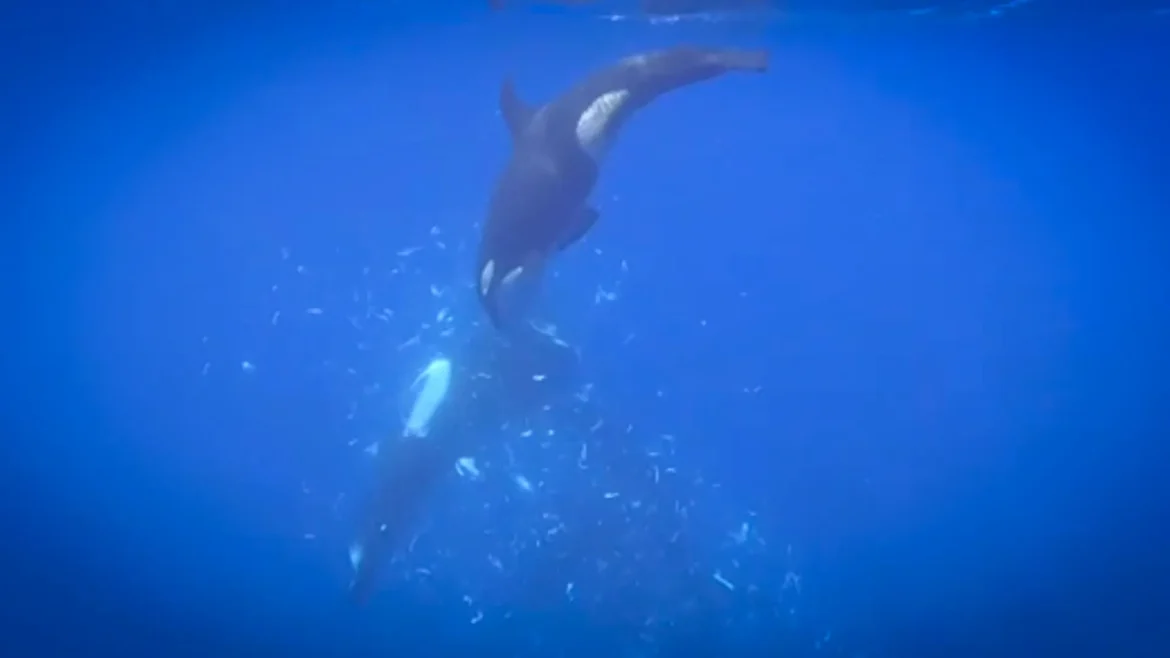
Researchers have documented a never-before-seen hunting and prey-processing strategy employed by orcas in the Gulf of California, where the apex predators have been observed shattering sunfish into thousands of pieces through high-speed collisions. This remarkable behavior, detailed in a recent publication in the journal Frontiers in Ethology, sheds new light on the sophisticated hunting techniques and potential nutritional adaptations of these highly intelligent marine mammals. The discovery, made by scientists from Beneath The Waves, a non-profit organization dedicated to ocean health, offers a fascinating glimpse into the complex social dynamics and feeding strategies of orca pods.
A Precise and Powerful Predatory Tactic
The newly described behavior involves a coordinated effort among orcas to dismantle a sunfish carcass. In both observed instances, one orca secured the dead fish, typically by its tail fin, creating a stable platform. Just as the prey was held steady, another orca would launch itself at high velocity, striking the sunfish with immense force. This impact, according to lead author Dr. Kathryn Ayres, a scientist at Beneath The Waves, caused the sunfish’s tissue to fragment into countless pieces. "We document how one orca holds the sunfish and lets go just before another orca hits it at high speed, causing the tissue to break apart into thousands of pieces," Dr. Ayres explained.
The purpose behind this elaborate dismemberment is currently being investigated. Researchers hypothesize several potential benefits, ranging from facilitating easier consumption for younger orcas to the possibility of the act being a form of play, a behavior well-documented in orca populations. "We think this may help younger orcas feed more easily or it could also just be for fun. Orcas are known for playing with their food," Dr. Ayres added.
Context: The Sunfish and its Vulnerability
Sunfish, also known as ocean sunfish (family Molidae), are among the largest and heaviest bony fish in the ocean. The sharp-tail sunfish, a species frequently targeted by orcas in the Gulf of California, can reach impressive dimensions, exceeding three meters in length and weighing up to 2,000 kilograms. Despite their formidable size, sunfish exhibit a behavior that makes them vulnerable to predation: they often ascend to the ocean’s surface. This surfacing can be for various reasons, including thermoregulation, basking in the sun, or to allow smaller fish and invertebrates to remove external parasites. It is during these periods of relative stillness at the surface that they become exposed to the hunting prowess of orcas.
The Gulf of California, a rich marine ecosystem known for its high biodiversity, serves as a critical habitat for both sunfish and various orca populations. The consistent presence of sunfish as a food source in this region likely contributes to the development and refinement of specialized hunting techniques by the local orca pods.
Chronology of Discovery: A Year Apart
The groundbreaking observations were meticulously recorded over a period of slightly more than a year, providing researchers with two distinct instances of this unique feeding strategy.
The first event occurred in July 2024. Dr. Ayres herself witnessed a group of orcas, including a juvenile, interacting with a dead sharp-tail sunfish. In this instance, a female orca gripped the substantial tail fin of the already deceased fish. This provided the necessary anchor point for the subsequent maneuver. A male orca then positioned itself and accelerated, charging directly at the sunfish. The female released her grip precisely moments before the impact, allowing the male’s full momentum to be transferred to the prey. The sheer force of the collision resulted in the sunfish’s tissue fragmenting into numerous small pieces that dispersed into the surrounding water. The juvenile orca then proceeded to feed on these smaller, more manageable fragments, while the adult orcas consumed the larger portions of the carcass, leaving the scattered remnants behind.
The second documented occurrence took place approximately fourteen months later, in September 2025. This event was captured on video by Héctor Franz, a local observer and photographer. The sequence of events mirrored the 2024 observation: an orca holding the sunfish, followed by its release, a high-speed ramming attack, and subsequent feeding. The consistency between these two independent observations strengthens the researchers’ assertion that this is a deliberate and potentially established behavior within these orca communities.
A Novel Food Processing Strategy: Beyond Predation
The forceful fragmentation of the sunfish suggests that this ramming technique serves a purpose beyond the initial act of killing. Researchers emphasize that while orcas are renowned for their diverse hunting methods, ramming as a strategy for processing prey has not been previously documented in formal scientific literature.
In both observed scenarios, the collaborative nature of the task was evident. The coordinated action of one orca holding the prey steady enabled the other to execute the ramming attack with enhanced precision and effectiveness. Given that the sunfish were already deceased, the primary function of these powerful impacts appears to be the physical breakdown of the carcass for consumption.
Microbial Exchange and Nutritional Implications
The scientific community is also exploring the potential ecological and nutritional implications of this behavior. Sunfish possess a unique gelatinous outer layer known as the capsule, and both this layer and their skin harbor distinct microbial communities. When the sunfish tissue is pulverized, these microbial taxa are dispersed into the surrounding seawater, altering its nutrient composition.
Researchers propose that this fragmentation could significantly increase the interaction between the sunfish’s microbiome and the orcas’ own microbial populations. Such exposure might offer a range of benefits, including enhanced nutrient absorption or even contribute to immune regulation within the orcas. This suggests a sophisticated understanding of their prey’s biological composition and how to best utilize it.
Parental Investment and Social Dynamics
Another significant hypothesis centers on the concept of parental investment. By breaking down the large sunfish into smaller, more manageable portions, the adult orcas could be making it considerably easier for their calves and juveniles to feed. This aligns with other observed orca behaviors where adults actively provision younger members of the pod.
"Orcas often tear apart prey and share it with other members of the group, including calves and juveniles," Dr. Ayres stated, reinforcing the idea that this behavior is consistent with established patterns of social feeding and resource distribution within orca society.
However, the researchers acknowledge that feeding may not be the sole driver behind this fascinating display. The interactions could also serve a social function, fostering group cohesion and communication. Alternatively, the sheer power and spectacle of the act might simply be a manifestation of orca playfulness, a characteristic that continues to astound marine biologists.
Unveiling the Secrets of the Sharp-Tail Sunfish
The observations also offer intriguing clues about the specific characteristics of the sharp-tail sunfish itself. To date, this particular type of tissue fragmentation upon impact has only been documented in this species. This suggests that the anatomical structure of sharp-tail sunfish tissue may respond to high-force impacts in a unique manner, differing from that of other, potentially larger or more robust, sunfish species. Further research into the biomechanics of sharp-tail sunfish tissue could shed more light on why they are particularly susceptible to this form of disintegration.
Future Research and the Ever-Surprising Orca
Scientists are keen to determine if the same individual orcas were involved in both observed events. Identifying individual animals is crucial for understanding the transmission of such behaviors within orca populations. This requires high-quality photographic evidence, particularly clear shots of dorsal fins and distinctive eye patches, which serve as unique identifiers for each orca.
"Collecting good identification photographs whenever possible is key: we are still seeing new techniques of how orcas hunt and process their prey," Dr. Ayres concluded. "They’re one of the most iconic marine predators in the world, yet they continue to surprise us."
The ongoing study of orca behavior in the Gulf of California promises to yield further insights into the complex lives of these marine giants. As technology advances and researchers refine their observational methods, the mysteries of orca hunting strategies, social structures, and their intricate relationship with their environment continue to unfold, reminding us of the vast and often unexpected wonders of the ocean. The discovery of this sunfish-shattering technique serves as a powerful testament to the ongoing need for marine conservation and scientific exploration.
