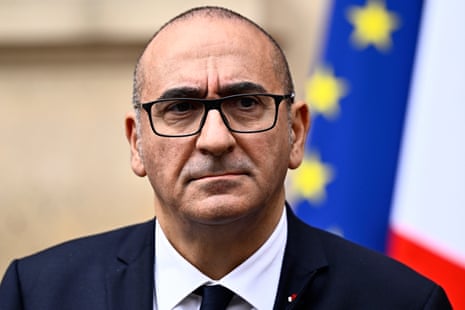
Widespread social unrest swept across several European nations on Saturday, with France bearing the brunt of the day’s demonstrations as nearly 1,000 individuals were arrested nationwide. Interior Minister Laurent Nunez confirmed the provisional arrest figures during a late-evening press briefing, warning that the final tally would undoubtedly climb as comprehensive police reports from regional commands continued to roll in. The coordinated actions, driven primarily by cost-of-living grievances, deteriorating public education infrastructure, and broader political discontent, drew hundreds of thousands of participants into the streets of major cities, testing the limits of government containment strategies and heavy police deployments.

The protests represent a critical escalation of a four-week movement that originated with high school students demanding urgent structural repairs for crumbling classrooms, underfunded facilities, and an overhauled university admissions system. Over the past month, this grassroots student mobilization has successfully forged alliances with powerful labor unions, anti-poverty campaigners, and citizens frustrated by persistent inflation. As similar anti-government sentiments rippled across neighboring European countries—including Italy, Spain, and Albania—governments found themselves grappling with an increasingly volatile public sphere defined by intersecting economic anxieties and a profound erosion of institutional trust.
A Chronology of Escalation: From Peaceful Marches to Evening Clashes
Saturday’s demonstrations followed a familiar, volatile trajectory that has characterized recent European weekends of civil unrest. In Paris, where approximately 110,000 demonstrators converged, the daytime mood initially resembled a festival of public grievance. Families, retirees, office workers, and students marched in unison, accompanied by brass bands and carrying banners defending public services and the fundamental right to demonstrate.
However, as daylight faded, the atmosphere in the capital deteriorated sharply. Authorities had deliberately restricted the primary union-backed march to the city’s southeastern periphery—specifically routing crowds away from central districts that had suffered extensive property damage during the previous weekend’s riots. Despite these precautions, police reported that several thousand radical activists, including roughly 500 violent instigators associated with ultra-left factions, embedded themselves at the rear of the procession.
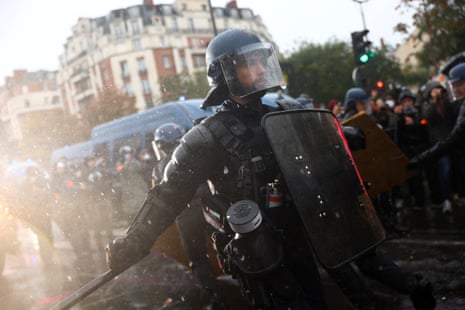
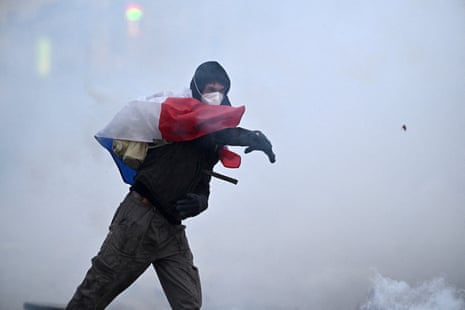
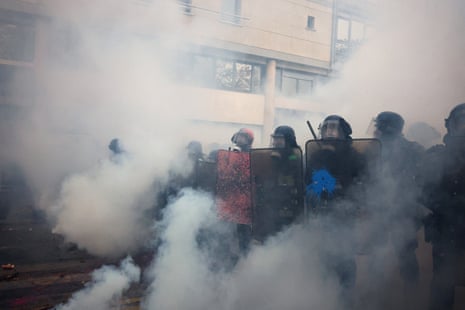
Near the Porte de Vincennes, masked individuals began hurling projectiles, glass bottles, and stones at law enforcement officers, alongside setting fire to street bins and launching commercial fireworks directly at police lines. Security forces responded forcefully, deploying tear gas, water cannons, and stun grenades to disperse the crowd. The ensuing urban skirmishes lasted approximately two hours before order was restored and the streets were cleared.
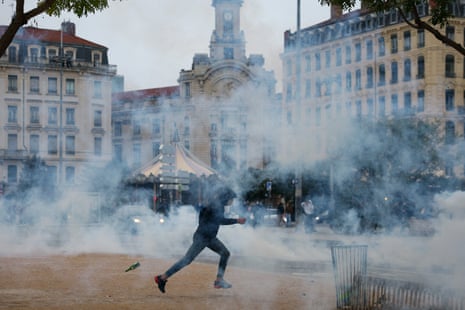
Similar scenes played out in regional hubs. In Lyon, police deployed tear gas early in the day to break up unauthorized road blockades, while in Marseille, live broadcast footage captured masked participants clashing with riot police amidst burning debris. In Bordeaux, demonstrators defied a comprehensive city-wide ban to gather at the historic Place de la Bourse, drawing solidarity from regional labor organizations.
National Turnout and Security Measures
The French Ministry of the Interior estimated total nationwide turnout at approximately 410,000 protesters participating across 136 separate street actions—a notable decrease in the number of individual demonstrations compared to the 264 actions recorded the previous weekend, yet indicative of sustained public mobilization.

In a bid to avert the widespread looting and ransacking that marred mid-October demonstrations, the French government enacted an unprecedented security response. More than 70,000 police officers, gendarmes, and auxiliary forces were deployed across the country, representing a 20% increase in active security personnel. In Paris, authorities implemented severe logistical restrictions, closing 24 metro stations in central transit hubs, suspending bike-sharing rentals, and advising commercial establishments to board up their storefronts. The extraordinary security precautions even impacted international events; the National Football League (NFL) announced the precautionary closure of its fan-engagement "NFL House" ahead of a historic regular-season game scheduled between the New Orleans Saints and the Pittsburgh Steelers at the Stade de France.
Despite the heavy police presence, the day was marred by severe injuries. Interior Minister Nunez reported two major casualties resulting from the unrest, including a 20-year-old protester in Toulouse who suffered traumatic amputations to his fingers when a pyrotechnic device detonated prematurely, and a second serious injury reported in Clermont-Ferrand. Police also confiscated an array of dangerous items during preventative security checks, including metal balls, lead pellets, slingshots, airsoft weapons, and improvised incendiary devices.
Broader European Unrest: Italy, Spain, and Albania
The wave of Saturday protests extended far beyond French borders, reflecting a continent-wide pattern of social friction. In Italy, the interior ministry reported that nine individuals were arrested and 371 others were briefly detained across eight cities following targeted police raids that preemptively searched 150 homes in Milan and Turin. Among those detained were 51 minors suspected of planning violent disruptions.
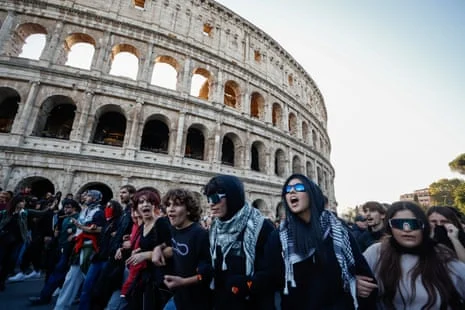
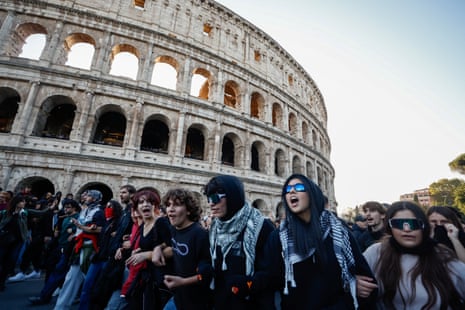
In Rome, tensions flared as a small faction of protesters attempted to force entry into the historic Colosseum before being turned back by private security guards. Simultaneously, separate anti-war demonstrations near the Piazza della Repubblica devolved into minor skirmishes with police, prompting the deployment of water cannons. The unrest in Italy follows stringent government countermeasures ordered by Prime Minister Giorgia Meloni, who recently deployed 500 elite paratroopers to patrol central Milan and introduced harsher legislative penalties for minors involved in urban vandalism.
Meanwhile, in Madrid, approximately 25,000 retirees and pensioners marched from the Atocha station to the Gran Via shopping district. The Spanish demonstrators demanded absolute state guarantees for the public pension system ahead of an upcoming snap parliamentary election. Prime Minister Pedro Sanchez has sought to leverage public anxiety over the cost of living by accusing conservative political opponents of plotting to privatize state benefits—a fear magnified by ongoing, months-long housing and rental affordability protests centered around tent encampments in the capital’s Puerta del Sol.
In Albania, anti-government demonstrations entered their twelfth consecutive day, transforming into what activists have termed a popular revolution against Prime Minister Edi Rama. Sparked initially by environmental opposition to a controversial, foreign-backed tourist development project in previously protected landscapes, the movement has swelled to encompass broader grievances regarding state corruption, low living standards, and the erosion of the rule of law. Human rights organizations, including the Albanian Rehabilitation Centre for Trauma and Torture, raised alarms over the indiscriminate use of rubber bullets by police, reporting that at least nine protesters suffered severe injuries during clashes in Tirana.
Political Implications and Official Responses
The escalating civil unrest presents a profound political challenge for European leaders, testing their capacity to balance public security with the preservation of democratic rights of assembly. In France, the crisis has been exacerbated by a charged domestic climate following a racially motivated terrorist drive-wing shooting in towns west of Paris just days prior, which claimed the life of a prominent martial arts athlete and wounded several others, including a 12-year-old child.
President Emmanuel Macron attempted to defuse the high school education crisis on Friday by hosting a two-and-a-half-hour delegation meeting with twenty student representatives at the Élysée Palace. While student leaders acknowledged that the president appeared attentive regarding their demands for school renovations, curriculum overhauls, and the repeal of the opaque Parcoursup university admissions platform, they nevertheless encouraged their peers to maintain pressure through weekend demonstrations.
Radical-left figures, however, adopted a combative stance. Jean-Luc Mélenchon, leader of the La France Insoumise party, vehemently criticized the government’s policing tactics, accusing law enforcement of "shooting indiscriminately" and intentionally provoking evening clashes to generate sensationalist media footage.
As law enforcement agencies remain on high alert throughout the weekend, analysts warn that unless structural economic reforms are introduced to address runaway inflation, decaying public infrastructure, and youth disenfranchisement, recurring weekend protests will remain a permanent feature of the European political landscape, further polarizing societies already strained by economic and social pressures.