
The Mechanism of Cosmic Consumption
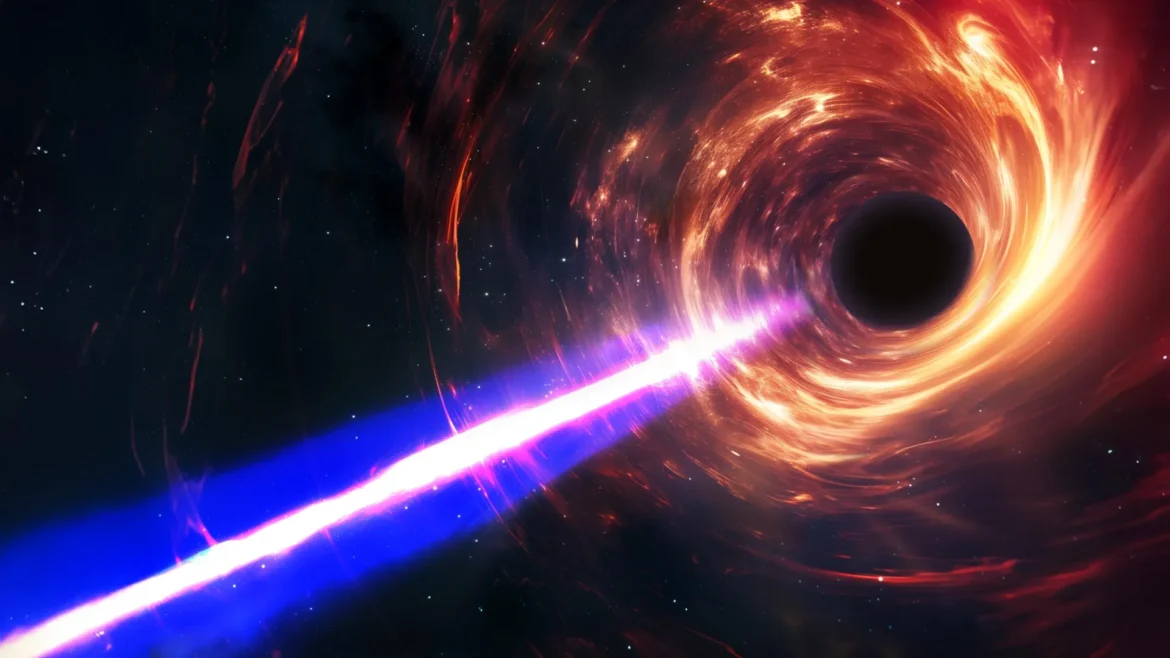
Black holes have long been popularized in media as celestial vacuum cleaners that indiscriminately pull matter into an inescapable gravitational well. However, the reality of black hole physics is significantly more complex and chaotic. When a black hole feeds, it does not simply swallow everything in its proximity. Instead, the infalling matter forms an accretion disk, a swirling, superheated structure of gas and dust. Much of this material never reaches the event horizon; instead, it is redirected, compressed, and expelled into space through intense, high-velocity jets.
These jets are among the most energetic phenomena in the universe, often spanning thousands of light-years and influencing the star-formation rates of entire galaxies. The mystery that has long perplexed astrophysicists is the inconsistent timing of these jets. While some black holes exhibit jet activity immediately upon consuming matter, others remain dormant for months or even years before suddenly erupting. The new study, published in Nature Astronomy, provides the first evidence that this behavior is dictated by a specific "critical accretion rate"—a tipping point in the feeding cycle that triggers the launch of these massive outflows.
Tidally Disrupted Stars as Natural Laboratories
The primary challenge in studying supermassive black holes (SMBHs) is the timescale on which they operate. Because these objects can be millions or billions of times the mass of the Sun, the cycles of growth and activity often span eons, far exceeding the duration of human scientific observation. To overcome this limitation, Mummery and Goodwin turned their attention to Tidal Disruption Events (TDEs).
A TDE occurs when a star wanders too close to a supermassive black hole. The black hole’s extreme tidal forces overcome the star’s own gravity, shredding it into a stream of stellar plasma. This creates a sudden, intense pulse of accretion—a "feeding frenzy" that unfolds over a period of just a few years. By observing these events, astronomers gain a "fast-forward" view of processes that would otherwise be impossible to track in real time.
The research team analyzed twenty such events, drawing upon a global network of observational data. By synthesizing information from telescopes in America, Australia, India, and South Africa, alongside space-based observatories, they were able to refine their data set to ten high-quality events where both the accretion rate and the timing of radio jet formation could be precisely mapped.
Defining the Two Phases of Ejection
The study reveals that jet formation occurs in two distinct, predictable phases. The first phase happens early in the event, during the initial peak of the black hole’s consumption of stellar material. The second phase, however, occurs much later—often hundreds or even thousands of days after the initial disruption.
The researchers identified that the delayed jet formation consistently occurs when the black hole’s feeding rate drops to approximately two percent of its Eddington limit. The Eddington limit represents the theoretical maximum luminosity a black hole can achieve when the outward pressure of its radiation balances the inward pull of its gravity.
Crucially, this two-percent threshold is the exact point known to trigger jet formation in stellar-mass black holes—those approximately ten times the mass of the Sun—within our own Milky Way galaxy. The fact that the same physical threshold applies to supermassive black holes suggests that the physics of jet production is scale-invariant. Whether a black hole is born from a collapsing star or exists as a gargantuan anchor at the center of a galaxy, the "plumbing" of its accretion disk appears to operate under the same fundamental constraints.
The Madrid Breakthrough and Collaborative Effort
The genesis of this discovery serves as a testament to the importance of informal scientific exchange. During an astrophysics conference held in Madrid, Mummery and Goodwin engaged in a discussion that shifted from general observations to the specific patterns of jet behavior. They realized that by applying the known physics of smaller black holes to the observational data of TDEs, they could potentially solve the mystery of why some supermassive black holes "fire up" long after a stellar disruption.
"We really wanted to figure out this massive puzzle," Mummery stated. "Why do some supermassive black holes blast out radio jets right after shredding a star, while others just sit there looking completely dormant, only to suddenly fire up their jets months or even years later?"
The collaborative nature of the study allowed for a multi-wavelength approach. By combining optical, ultraviolet, X-ray, and radio wave data, the team could see the full life cycle of the stellar material—from the initial destruction of the star to the eventual expulsion of matter in the form of jets.
Broader Implications for Galactic Evolution
The ability to predict when a black hole will erupt is not merely a theoretical victory; it has significant practical implications for the field of observational astronomy. Currently, astronomical observation time on major telescopes is a highly sought-after commodity. Astronomers often spend significant resources monitoring black holes that show no signs of activity, only to miss the brief windows when jets are actually produced.
By utilizing this new model, researchers can schedule their observations with much greater precision, focusing their efforts on the specific moments when a black hole is nearing that critical two-percent accretion threshold. This efficiency will be particularly vital for the next generation of high-resolution instruments, such as the Square Kilometre Array (SKA), which is slated to begin operations in 2028. The SKA will be the most sensitive radio telescope ever constructed, and the ability to anticipate jet eruptions will allow it to capture the early evolution of these phenomena with unprecedented clarity.
Furthermore, these "cosmic burps" play a significant role in the lifecycle of galaxies. The energy released by these jets can heat up surrounding gas, preventing the formation of new stars and dictating the overall structure and size of the host galaxy. By establishing that these outflows are governed by a universal critical rate, the research team has provided a new tool for galaxy evolution models. It helps scientists understand how the central black hole—a tiny point in the context of a galaxy—can influence the environment at a galactic scale.
Conclusion and Future Outlook
The findings represent a significant leap forward in high-energy astrophysics. By confirming that a universal rule governs the formation of black hole jets, Mummery and Goodwin have demystified one of the most violent and energetic processes in the universe. The study reinforces the notion that the laws of physics are consistent across vast orders of magnitude, providing a framework that will guide future observations and deepen our understanding of the cosmic engines that drive the evolution of the universe.
As the astronomical community looks toward the launch of the Square Kilometre Array and other advanced observatories, the "two-percent rule" identified by this team will likely serve as a cornerstone for future research. The work not only resolves a long-standing question regarding the timing of black hole eruptions but also paves the way for a more integrated understanding of the life cycles of the most powerful objects in the cosmos. Through the systematic study of tidal disruption events, humanity has gained a rare and invaluable window into the mechanisms that fuel the growth and impact of the universe’s most formidable inhabitants.
