
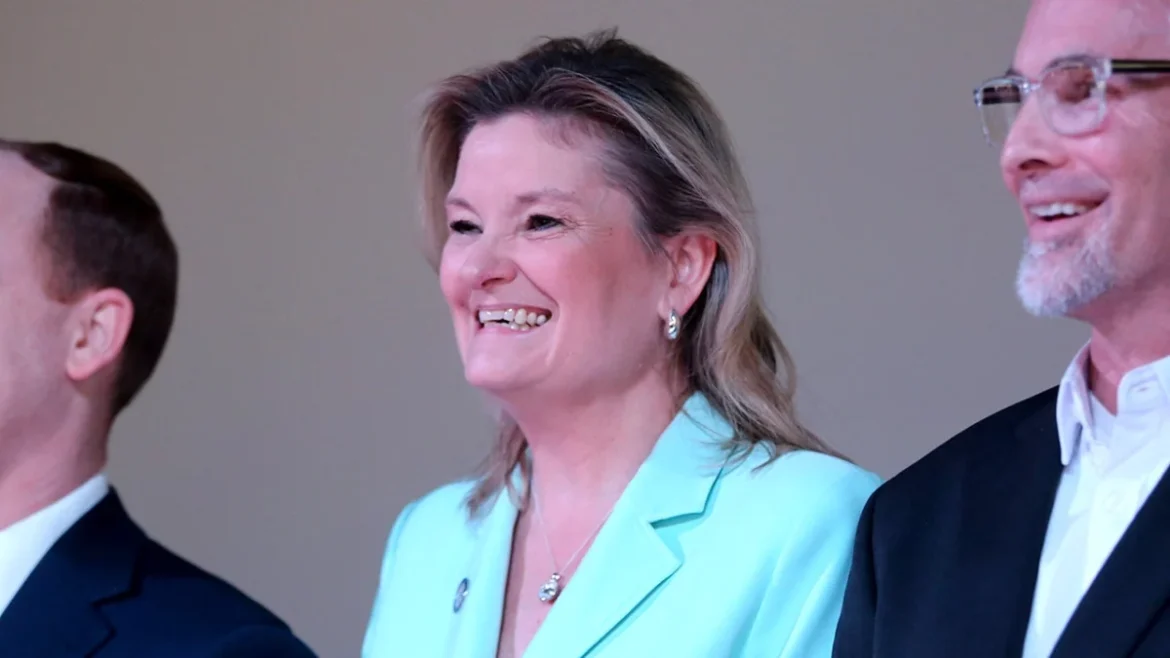
The electoral victory for Holscher signifies a continuation of Democratic leadership in a state that has increasingly become a battleground for competing visions of governance in the American Midwest. By securing the governorship, Holscher extends the Democratic party’s hold on the executive mansion to a third consecutive term, following the eight-year tenure of outgoing Governor Laura Kelly, who was prohibited by state law from seeking a third consecutive term.
The Election Outcome and Path to Victory
The race between Holscher and Senate President Ty Masterson was widely viewed as one of the most significant gubernatorial contests of the 2026 cycle. As the incumbent President of the Kansas Senate, Masterson represented the conservative stronghold of the state legislature, running on a platform emphasizing tax reform, school choice, and a reduction in state regulatory oversight. Conversely, Holscher, a legislator with a background in the Kansas House of Representatives and Senate, campaigned on themes of healthcare expansion, infrastructure investment, and moderate fiscal policy.
The Associated Press declared Holscher the winner on Thursday, noting that the margin of victory was sufficient to overcome any late-arriving mail-in ballots. The result solidifies a trend in Kansas politics where moderate-leaning suburban voters—particularly in Johnson County—have exerted increasing influence over statewide outcomes, often breaking from the more conservative rural voting blocs that define the state’s western regions.
Historical Context and Political Background
To understand the weight of this election, one must look at the recent trajectory of Kansas politics. For decades, Kansas was a reliable "red state" stronghold. However, the 2018 election of Laura Kelly, which followed the tenure of conservative Governor Sam Brownback, signaled a shift. Kelly’s ability to navigate a Republican-controlled legislature proved to be a template for Democratic success in the region.
Cindy Holscher’s ascent to the governorship was not without internal hurdles. In the August primary, she faced a formidable challenge from fellow state Sen. Ethan Corson. The primary was characterized by a contest for the ideological direction of the Kansas Democratic Party. While Corson enjoyed the high-profile endorsements of Governor Kelly and former Governor Kathleen Sebelius, Holscher’s grassroots campaign and focus on economic accessibility resonated with a broader segment of the primary electorate. Her victory in August set the stage for a general election that focused heavily on social issues and the role of the state in personal life.
The Controversy Surrounding the Campaign
Throughout the general election, the campaign was punctuated by intense scrutiny regarding past remarks made by Holscher. In 2023, during a heated legislative debate concerning proposed restrictions on drag performances in public spaces—specifically those accessible to children—Holscher became the center of a national firestorm. During a floor speech, she referenced the concept of gender identity in a way that led to critics accusing her of suggesting that Jesus Christ could have been transgender.
The resurfacing of these comments during the 2026 campaign served as a primary point of attack for the Masterson campaign and affiliated political action committees. Masterson’s team utilized the clips to frame Holscher as being out of touch with the traditional values of the Kansas electorate. Holscher, however, maintained that her comments were taken out of context and were intended to highlight the importance of inclusivity and the separation of church and state, rather than to make a theological assertion about religious figures. The persistence of this issue throughout the campaign highlighted the cultural divide currently defining Kansas politics.
Chronology of the 2026 Election Cycle
The 2026 Kansas gubernatorial cycle was marked by several key milestones that defined the eventual outcome:
- January 2026: Outgoing Governor Laura Kelly announces her focus on legislative priorities, signaling the start of the open seat race.
- April 2026: Ty Masterson announces his candidacy, solidifying his status as the GOP frontrunner.
- August 4, 2026: The primary elections occur. Cindy Holscher upsets the establishment-backed Ethan Corson, while Masterson secures the Republican nomination with the endorsement of Donald Trump.
- September 2026: The campaign enters a phase of heavy advertising, with the Masterson campaign focusing on the 2023 "transgender" comments, while Holscher focuses on healthcare and economic stability.
- October 2026: A series of three debates highlight the stark differences in policy, particularly regarding the expansion of Medicaid and the management of state education funds.
- November 3, 2026: Election Day. High voter turnout in suburban Kansas leads to the projection of Holscher as the winner.
Data and Electoral Trends
Data from the 2026 election indicates a significant shift in voting demographics. In Johnson County, the state’s most populous region, Holscher outperformed previous Democratic candidates, capitalizing on the migration of moderate voters away from the national GOP platform.
Economic data also played a role. While Kansas has seen steady growth, concerns over the cost of living and the availability of rural healthcare remained at the forefront of voter concerns. Exit polling suggested that while Masterson led in rural counties by double digits, Holscher’s dominance in urban centers—Wichita, Topeka, and the Kansas City suburbs—was the deciding factor.
Reactions and Official Statements
Following the projection, Ty Masterson issued a brief statement thanking his supporters and emphasizing the importance of a loyal opposition in the legislature. "While this is not the result we hoped for, the work of the Kansas Senate to ensure fiscal responsibility and defend our conservative principles will continue unabated," Masterson stated. He signaled that the legislature would remain a check on the executive branch during the transition.
Governor-elect Holscher held a press conference shortly after the results were confirmed. "This election was about the future of Kansas," Holscher said. "It was about ensuring that every Kansan has a seat at the table, regardless of their zip code or their background. We have a lot of work to do, and I am ready to begin the process of transitioning into this office."
Democratic party leaders expressed optimism regarding the result. National party figures viewed the win as a critical hold, preventing a loss of momentum in the Midwest. Meanwhile, state-level GOP leadership has already begun discussions regarding a strategy for the 2028 cycle, noting that the legislative supermajority in the Kansas House and Senate will likely continue to create a "gridlock" environment that will define Holscher’s first two years in office.
Broader Impact and Future Implications
The election of Cindy Holscher carries several implications for the state of Kansas and the nation at large:
- Legislative Gridlock: With the Kansas Legislature remaining firmly in Republican hands, Governor-elect Holscher will face the immediate challenge of governing through a hostile legislative body. The likelihood of vetoes and subsequent override attempts by the legislature remains high.
- Medicaid Expansion: One of the central pillars of Holscher’s platform was the expansion of Medicaid. The ability of the new governor to push this through a skeptical Senate will be a litmus test for her political capital.
- National Political Signaling: Kansas continues to serve as a microcosm for the national struggle between traditional conservatism and shifting social values. The success of the Holscher campaign will likely lead to further analysis by political scientists regarding the efficacy of "culture war" rhetoric in gubernatorial races.
- Judicial Appointments: Perhaps the most lasting legacy of this election will be the appointments to the state judiciary. As governor, Holscher will have the authority to fill vacancies on the state’s appellate courts, which will have long-term consequences for state law and public policy.
As the state transitions to a new administration, all eyes will be on the appointments made to the cabinet and the tone set during the upcoming legislative session. For now, the Kansas gubernatorial race has concluded, leaving a state that is deeply divided but clearly signaling a preference for a continuation of the policies championed by the outgoing administration. The challenge for Governor-elect Holscher will be to bridge that divide while fulfilling the promises made to her supporters during an arduous and highly contentious campaign.
