
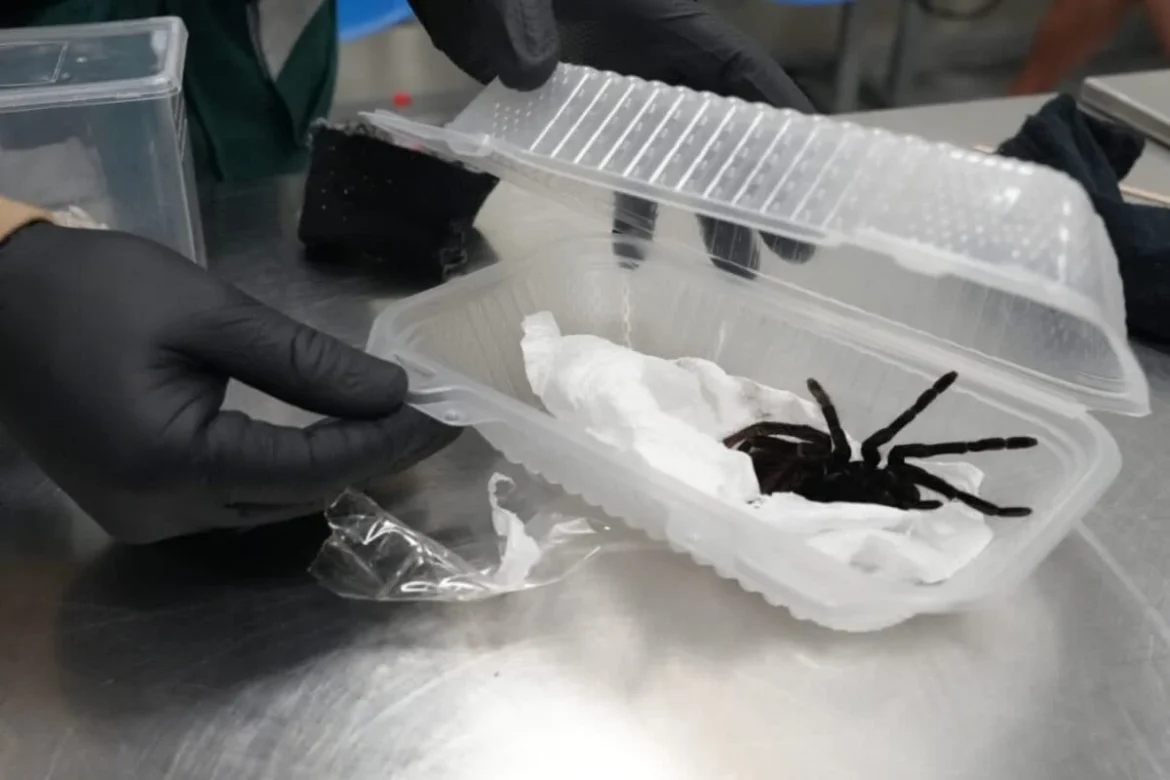
In a significant blow to the illicit wildlife trade, Peruvian customs officials and agents from the National Forest and Wildlife Service (SERFOR) intercepted more than 3,000 live tarantulas at the Jorge Chávez International Airport in Lima on November 4, 2026. The spiders, which were destined for Germany, had been meticulously packed into socks and hidden within the luggage of three individuals—two German citizens and one Polish national. Among the group, authorities confirmed the presence of a "renowned tarantula researcher," though his identity remains protected as the investigation proceeds. The suspects were promptly taken into custody by the Peruvian National Police’s environmental crimes unit and now face severe criminal charges related to the illegal extraction and trafficking of protected biodiversity.
The Anatomy of the Seizure
The operation was described by officials as a highly sophisticated attempt to bypass international wildlife protections. Upon searching three suitcases, inspectors discovered thousands of specimens representing various stages of the arachnid life cycle, ranging from eggs and delicate hatchlings to fully mature adults. Cora Suárez, a forest and wildlife control technician at SERFOR, noted in a press statement that the traffickers had curated a collection of immense biological diversity.
The seizure included a variety of rare species, some of which are so elusive they have yet to be formally described by the scientific community. The spiders were sourced from a wide swath of Peruvian geography, spanning the diverse ecosystems of Junín, Loreto, Cajamarca, Cusco, and La Libertad. The collection effort required not only significant local knowledge of these regions but also a coordinated logistics chain to consolidate the animals before the attempted flight to Europe.
Biodiversity Under Threat: Targeted Species
The confiscated haul contained several high-value species sought after in the international exotic pet trade. Among them were spiders of the genus Pamphobeteus, known for their impressive size and striking appearance. These are highly prized by collectors, often fetching prices as high as 80 USD (60 GBP) per specimen on illicit online marketplaces.
Also present in the suitcases were "blue bird eaters" (Thrixopelma lagunas), which retail for approximately 53 USD (40 GBP). Perhaps most alarming to conservationists is the presence of Antikuna sp., a genus only formally described by science in 2021, and several species of Avicularia that remain scientifically unidentified. The inclusion of the Bolivian blue leg bird eater (Pamphobeteus antinous)—a species officially listed as vulnerable to extinction under Peruvian national law—further underscores the ecological risk posed by such smuggling operations. While none of the species involved are currently protected under the Convention on International Trade in Endangered Species of Wild Fauna and Flora (CITES), their removal from the wild in such massive quantities poses a direct threat to local populations and regional biodiversity.
Chronology of the Investigation
The interception follows a period of heightened scrutiny at Peruvian transit hubs. While the arrests occurred on November 4, 2026, the investigation into the suspects’ movements suggests a planned operation to extract wildlife from multiple protected regions over several weeks.
- Late October 2026: Suspected traffickers reportedly move through the identified regions of Peru (Junín, Loreto, Cajamarca, etc.) to collect specimens.
- November 3, 2026: The trio prepares the cargo, using socks and suitcases to conceal the spiders in a manner intended to bypass x-ray detection or manual inspection.
- November 4, 2026: Customs and SERFOR agents at Jorge Chávez International Airport flag the luggage for inspection based on behavioral profiling and intelligence-led screening.
- Post-Seizure: Authorities initiate the identification process. The spiders are moved to an authorized breeding center where they are being evaluated by entomologists to determine their condition and eventual release or permanent placement.
Global Trends in Invertebrate Trafficking
This incident is not an isolated event but rather a symptom of an escalating global trend in the smuggling of invertebrates. Historically, wildlife trafficking laws have focused heavily on charismatic megafauna like elephants, rhinos, and big cats. However, the exotic pet trade has increasingly pivoted toward insects and arachnids.
In the months leading up to this event, international authorities have reported a surge in seizures. In July 2026, over 100 queen ants destined for Laos were intercepted in Mexico. Just a month earlier, Australian officials seized 10,000 live cockroaches in a crackdown on exotic insect markets, and South African authorities arrested a man attempting to smuggle 150 venomous scorpions.

Experts suggest that the relative ease of transporting invertebrates—which are small, require little food, and are often overlooked by airport security—has made them an attractive commodity for smugglers. The lower overhead costs and the "newness" of certain species create a high-profit margin for traffickers who exploit gaps in international enforcement.
Legal Loopholes and the EU Connection
The involvement of European nationals and the destination of the cargo highlight a significant regulatory failure. Currently, many countries, particularly within the European Union, lack stringent regulations regarding the importation of non-CITES listed species. This creates a "legal gap" that allows traffickers to capitalize on stolen wildlife.
Sandra Altherr, a researcher with the German NGO Pro Wildlife, has long warned that existing laws are insufficient. "This is a pattern that we have observed again and again," Altherr stated. "If they were not seized in Peru, they could have been legally imported to the EU because of a legal loophole. This means a lower legal risk for the smugglers but with high profit."
Under current EU regulations, if a species is not protected by CITES, customs agents may allow the entry of the animal provided it does not violate specific local veterinary health requirements. Because the smuggling violates the origin country’s national law (in this case, Peru’s), but not necessarily the destination country’s importation laws, the "stolen" status of the animal is effectively laundered once it clears the border. NGOs like Pro Wildlife are currently lobbying for a "positive list" approach or stricter requirements that mandate proof of legal acquisition for all wildlife imports, regardless of CITES status.
Implications for Conservation and Science
The loss of these 3,000 spiders represents more than just a crime against national borders; it is a loss of scientific data. When specimens are taken from the wild by unlicensed collectors, they are removed from their native habitats where they play essential roles as predators and prey. Furthermore, because some of these species were previously unknown to science, their extraction makes it nearly impossible for researchers to study their life cycles, environmental requirements, or evolutionary significance.
For the species that were already identified as vulnerable, such as Pamphobeteus antinous, the illegal trade creates a secondary pressure that can push stable populations toward localized extinction. As climate change and habitat loss already threaten the Andean and Amazonian ecosystems, the added pressure of poaching is a variable that complicates long-term conservation strategies.
Future Steps and Judicial Outlook
As of mid-November 2026, the three suspects remain in custody in Lima. The Peruvian judicial system is expected to prosecute them under national laws protecting biological heritage. While the specific legal strategy remains under development, authorities are looking to ensure that the sentencing serves as a deterrent to other collectors and researchers who may consider bypassing legal export protocols.
Meanwhile, SERFOR is overseeing the delicate process of housing the surviving spiders. The "authorized breeding center" tasked with their care faces the monumental challenge of maintaining the health of 3,000 individual arachnids, many of which have been stressed by the conditions of their transport. The eventual goal is to document the species—particularly those that are new to science—and determine if any can be rehabilitated and returned to their native habitats, though such an endeavor is fraught with biological risks, including the potential for cross-contamination of captive-bred pathogens back into the wild.
The seizure at Jorge Chávez International Airport serves as a stark reminder that the battle for biodiversity is moving into the shadows of the exotic pet trade. With increasing global demand for rare invertebrates, the collaboration between Peruvian authorities and their international counterparts will be critical in preventing the further depletion of the region’s unique and irreplaceable biological wealth.
