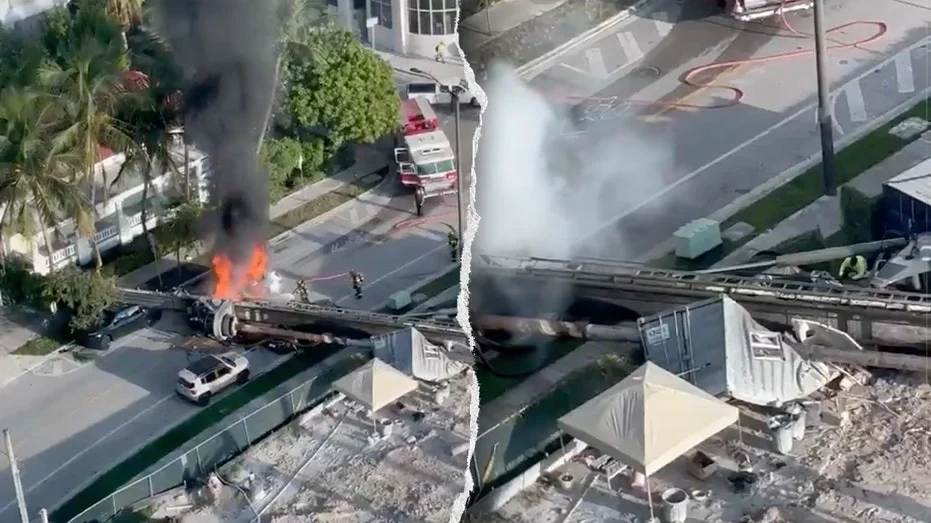
A Monday morning construction accident in Miami’s bustling financial district sent shockwaves through the local community when a massive drilling rig toppled over, crushing multiple vehicles, igniting a fiery inferno, and trapping workers inside a metal container. The incident, which unfolded at approximately 8:00 a.m. near the intersection of Southeast 12th Street and Brickell Bay Drive, prompted an immediate, multi-agency emergency response. While the collapse resulted in severe property damage and significant traffic disruptions across the high-density urban corridor, miraculous escapes and swift tactical interventions prevented what could have been a catastrophic loss of life.
Four individuals sustained injuries during the harrowing episode and were subsequently transported to local medical facilities for treatment. Among the injured were two construction workers who found themselves pinned inside a heavily damaged Conex construction box, the 47-year-old operator of the rig, and a motorist whose vehicle was engulfed in flames after bearing the brunt of the falling heavy machinery. Officials confirmed that all 18 workers assigned to the job site have been fully accounted for, and all four hospitalized patients are currently listed in stable condition with minor injuries.
A Rapid and Complex Emergency Response
The gravity of the situation required a coordinated deployment of hazardous incident personnel, specialized extraction teams, and suppression units from Miami Fire Rescue. According to Miami Fire Chief Robert Hevia, who provided operational details during an afternoon press conference, the emergency response involved simultaneous, high-risk maneuvers.
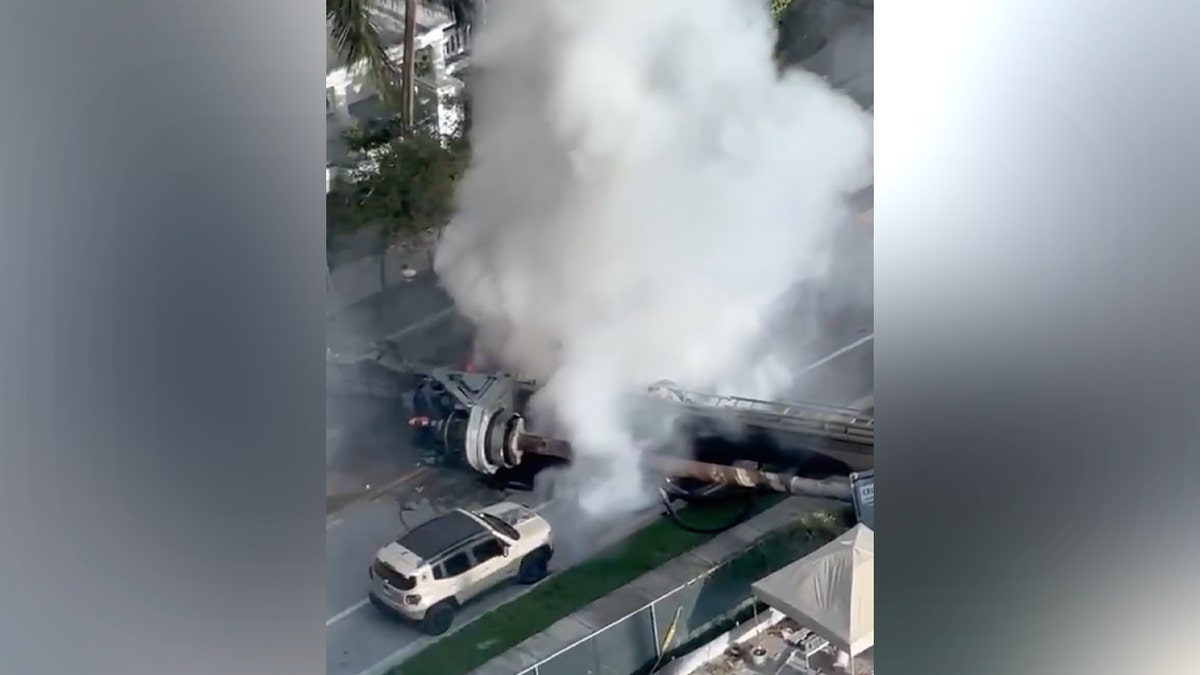
As firefighters battled an aggressive blaze that erupted when the heavy rig crashed onto a moving BMW, specialized technical rescue units went to work on an adjacent front. They were tasked with cutting through the reinforced steel walls of a crushed construction container to reach two trapped employees, identified as young men aged 27 and 29.
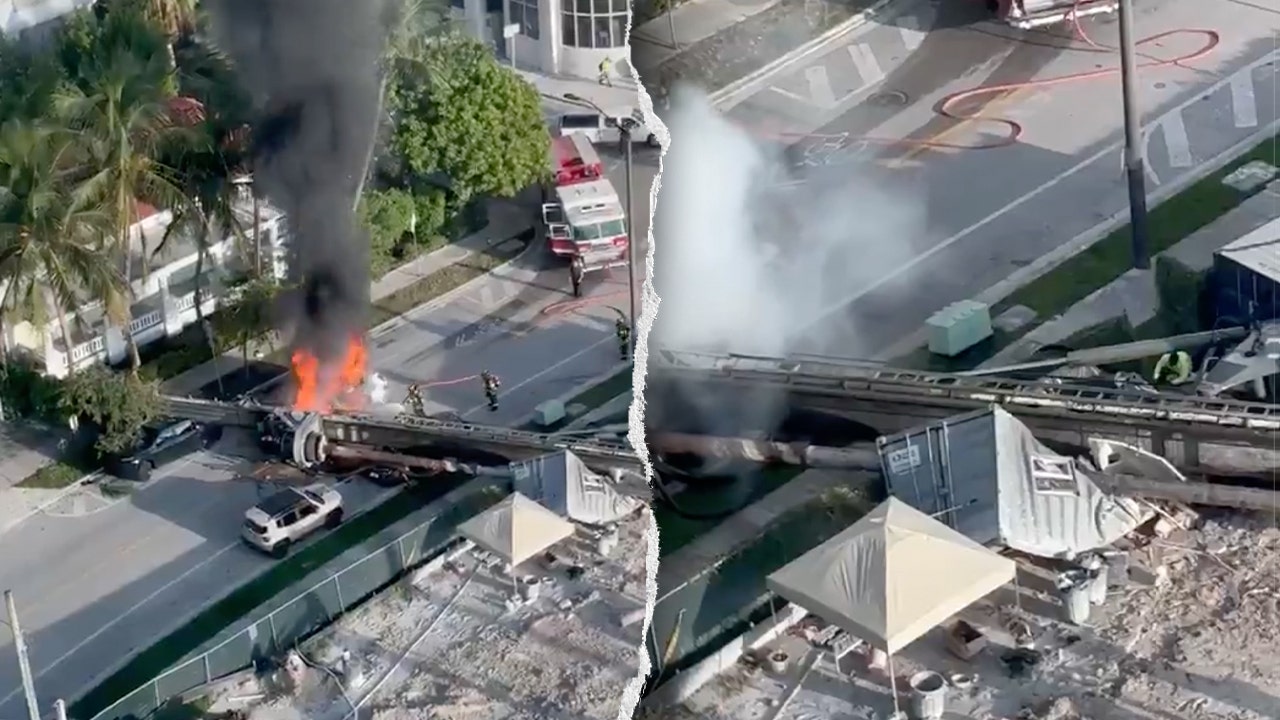
“It was a very complex scene with a fire that was occurring, our crews were putting out the fire and our technical rescue team working simultaneously to cut through the Conex box, the construction box, and they were able to successfully extricate the two victims,” Chief Hevia stated to reporters.
The successful extraction of the two workers underscored the rigorous training and preparedness of South Florida’s technical rescue divisions. Working amid intense heat, dense smoke, and unstable structural elements, the response teams managed to pull the men from the wreckage safely before transferring them to paramedics.
Miraculous Escapes Amid the Chaos
While the physical damage to the surrounding infrastructure was extensive, the human element of the morning’s events featured moments of astonishing fortune. Chief Hevia highlighted the incredible presence of mind demonstrated by the driver of the BMW crushed during the collapse.
Rather than succumbing to panic as the heavy equipment struck his vehicle and sparked an immediate fire, the motorist managed to throw the car into reverse while explosions of heat and sparks surrounded him. He then managed to scramble out of the rear of the vehicle just as the flames intensified.
“To be able to see the crane falling, pull the car in reverse and pop out of the back while the car’s on fire, really incredible,” Hevia marveled, pointing out that the driver escaped with only minor injuries.
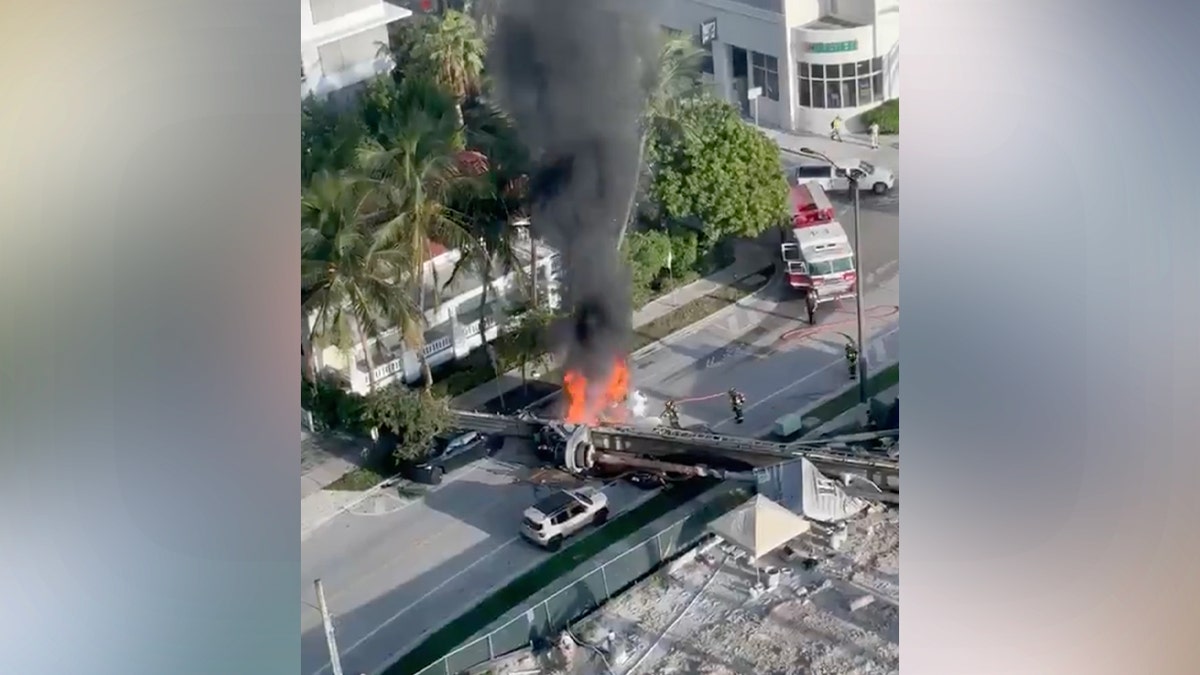
In addition to the burning BMW, the drilling rig crushed two other passenger vehicles that were legally parked and unoccupied at the time of the accident. The rig operator, an adult male, was also safely removed from the wreckage and transported alongside the other victims for evaluation.
Timeline of Events
- 7:45 a.m. – 8:00 a.m.: Construction crews begin operations at the job site located along Brickell Bay Drive.
- 8:00 a.m. (Approximate): The heavy drilling rig suddenly loses stability and topples outward, crashing onto the roadway and trapping structures below.
- 8:02 a.m.: The impact crushes a moving BMW, instantly sparking a vehicle fire, while simultaneously pancaking a construction container holding two workers.
- 8:05 a.m.: Miami Fire Rescue units are dispatched to Southeast 12th Street and Brickell Bay Drive following multiple 911 calls from witnesses reporting the collapse and fire.
- 8:15 a.m.: First responders arrive on the scene. Fire suppression teams attack the vehicle blaze while technical rescue personnel secure the perimeter of the crushed container.
- 8:30 a.m. – 9:00 a.m.: Firefighters successfully cut through the structural metal of the Conex box, extracting the 27- and 29-year-old construction workers. All four injured parties are triaged and prepared for transport.
- 9:15 a.m.: The Miami Police Department issues public alerts via social media channels, ordering motorists to avoid Brickell Bay Drive between SE 12th Street and SE 13th Street due to extended road closures.
- Late Morning: Emergency crews stabilize the site, verify that all 18 on-site workers are accounted for, and hand over control of the investigation to federal and municipal oversight bodies.
High-Profile Construction Site Context
Local reports and regional media outlets, including NBC 6 South Florida, have identified the incident site as the future home of billionaire hedge fund manager Ken Griffin’s new Citadel headquarters. The ambitious high-rise project has been one of the most closely watched developments in the region following Citadel’s high-profile corporate relocation from Chicago to Miami.
The Brickell neighborhood, often referred to as the "Wall Street of the South," has experienced an unprecedented boom in commercial and residential high-rise construction over the past decade. The continuous influx of corporate relocations, luxury developments, and high-density infrastructure projects has transformed the skyline but has also placed intense scrutiny on urban safety protocols, traffic management, and heavy equipment operation in tight spaces.
Investigation and Regulatory Oversight
In the wake of Monday’s collapse, questions immediately turned to what caused the heavy drilling rig to fail. As of late Monday afternoon, municipal authorities and emergency officials had not released a definitive cause for the structural failure.
Responsibility for investigating the mechanics of the collapse has fallen to the Occupational Safety and Health Administration (OSHA). Federal investigators will examine equipment maintenance logs, soil stability reports, weight distribution metrics, and operator actions to determine whether protocol violations, mechanical malfunctions, or environmental factors contributed to the accident.
OSHA investigations of major construction accidents typically involve interviewing witnesses, reviewing site blueprints, and analyzing structural components. Findings from these federal inquiries can take several months to be finalized, occasionally resulting in safety citations or civil penalties if negligence or regulatory breaches are uncovered.
Broader Implications for Urban Infrastructure and Safety
Incidents involving heavy construction equipment in densely populated metropolitan areas inevitably spark broader conversations regarding urban safety, zoning enforcement, and the oversight of massive commercial projects. Brickell’s narrow corridors, heavy vehicular traffic, and high pedestrian volume mean that any failure on a job site carries an amplified risk to the general public.
Following the initial emergency response, city officials praised the collaboration between local police, fire rescue, and municipal planners in minimizing the disaster’s footprint. Road closures along Brickell Bay Drive created severe localized gridlock during the tail end of the morning commute, highlighting the vulnerability of the district’s arterial roadways to unexpected structural emergencies.
As repair crews clear the debris and federal investigators comb through the wreckage, the incident serves as a stark reminder of the inherent hazards associated with vertical urban development. For the residents, commuters, and workers in Miami’s premier financial district, Monday’s collapse underscores both the fragility of urban infrastructure and the vital importance of rigorous safety standards in an era of relentless urban expansion.