
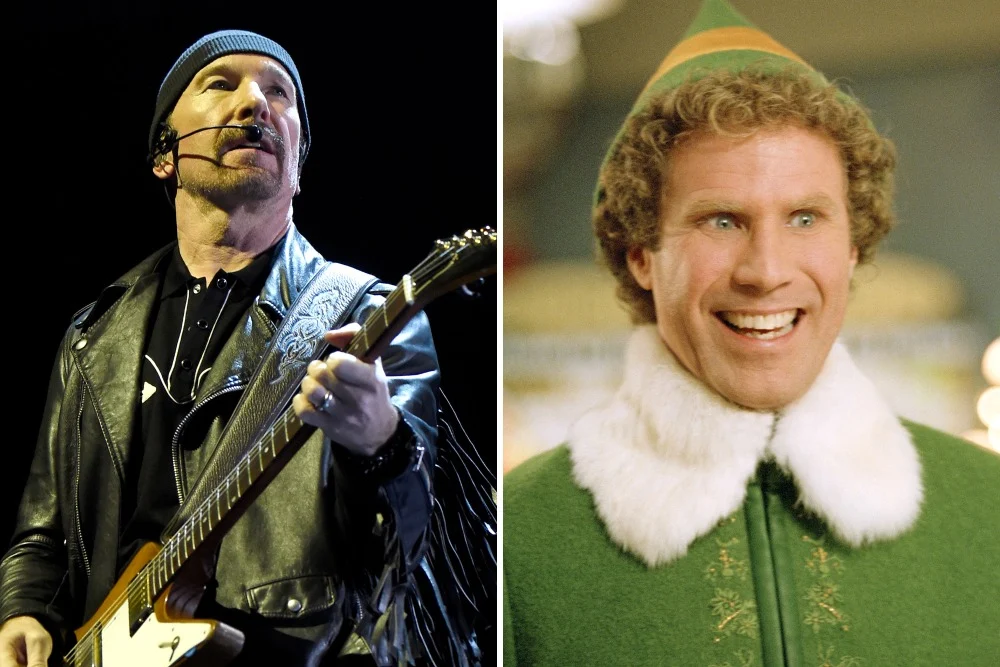
The cinematic landscape of holiday films is defined by a handful of undisputed classics, and few hold as prominent a place in modern pop culture as the 2003 Jon Favreau-directed feature, Elf. For more than two decades, the story of Buddy the Elf, a human raised in the North Pole who journeys to New York City to find his biological father, has remained a perennial favorite. However, recent revelations from actor Andy Richter suggest that the legacy of this film could have taken a vastly different, and perhaps more surreal, path. During a candid appearance on Obsessed: The Podcast, Richter disclosed that none other than David Howell Evans—better known as The Edge of the legendary rock band U2—once drafted a full-length screenplay for a potential sequel to the film.
The Mystery of the Lost Script
The existence of this script serves as one of Hollywood’s most peculiar "what-if" scenarios. According to Richter, who appeared in the original film as a colleague of Walter Hobbs, the project surfaced through industry backchannels. The narrative reportedly reached Shauna Robertson, a powerhouse producer known for her work on various high-profile comedies.
"Somebody reached out to her and said, ‘The Edge from U2 has written a sequel to Elf, and he wants to talk to you about it,’" Richter explained during the podcast. "It’s the weirdest story, but apparently it was fully written. Somewhere in the world, there is an Edge-penned Elf 2 out there."
Despite the stature of the songwriter behind such hits as "Where the Streets Have No Name," the pitch did not gain momentum. Richter noted that while the initial outreach occurred, the meetings failed to materialize into a formal development deal, and the script was quietly shelved. The project, much like the ephemeral nature of a snowflake, simply vanished into the ether of unproduced Hollywood intellectual property.
Multiple Attempts at a Follow-up
The Edge’s contribution was not the only attempt to revisit the world of Buddy the Elf. Richter’s revelations shed light on a broader, largely unknown history of development efforts for a franchise that ultimately never launched. He confirmed that Scot Armstrong—the screenwriter behind successful comedies such as Old School and The Hangover Part II—had also been commissioned to write a sequel script.
The premise of the Armstrong draft, as described by Richter, leaned into a more antagonistic conflict. "It was about the evil South Pole elves kidnapping Santa or something like that," Richter recalled. Armstrong’s involvement is particularly noteworthy because he contributed to the writing of the original 2003 film, though his work went uncredited due to the intricacies of the Writers Guild of America (WGA) arbitration processes common in the early 2000s.
These revelations underscore the reality that major studios frequently explore sequels for successful films, even when the creative leads—specifically Will Ferrell and Jon Favreau—have publicly expressed a desire to avoid them. The existence of these manuscripts suggests that while the creative team behind the original may have been resistant, the corporate machinery behind the intellectual property was actively seeking ways to capitalize on the film’s enduring popularity.
The Cultural Footprint of Elf
Released on November 7, 2003, Elf was a critical and commercial success, grossing over $220 million worldwide against a production budget of approximately $33 million. It propelled Will Ferrell to a new tier of superstardom and solidified his transition from Saturday Night Live performer to a leading man capable of anchoring a holiday tradition.
The film’s longevity is substantiated by its constant presence in the streaming and broadcast markets every November and December. Its success, however, is often attributed to the specific alchemy of its production: the earnestness of Ferrell’s performance, the grounded performance of James Caan, and the visually distinct, practical effects-heavy aesthetic favored by Favreau.
The reluctance to produce a sequel is rooted in a collective industry understanding that the film’s "lightning-in-a-bottle" quality is fragile. Richter, who recently co-authored the book Elf Unwrapped: Behind the Scenes of a Modern Christmas Classic, is firmly against the idea of revisiting the narrative. "I’m on the side of ‘Let it stand,’" Richter stated. "Just let Elf be Elf. You don’t have to use every part of the animal."
The Industry Perspective on Sequels
Richter’s comments reflect a broader shift in the conversation surrounding legacy films. In an era dominated by cinematic universes and endless franchise extensions, the refusal to produce a sequel to a beloved film is increasingly rare.
Industry analysts often point to the risk of "tarnishing" a classic. If a sequel fails to capture the tone, heart, or humor of the original, it can negatively impact the perception of the franchise as a whole. For a film as culturally entrenched as Elf, the risk-to-reward ratio is significantly skewed toward risk. The public’s affection for the movie has only deepened over the last 23 years, turning it into a generational touchstone that bridges the gap between the era of physical media and the digital streaming age.
"Now that time has passed, the movie has become so special that I think that people, rightfully so, are loath to mess with it because we all can think of movies that have been tarnished by their sequels," Richter observed. "And this is so special and so perfect and so beloved… Why risk it?"
Why the Projects Failed
The failure of these sequel scripts to move forward highlights the necessity of creative alignment in major film production. For a sequel to reach production, it typically requires the endorsement of the primary talent—in this case, Will Ferrell—and the director, Jon Favreau.
Ferrell has been notoriously firm in his stance regarding an Elf sequel. In various interviews over the years, he has suggested that a follow-up would likely be "pathetic" and that he had no interest in reprising the role for a substantial paycheck. Without the involvement of the central character, a sequel would lose the core element that made the original work. Even with a script written by a famous musician like The Edge or an established comedy writer like Scot Armstrong, the lack of buy-in from the film’s creative heart rendered the projects dead on arrival.
Legacy and Future Outlook
As of 2025, the intellectual property rights for Elf remain within the Warner Bros. ecosystem. While the studio has explored animated specials and stage adaptations, the "feature film sequel" remains a closed door.
The story of the lost scripts—the "Edge-penned" version and the "South Pole" concept—serves as a fascinating footnote in the history of 21st-century cinema. It provides a glimpse into the internal dynamics of Hollywood, where massive projects are often conceptualized in the shadows, only to be abandoned due to creative incompatibility or, in this case, a healthy respect for a finished work of art.
For fans, the knowledge that these scripts exist does not necessarily create a desire to read them, but rather reinforces the stature of the 2003 original. By choosing to let the film stand alone, the producers and creators have protected the integrity of a modern holiday classic. In an industry that is often criticized for a lack of originality and an over-reliance on established IP, the story of the unmade Elf 2 stands as a testament to the idea that sometimes, the best creative decision is to leave a perfect story exactly as it is.
The publication of Richter’s book, Elf Unwrapped, further cements the film’s place in history, providing the definitive account of its creation. As the film approaches its quarter-century anniversary, it remains a rare example of a commercial success that resisted the siren call of endless iteration, choosing instead to remain a singular, preserved moment in cinematic time.
