
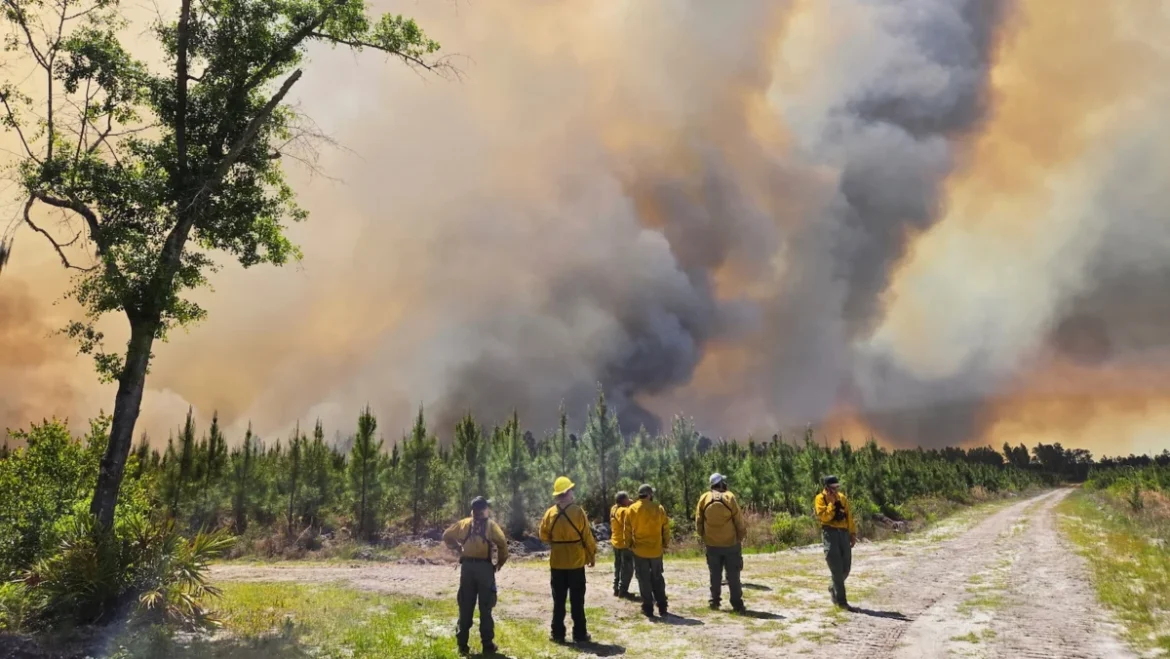
A rapidly escalating wildfire crisis has seized the state of Georgia, consuming more than 27,000 acres across the southern landscape and forcing Governor Brian Kemp to declare a state of emergency for 91 counties. The disaster, fueled by a combination of historic drought conditions and a massive accumulation of debris left in the wake of Hurricane Helene, has already resulted in the destruction of dozens of homes and the displacement of hundreds of residents. As of Wednesday, fire crews from across the state and neighboring regions are battling to contain multiple blazes that have shown a terrifying ability to leap containment lines and intensify within hours.
The most acute devastation has been recorded in Brantley County, where the Brantley Highway 82 fire has transformed into a fast-moving inferno. What began as a manageable brush fire on Monday night quickly spiraled out of control. By Tuesday morning, the fire covered several hundred acres and was reported to be 75 percent contained, leading officials to believe the worst had passed. However, a shift in wind patterns and the presence of extremely dry fuel sources caused the fire to "blow up" late Tuesday. By Wednesday morning, the fire had ballooned to 5,000 acres, with containment dropping precipitously to just 10 percent.
The Human Toll and Property Destruction
The rapid intensification of the Highway 82 fire left residents with little time to evacuate. Local officials confirmed on Wednesday that 54 homes have been completely destroyed in Brantley County alone. The scene in affected neighborhoods has been described as apocalyptic, with charred remains of vehicles and blackened foundations where family homes once stood. Despite the speed and ferocity of the blaze, no fatalities have been reported, a fact that local leaders are calling a testament to the quick work of first responders and a significant amount of luck.
Brantley County Manager Joey Cason addressed the media on Wednesday afternoon, expressing both grief for the losses and relief regarding the lack of casualties. "I will be very honest with you and say it’s a miracle that there have not been any lives lost," Cason said. He noted that the county’s immediate priority is providing shelter and basic necessities for those who have lost everything. Several area churches and community centers have been converted into emergency shelters, and a massive donation drive has begun to support both the displaced families and the exhausted firefighting crews.
In Clinch County, located near the Florida border, the Pinelands Road fire continues to burn across a massive 16,000-acre footprint. This fire, which ignited over the weekend, has proven difficult to manage due to the remote nature of the terrain and the density of the vegetation. Like the Brantley County fire, the Pinelands Road blaze remains only 10 percent contained as of Wednesday evening.
A Chronology of the Crisis
The current wildfire emergency is the result of a compounding series of events that began weeks before the first spark was ignited. To understand the scale of the current situation, a look at the timeline of the last several days is necessary:
- Saturday/Sunday: The Pinelands Road fire ignites in Clinch County. Initial suppression efforts are hampered by dry winds and low humidity.
- Monday Evening: The Highway 82 fire begins in Brantley County. Local crews respond, attempting to establish containment lines overnight.
- Tuesday Morning: Officials report high containment levels on the Highway 82 fire (75 percent). However, weather forecasts warn of "red flag" conditions, characterized by low humidity and gusty winds.
- Tuesday Evening: Containment lines are breached. The fire expands from a few hundred acres to several thousand in a matter of hours. Evacuation orders are issued for multiple residential zones in Brantley County.
- Wednesday Morning: State officials confirm the destruction of 54 homes. Governor Brian Kemp signs the executive order declaring a state of emergency for 91 counties, authorizing the use of National Guard resources and state funding for emergency response.
- Wednesday Afternoon: Smoke plumes from the South Georgia fires reach as far north as the Atlanta metropolitan area, prompting air quality warnings for millions of Georgians.
The Role of Hurricane Helene and "Exceptional Drought"
Environmental experts and state foresters point to two primary factors that have turned the Georgia woods into a powder keg: the lingering effects of Hurricane Helene and a severe, localized drought.
When Hurricane Helene swept through the region earlier this year, it brought down an unprecedented volume of timber. In South Georgia, a region dominated by the commercial timber industry and dense pine forests, the storm left behind millions of tons of "dead load"—downed trees, snapped branches, and uprooted vegetation. While the state has been working to clear this debris, the sheer volume made it impossible to remove everything before the dry season arrived.
Erin Lincoln, director of the Center for Forest Business at the University of Georgia, noted that these downed trees provide a heavy fuel load that burns hotter and longer than typical forest floor litter. "This is a serious and evolving situation," Lincoln explained. "The presence of cured, dry timber from the hurricane means that once a fire starts, it has an almost inexhaustible supply of high-energy fuel."
Compounding this issue is a historic lack of precipitation. According to the U.S. Drought Monitor, a large swath of South Georgia is currently classified as being in an "Exceptional Drought" (D4), the highest and most severe category in the federal monitoring system. Much of the remainder of the state is under "Extreme Drought" (D3) conditions. Rainfall levels in some counties are more than 10 inches below seasonal averages, causing the water table to drop and surface water sources like ponds, ditches, and swamps to dry up.
State forester Johnny Sabo emphasized how these conditions limit firefighting capabilities. "Under drought conditions, we have that much less water available either in the water table or in our swamps, ditches, drains, and lakes," Sabo said. "Normally, the natural wetness of the Okefenokee region acts as a barrier, but right now, those areas are dry enough to carry fire rather than stop it."
Regional Air Quality and Public Health Concerns
The impact of the fires is not limited to the immediate vicinity of the flames. On Wednesday, a thick haze of smoke settled over much of central and northern Georgia. In Atlanta, the air quality index (AQI) was downgraded to "moderate," a level that can cause respiratory distress for sensitive groups, including children, the elderly, and those with asthma or chronic obstructive pulmonary disease (COPD).
Further south, in cities like Macon and Columbus, air quality reached "unhealthy" levels. Health officials have advised residents in these areas to limit outdoor activities and keep windows closed. The smoke contains fine particulate matter (PM2.5), which is small enough to enter the bloodstream and cause systemic inflammation or cardiovascular issues.
The Georgia Environmental Protection Division is monitoring air quality stations across the state, warning that as long as the fires remain uncontained and the winds continue to blow from the south, the smoke will remain a persistent health hazard for the majority of the state’s population.
Official Response and Mitigation Efforts
In response to the escalating threat, the Georgia Forestry Commission (GFC) has issued a total burn ban for south and central Georgia. This ban prohibits all outdoor burning, including leaf piles, campfires, and agricultural burning. Human activity remains the leading cause of wildfires in the state, with Sabo noting that "people being careless" with outdoor fires often triggers the most destructive events.
The state of emergency declared by Governor Kemp allows for the mobilization of the Georgia National Guard to assist in debris clearance and fire suppression. It also streamlines the process for local governments to receive state aid for recovery. Tim Lowrimore, president and CEO of the Georgia Forestry Association, urged the public to take the situation seriously. "We urge all Georgians to remain vigilant. Preventing additional fires right now is critical as responders work to manage this emergency," Lowrimore stated.
The firefighting effort is a massive multi-agency operation involving the GFC, local fire departments, the U.S. Fish and Wildlife Service (due to the proximity to the Okefenokee National Wildlife Refuge), and private timber companies. Heavy equipment, including bulldozers and "V-plows," are being used to cut firebreaks through the dense, debris-strewn forest floor, while helicopters and air tankers drop water and fire retardant to protect structures.
Broader Implications and Climate Context
The current crisis in Georgia serves as a stark reminder of the changing nature of wildfire risk in the Southeastern United States. While wildfires are a natural part of the Southern ecosystem, the intensity and frequency of these events are shifting. Climate scientists point out that while climate change may not "cause" a specific fire, it creates the conditions—such as prolonged droughts and higher temperatures—that make large-scale, uncontrollable fires more likely.
The economic implications for Georgia are also significant. The state is a leader in the nation’s timber production, and the loss of 27,000 acres of forest represents a substantial blow to the local economy. For many landowners in Brantley and Clinch counties, the timber on their land represents their primary financial asset. The destruction of these stands, combined with the loss of homes, will require a multi-year recovery effort.
As of Wednesday night, weather forecasts offered little hope for immediate relief. No significant rainfall is predicted for the next seven to ten days, and humidity levels are expected to remain dangerously low. Firefighters are bracing for a long-term engagement, focusing on protecting life and property as they wait for a change in the weather pattern.
For the residents of South Georgia, the immediate future is one of uncertainty and resilience. As the smoke continues to rise over the Okefenokee, the focus remains on containment, community support, and the hope that the "miracle" of no lives lost continues through the duration of this historic fire season.
