
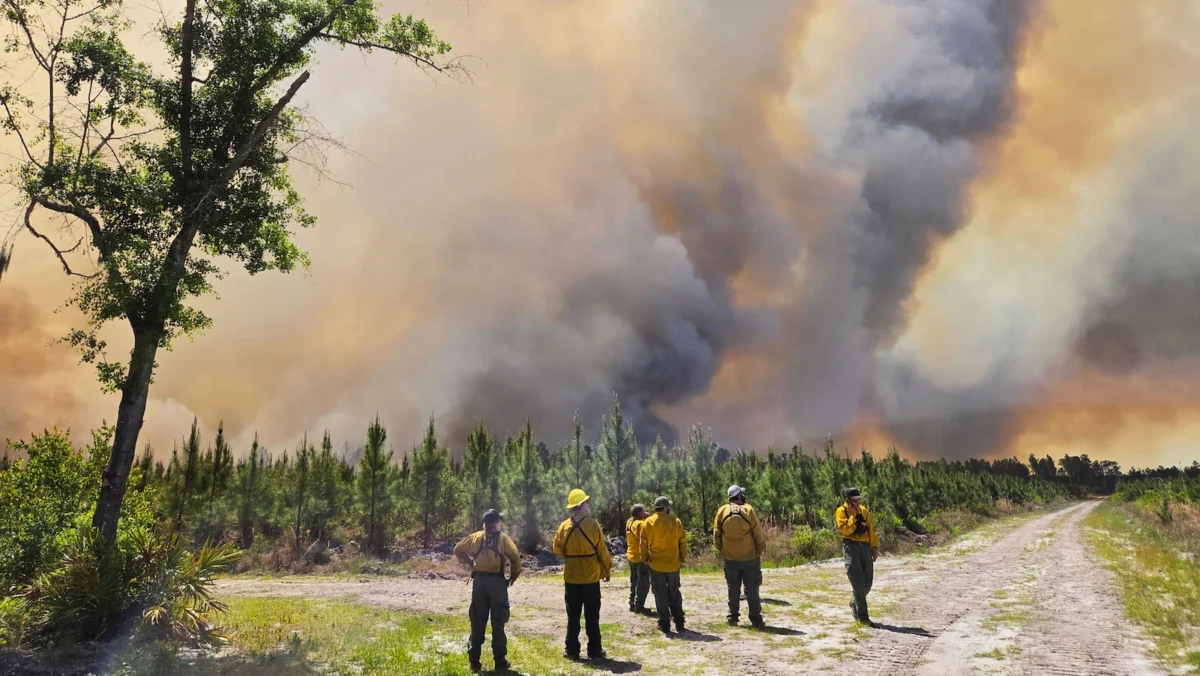
Governor Brian Kemp has declared a state of emergency for 91 counties as wildfires continue to ravage more than 27,000 acres across southern Georgia, marking one of the most significant fire threats to the region in recent years. The emergency declaration comes as firefighting crews struggle to contain multiple large-scale blazes that have already destroyed dozens of homes and forced hundreds of residents to flee. The crisis is being exacerbated by a "perfect storm" of environmental factors, including a record-breaking "Exceptional Drought" and a massive accumulation of dry timber debris left in the wake of Hurricane Helene.
The most immediate threat stems from the Brantley Highway 82 fire, which has exhibited extreme behavior over the last 48 hours. What began as a manageable brush fire on Monday night quickly escalated into a catastrophic inferno. By Tuesday morning, the fire was estimated to cover several hundred acres and was 75 percent contained. However, shifting winds and plummeting humidity levels caused the fire to jump containment lines. By Wednesday morning, the blaze had ballooned to 5,000 acres, with containment dropping to a mere 10 percent. Local officials confirmed that the rapid spread resulted in the destruction of at least 54 homes, leaving families displaced and communities in shock.
A Miraculous Lack of Fatalities Amidst Destruction
Despite the speed and intensity of the Brantley Highway 82 fire, emergency management officials report that there have been no confirmed fatalities or major injuries. Brantley County Manager Joey Cason emphasized the gravity of the situation during a press conference on Wednesday afternoon, describing the lack of loss of life as a "miracle." The rapid evacuation orders, issued as the fire intensified overnight Tuesday, are credited with saving lives, though the emotional and financial toll on the community remains immense.
To assist those who have lost everything, Brantley County officials and local religious organizations have established several emergency shelters. Churches across the region have opened their doors to provide food, bedding, and basic necessities. Meanwhile, community donation drives are underway to support both the displaced residents and the hundreds of exhausted firefighters working on the front lines. The Georgia Forestry Commission (GFC) has deployed heavy machinery, including bulldozers and tractor-plow units, to create firebreaks, but the terrain and dry conditions have made progress slow and dangerous.
The Pinelands Road Fire and Regional Contagion
While the Brantley fire has drawn significant attention due to property loss, it is not the largest blaze currently burning. To the west, in Clinch County, the Pinelands Road fire has consumed over 16,000 acres since it ignited over the weekend. Located near the Florida-Georgia border, this fire is also only 10 percent contained. Both Brantley and Clinch counties are characterized by dense pine forests and their proximity to the Okefenokee Swamp, a massive peat-filled wetland that presents unique challenges for fire suppression.
The crisis is not confined to Georgia. Northern Florida is experiencing a parallel surge in wildfire activity, with officials in both states monitoring more than 100 active fire starts as of mid-week. While many of these smaller fires were quickly suppressed, the sheer volume of ignitions has strained regional resources. The shared border region is currently trapped in a cycle of high temperatures and negligible rainfall, turning the lush coastal plain into a tinderbox.
Chronology of the 2024 South Georgia Fire Outbreak
The current emergency is the result of a week-long escalation of fire activity:
- Saturday & Sunday: The Pinelands Road fire ignites in Clinch County. Initial suppression efforts are hampered by difficult terrain near the swamp edges.
- Monday Evening: The Brantley Highway 82 fire is reported. Crews initially believe they have the upper hand.
- Tuesday Morning: The Brantley fire reaches 75 percent containment. However, meteorologists warn of "red flag" conditions, including low humidity and gusty winds.
- Tuesday Night: The Brantley fire undergoes a "blow up" event, jumping firebreaks and entering residential areas. Evacuation orders are issued for neighborhoods along the Highway 82 corridor.
- Wednesday Morning: Assessments reveal the loss of 54 structures. Governor Kemp signs the executive order declaring a State of Emergency for 91 counties to mobilize the Georgia National Guard and state resources.
- Wednesday Afternoon: Containment on major fires remains low (10%) as the state issues a comprehensive burn ban for central and southern Georgia.
The Science of the "Exceptional Drought"
The primary driver behind this volatility is a severe lack of precipitation. According to the U.S. Drought Monitor, a large portion of South Georgia is currently classified under "Exceptional Drought" (D4), the highest and most severe category possible. In these conditions, the water table drops significantly, and even wetlands like the Okefenokee begin to dry out.
State Forester Johnny Sabo explained that the lack of moisture in the soil and vegetation means that fires do not just burn the surface; they burn deeper and hotter. "Under drought conditions, we have that much less water available either in the water table or in our swamps, ditches, drains, and lakes," Sabo stated. "This allows wildfires to spread more rapidly and makes them much harder to extinguish, as the fuel—even the mud and peat—becomes flammable."
Climate scientists point to a shifting pattern in the Southeast where the duration and intensity of dry spells are increasing. While Georgia is historically a high-rainfall state, the "flash droughts" of recent years have created windows of extreme vulnerability. When these droughts coincide with high-wind events, the landscape becomes primed for the kind of rapid fire expansion seen this week.
The Hurricane Helene Factor: A Landscape of Fuel
Adding to the danger is the lingering impact of Hurricane Helene, which tore through the region earlier this season. While the hurricane brought initial rain, its primary contribution to the current fire crisis was the destruction of millions of trees. Across South Georgia, forests are cluttered with downed timber, snapped branches, and dead foliage that has had several weeks to dry out.
Erin Lincoln, director of the Center for Forest Business at the University of Georgia, noted that this debris acts as "heavy fuel" for wildfires. In a healthy forest, fire often stays low to the ground, burning pine needles and small brush. However, with massive amounts of downed timber from the hurricane, the fires have more energy to burn hotter and longer, making it nearly impossible for hand crews to approach the flames. This "fuel loading" is a major concern for the Georgia Forestry Association, as it complicates both fire prevention and timber harvesting—a cornerstone of the local economy.
Regional Air Quality and Public Health Risks
The impact of the fires is being felt hundreds of miles from the front lines. A thick haze of smoke has drifted northward, reaching as far as the Atlanta metropolitan area. The Environmental Protection Agency’s Air Quality Index (AQI) downgraded air quality in Atlanta to "moderate" on Wednesday, while cities closer to the fires, such as Macon and Columbus, reported "unhealthy" levels.
Health officials are advising residents in affected areas, particularly the elderly, children, and those with respiratory conditions like asthma or COPD, to remain indoors. The fine particulate matter (PM2.5) found in wildfire smoke can penetrate deep into the lungs and enter the bloodstream, posing significant long-term health risks. In communities adjacent to the Brantley and Clinch fires, visibility on highways has been reduced to near zero at times, leading to several traffic accidents and the temporary closure of local roads.
Official Response and the Critical Burn Ban
In response to the escalating threat, the Georgia Forestry Commission has issued a total burn ban for south and central Georgia. This ban prohibits all outdoor burning, including leaf piles, campfires, and agricultural burning. Tim Lowrimore, President and CEO of the Georgia Forestry Association, issued a stern warning to the public, noting that human activity remains the leading cause of wildfire ignitions in the state.
"This is a serious and evolving situation," Lowrimore stated. "We urge all Georgians to remain vigilant. Preventing additional fires right now is critical as responders work to manage this emergency."
The state’s firefighting strategy currently focuses on "indirect attack"—using heavy equipment to clear wide swaths of land ahead of the fire to starve it of fuel. However, with the current drought, even these lines are not guaranteed to hold. The state has requested additional aerial support, including "scooper" planes and helicopters capable of dropping thousands of gallons of water and fire retardant, though these assets are often limited by the smoky conditions which can ground aircraft.
Long-term Implications for Georgia’s Forestry and Ecology
The long-term consequences of these fires extend beyond the immediate destruction of homes. Georgia is the nation’s leading producer of timber, and the loss of thousands of acres of managed pine forests represents a significant blow to the state’s multi-billion dollar forestry industry. Many small landowners who were already reeling from the timber losses caused by Hurricane Helene are now seeing their remaining standing timber consumed by fire.
Ecologically, the fires near the Okefenokee Swamp are a double-edged sword. While fire is a natural part of the swamp’s ecosystem, the current "Exceptional Drought" means that fires could burn into the peat layers of the swamp. Peat fires can smolder underground for months, even through rain, and are notoriously difficult to extinguish. If the fires penetrate deep into the Okefenokee, they could alter the landscape for decades and continue to produce smoke that plagues the region well into the winter months.
As of Wednesday evening, weather forecasts offer little relief. No significant rainfall is predicted for the next seven to ten days, and temperatures are expected to remain above average. Firefighters are bracing for a prolonged engagement, and state officials continue to monitor the situation hourly. The priority remains the protection of human life and the remaining residential structures as Georgia grapples with one of its most challenging wildfire seasons in modern history.

