The global education landscape has faced unprecedented turbulence over the past two decades, exacerbated significantly by the disruptions of the COVID-19 pandemic. However, long before global lockdowns forced classrooms onto computer screens, many nations were already registering profound stagnation or outright declines in student performance. A critical examination of education systems across Europe reveals that structural shifts, driven by progressive ideological frameworks focused heavily on equity over academic rigor, have systematically eroded student achievement. From the poster child of global education, Finland, to southern European nations like Portugal and Spain, the prioritization of low-accountability models, relaxed standards, and the elimination of standardized testing have created a severe learning crisis.
The Genesis of the Global Learning Stagnation
To understand the current crisis, one must look back to the turn of the millennium, when the Organisation for Economic Co-operation and Development (OECD) launched its Programme for International Student Assessment (PISA). Administered every three years, PISA evaluates 15-year-old students in reading, mathematics, and science. When the program debuted in 2000, Finland emerged as an undisputed global superpower in education. Policymakers and education experts worldwide flocked to the Nordic nation to decode its success, attributing its high rankings to teacher autonomy, high social trust, and a seemingly egalitarian approach to schooling.
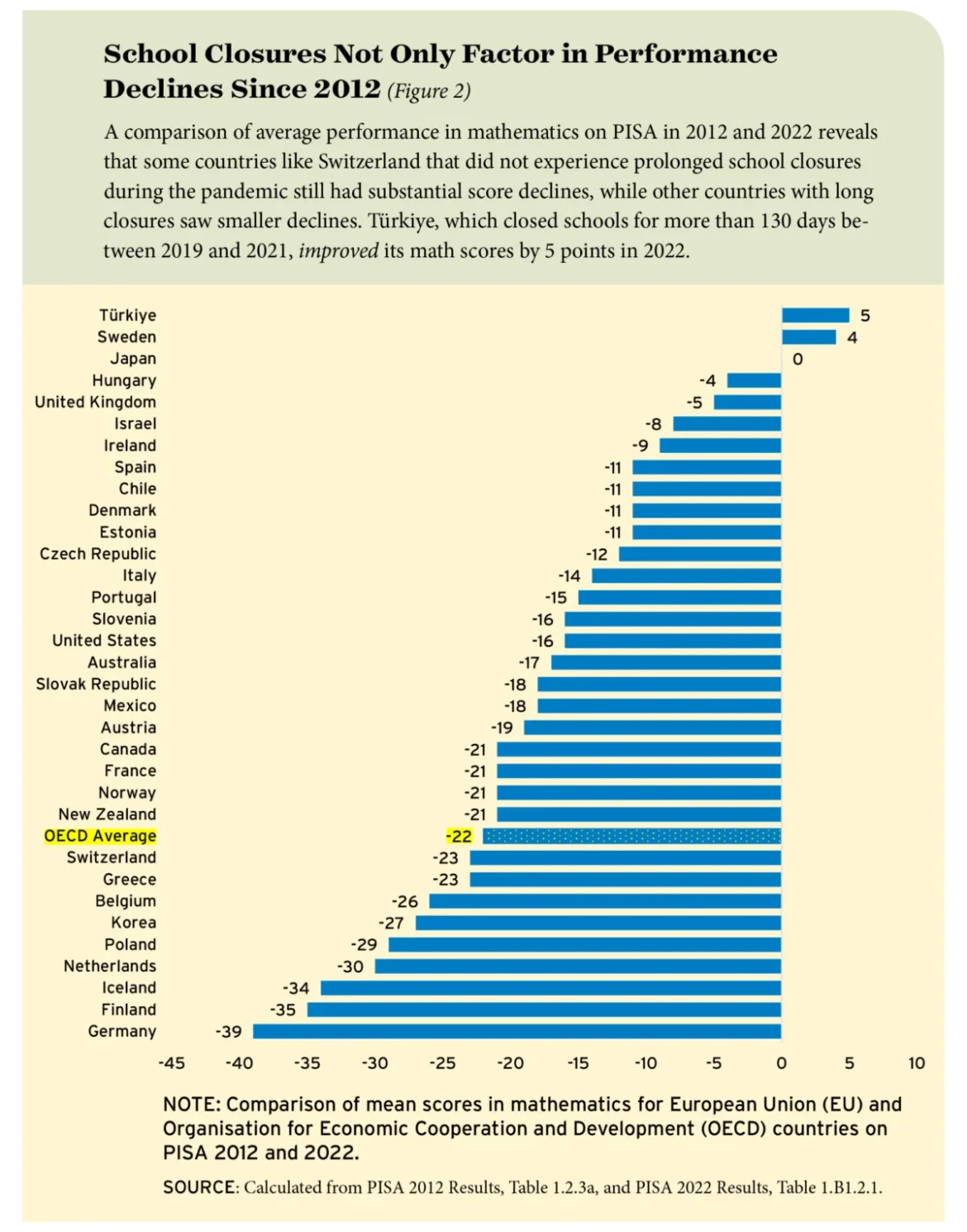
Yet, a closer look at the data reveals that Finland’s downward trajectory began shortly after its initial triumphs. Math performance among Finnish 15-year-olds has been in a steady decline since 2006. Most alarming is the demographic shift within that cohort: the proportion of low-performing students swelled dramatically from just 7 percent in 2000 to a staggering 25 percent by 2022. Between 2012 and 2022 alone, PISA estimates indicate that Finnish students suffered cumulative losses equivalent to an entire school year across all three core subjects.
This deterioration caught policymakers and international analysts flat-footed. At the official launch of the PISA 2022 results, the Finnish Ministry of Education and Culture characterized the downward trend as "extremely disconcerting." Andreas Schleicher, the OECD’s director for education and skills and widely considered the architect of PISA, offered a candid reassessment in an interview with the Financial Times. Schleicher admitted that while observers initially viewed the Finnish model as a universal recipe for success, two decades of data show that it is unclear whether those specific policies formed part of the solution or actively contributed to the problem. Schleicher emphasized a crucial lesson moving forward: student well-being must be achieved not at the expense of academic success, but precisely through it.
Structural Flaws in the Finnish Model
Analysts pointing to the roots of Finland’s decline highlight several compounding structural vulnerabilities. First, the country maintained a rigid "inclusive" model—treating all students identically—even as broader socioeconomic inequalities increased within Finnish society. Second, the system grew heavily reliant on weak accountability mechanisms. Finland largely eschewed national standardized examinations, utilizing them only at the very end of secondary school.
Furthermore, extensive school autonomy was granted to local municipalities and institutions despite mounting evidence that this decentralized approach was producing deteriorating educational outcomes. Compounding these issues was a progressive narrowing of core content knowledge within the curriculum. When the systemic shock of the COVID-19 pandemic arrived, it impacted a structure that was already structurally flimsy, causing student achievement to plummet despite relatively short school closures compared to the rest of Europe.
Portugal: The Rise, Fall, and Distortion of Standards
The dangers of ideological shifts in education policy are similarly visible in Portugal, though with a more volatile timeline. During the mid-2000s, Portugal implemented a series of rigorous structural reforms. These included the introduction of national standardized exams, enhanced professional development and training for teachers, and a renewed emphasis on robust content knowledge within the curriculum. Between 2006 and 2015, these evidence-based measures yielded clear, measurable improvements in student performance on international assessments.
However, the political landscape shifted in 2015 when a conservative government was replaced by a progressive coalition. The new administration systematically reversed the previous reforms. By the time the 2018 PISA results were published, achievement declines were already evident.
The ideological pivot deepened during the pandemic. The Portuguese government implemented measures to limit grade retention strictly to "exceptional circumstances." Standards were relaxed, and student grades were inflated. This combination created a distorted domestic picture of soaring student performance that stood in stark, irreconcilable contradiction to the objective reality captured by international assessments. Consequently, during and immediately after the pandemic, Portugal experienced learning losses in reading and math that were twice as large as those recorded in countries like Ireland and Estonia, nations that had enforced similarly brief school closures.
Spain: Ideological Experimentation and the Paradox of "Leaving No One Behind"
Spain offers one of the most vivid and thoroughly documented case studies of education policies designed under the banner of equity—seeking to "leave no one behind"—that ultimately failed students across the board. Like Finland, Spain closed its schools for fewer than 50 days during the pandemic, yet it suffered the second-largest drop in student performance among nations with similarly brief closures, rivaling countries that kept classrooms shuttered for much longer periods.
Decades Prior to the Pandemic
For decades prior to COVID-19, international surveys consistently showed that student achievement levels in Spain hovered well below the OECD average. The first glimmer of systematic reform appeared around 2015 and 2016 with the implementation of an education reform law known as LOMCE (Ley Orgánica para la Mejora de la Calidad Educativa). LOMCE mandated changes mirroring the successful contemporaneous reforms in Portugal, emphasizing standards and assessment.
However, when the conservative government lost power in 2018, an incoming left-wing coalition promptly dismantled the legislation. This political reversal coincided with a pre-pandemic decline in student outcomes on international tests—a downward trend that accelerated during and after the public health crisis.
Decentralization and the Resistance to Standardization
Spain’s educational governance contains unique structural features that amplified the pandemic’s negative impact. Following its transition to democracy in the late 1970s and 1980s, Spain decentralized its education system, delegating administrative management responsibilities to its 17 autonomous regions. Despite this decentralization—and the fact that academic degrees continue to be officially issued by the national Ministry of Education—no national or regional examinations with common, standardized criteria were established.
LOMCE represented the first serious attempt to implement national standardized testing. The initiative met immediate and fierce resistance from multiple fronts:
- Regional authorities viewed the tests as an infringement on local autonomy and an attempt at recentralization.
- Teachers’ unions fiercely rejected assessments that could theoretically be used to evaluate instructional quality.
- Left-wing political parties argued that standardized testing inherently discriminated against students from disadvantaged socioeconomic backgrounds, who historically scored lower on such metrics.
Despite early data demonstrating measurable improvements in international assessments following the introduction of these tests, political pressure forced the government to scrap the national exams after just two years.
The Pandemic Response: Lowering the Bar
When COVID-19 struck, the central government declared a nationwide state of emergency, temporarily empowering it to issue uniform mandates across all 17 regions. Aligning with progressive ideological tenets, the government framed its educational priorities around "leaving no one behind" and protecting student well-being.
Rather than channeling targeted remedial resources and academic support to struggling students, policymakers chose to lower academic standards for the entire student body. Curricular content was systematically reduced. Policies were enacted allowing students to progress to the next grade level even if they failed specific courses. Crucially, students who failed multiple subjects were still permitted to graduate and obtain national education degrees at the conclusion of both lower secondary education (typically ages 11 to 15) and upper secondary education (ages 16 to 18).
Institutionalizing the Decline
What was originally defended as an emergency, temporary measure to cope with pandemic disruptions was permanently codified into law with the approval of the LOMLOE education reform at the end of 2020. This new legislative framework cemented grade retention as a rare exception. Notably, this change was not driven by successful interventions that ensured all students mastered high academic standards; rather, it permitted students who failed multiple classes—according to the professional judgment of their teachers—to advance automatically and eventually receive official diplomas.
Broader Implications for Global Education
The parallel experiences of Finland, Portugal, and Spain highlight a profound policy lesson regarding contemporary educational reform. Across these diverse nations, well-intentioned efforts to foster inclusivity and student well-being through the systemic dismantling of accountability, the dilution of curriculum content, and the elimination of objective performance markers have yielded disastrous results.
When educational authorities replace academic rigor with grade inflation, automatic promotion, and an aversion to standardized measurement, they do not bridge achievement gaps. Instead, they obscure them, leaving vulnerable students ill-equipped for a competitive global economy. As international organizations and national ministries grapple with post-pandemic academic recovery, the evidence increasingly suggests that genuine educational equity requires maintaining high standards, robust accountability, and a commitment to academic achievement as the true foundation of student well-being.