
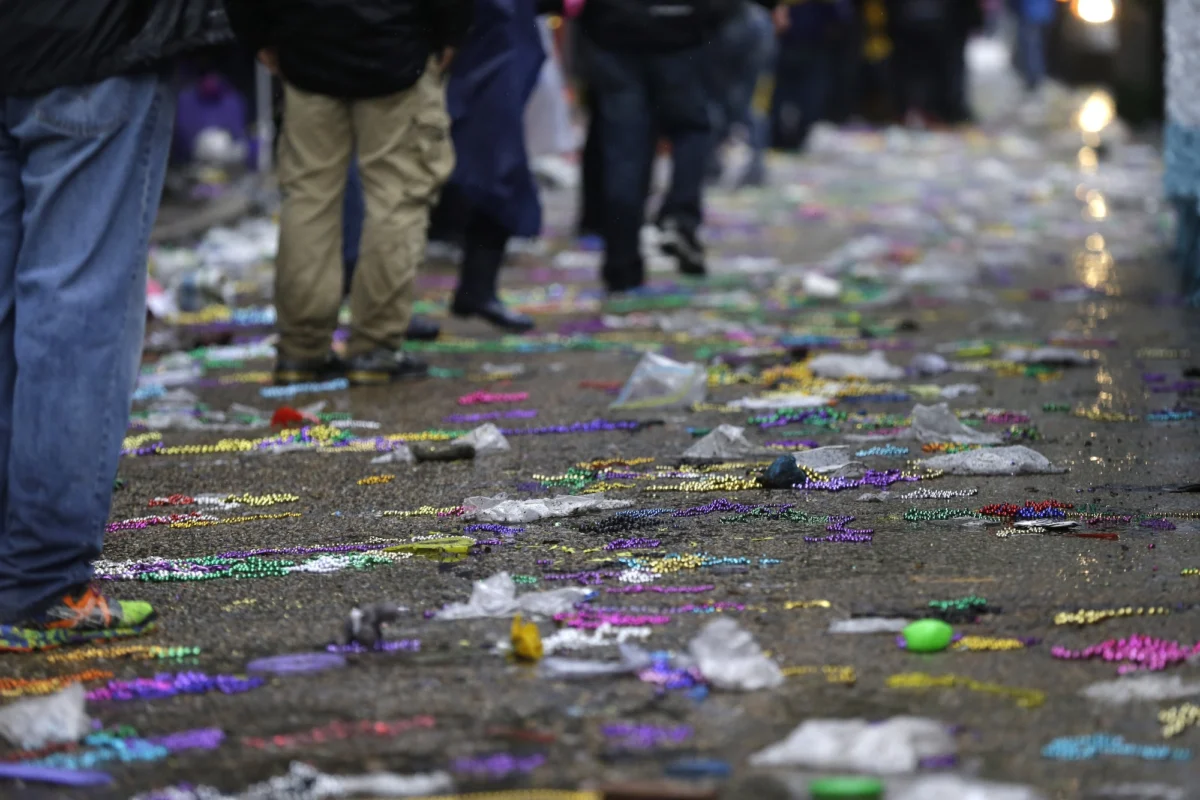
The 2026 Carnival season in New Orleans has concluded with a sobering statistical milestone that has left city officials and environmental advocates grappling with the sustainability of the world-famous celebration. Despite a decade of promises to reform the city’s waste management and drainage protection strategies, the volume of refuse collected from parade routes has surged to an all-time high. During the five-week period spanning January 6 to February 17, municipal cleaning crews removed a staggering 1,363 tons of debris from the streets of New Orleans. This figure represents a 24 percent increase over the previous year and stands as the highest tonnage on record since the city began tracking these metrics.
To put the magnitude of this waste into perspective, the tonnage is equivalent to the weight of approximately 741 mid-sized automobiles. In local terms, the debris matches the weight of the historic Steamboat Natchez or the cumulative mass of more than one million king cakes. The surge in waste comes at a precarious time for the city’s infrastructure, which remains highly vulnerable to flooding exacerbated by the accumulation of plastic and "throws" in the subterranean drainage system.
The Ghost of 2018: A Legacy of Clogged Infrastructure
The current waste crisis is framed by a haunting memory from 2018. During a massive post-Carnival cleaning operation that year, Department of Public Works crews focused on the city’s aging drainage system. Upon opening the catch basins along the historic St. Charles Avenue parade route, workers discovered a subterranean mass of 46 tons of Mardi Gras beads. These plastic necklaces, accumulated over decades, had formed a nearly impermeable barrier, severely restricting the flow of water to the city’s pumping stations.
The discovery prompted a national outcry and led then-Public Works director Dani Galloway to declare that the city "had to do better." In the years following, the city implemented several mitigation strategies, including the installation of "gutter buddies"—temporary filtration screens designed to prevent large items from entering the catch basins. However, the 2026 data suggests that while the drains may be better protected, the sheer volume of surface-level waste is spiraling out of control, threatening the city’s ability to maintain basic sanitation and environmental standards.
Analyzing the 2026 Tonnage Spike: Attendance vs. Consumption
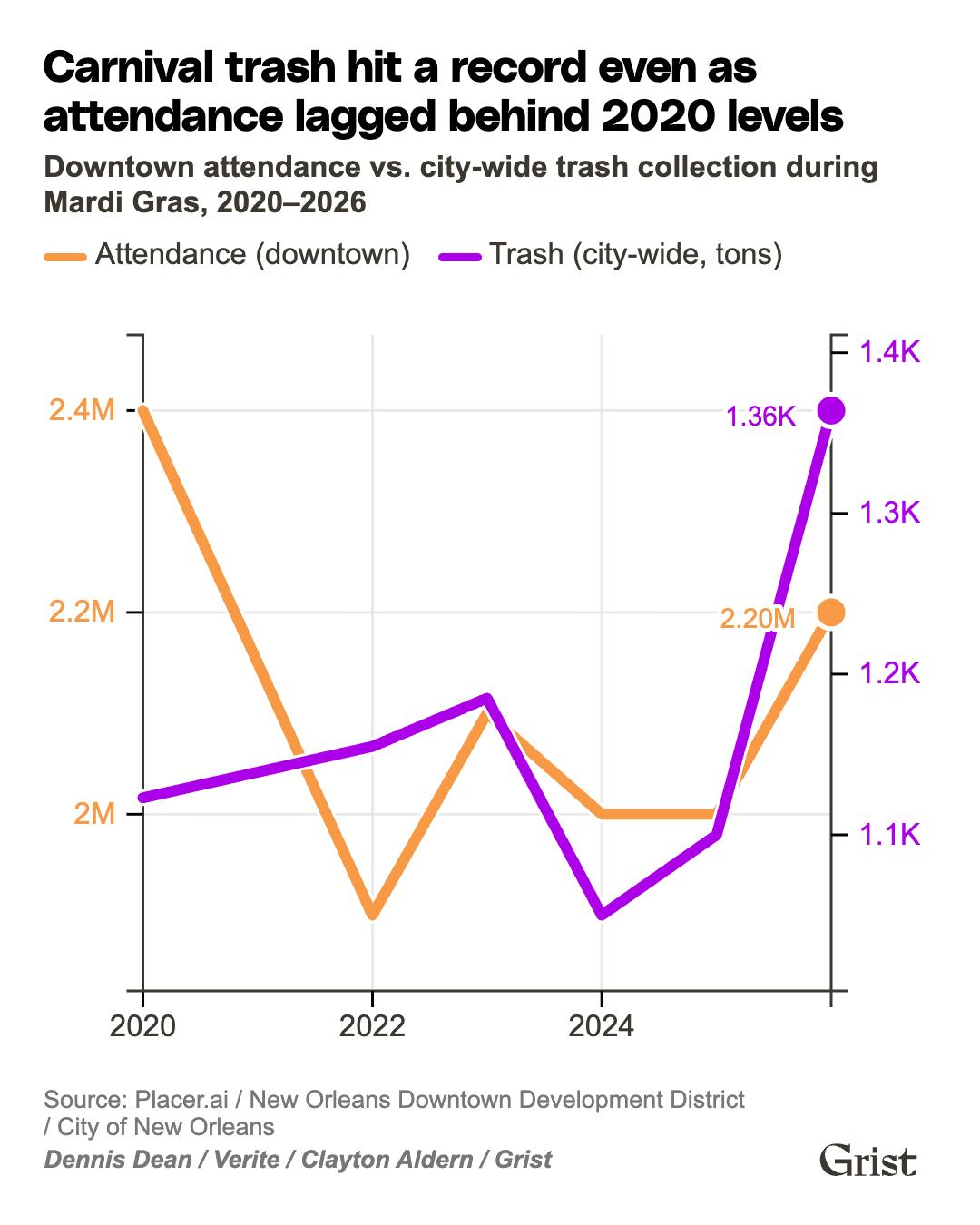
Initial explanations from the New Orleans Department of Sanitation attributed the 2026 trash spike to increased tourism. According to data from the Downtown Development District and location analytics firm Placer.ai, approximately 2.2 million people visited the downtown area during the 2026 Carnival season—a 10 percent increase over 2025. Sanitation Director Matt Torri informed the City Council in March that the increase in rubbish was "directly associated with the larger crowds," suggesting that higher attendance naturally correlates with higher waste.
However, a comprehensive analysis of historical data reveals a more complex and troubling trend. Historical records show that there is no direct, linear relationship between the number of revelers and the amount of trash left behind. For instance, the 2020 Mardi Gras season saw a peak attendance of approximately 2.4 million people, yet it produced 241 fewer tons of garbage than the 2026 season. Throughout the early 2010s, trash levels remained relatively stable at around 880 tons per year. A significant shift occurred in 2017, when the total surpassed 1,320 tons. Since then, excluding the 2021 season which was canceled due to the COVID-19 pandemic, the tonnage has consistently remained above the 1,000-ton threshold, regardless of attendance fluctuations.
This data suggests that the "waste per capita" is increasing. While the number of visitors has remained within a predictable range of 1.9 million to 2.4 million over the last six years, the volume of abandoned items has intensified, pointing to a shift in consumer behavior and a decline in the effectiveness of "leave no trace" initiatives.
The Evolution of the "Throw": From Beads to Abandoned Furniture
For over a century, the tradition of "throws"—items tossed from floats to the crowds—has been central to the Mardi Gras experience. Historically, these included glass beads, coconuts, and doubloons. In the late 20th century, cheap, mass-produced plastic beads became the standard. These items are frequently laden with toxic chemicals, including unsafe levels of lead, bromine, and antimony. Environmental groups have long warned that these beads, when crushed underfoot and washed into the ecosystem, contribute to microplastic pollution in Lake Pontchartrain and the Gulf of Mexico.
In recent years, many parade organizations, or "krewes," have attempted to pivot toward sustainability. High-value, functional throws like socks, baseball caps, wooden spoons, and metal cups have gained popularity. Concurrently, the rising cost of plastic trinkets—driven by global inflation and high tariffs on imports from China—was expected to reduce the sheer quantity of items thrown.
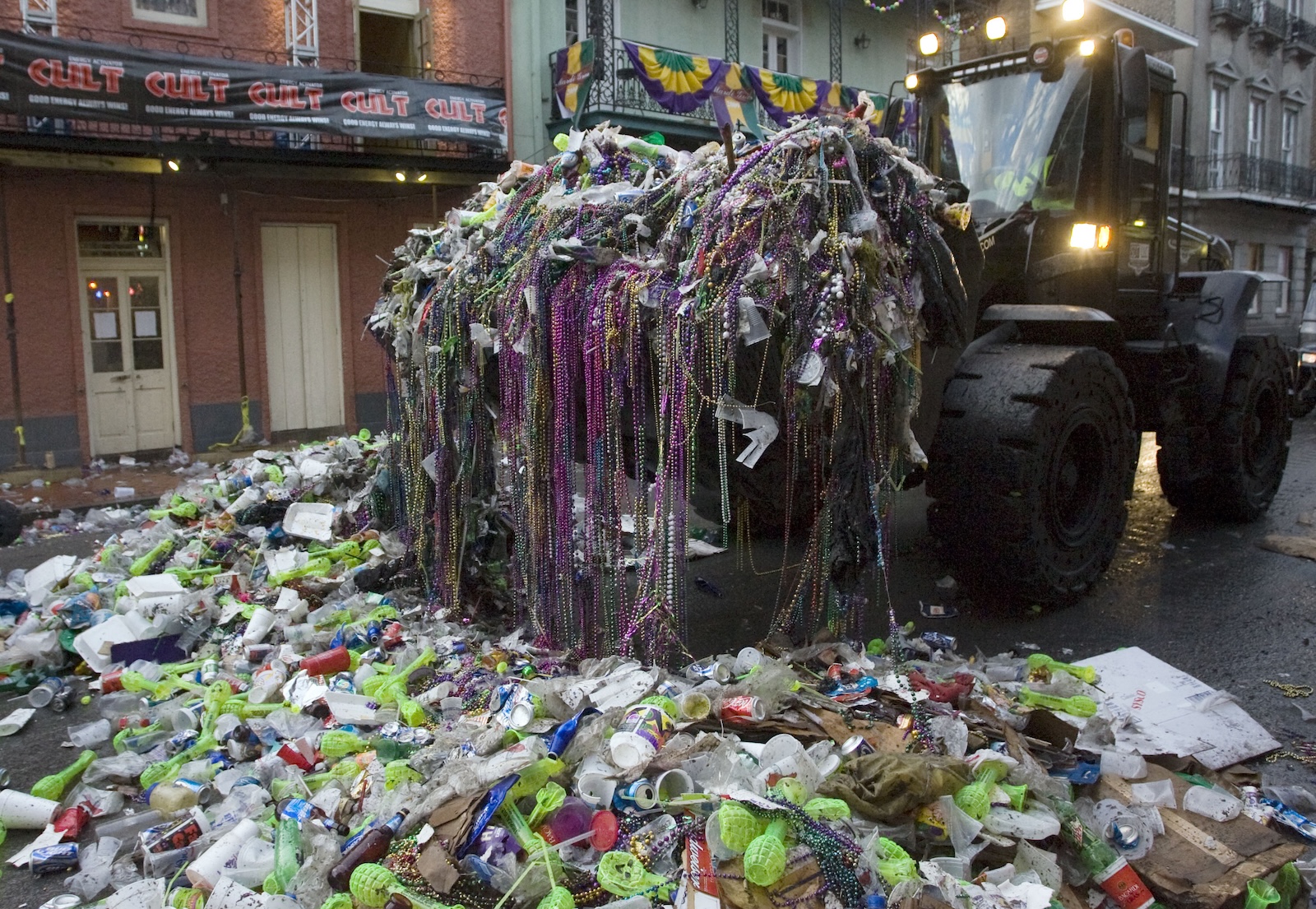
Despite these efforts, the total weight of waste continues to climb. Experts like Brett Davis, founder of the nonprofit Grounds Krewe, suggest the problem has shifted from what is being thrown to what is being brought. The modern parade-goer often arrives equipped with an array of domestic comforts: folding chairs, canopy tents, heavy-duty coolers, grills, and wagonloads of food. In many cases, these items are treated as disposable. As the parades end, broken chairs, grease-covered grills, and even large sofas are frequently abandoned on the "neutral ground"—the grassy medians between city streets.
The Rise of the "Krewe of Chad" and the Enforcement Vacuum
The phenomenon of "territorial" parade-watching has significantly contributed to the waste crisis. Known colloquially as the "Krewe of Chad," this group of revelers is characterized by the early appropriation of public space. Despite city ordinances that prohibit the setup of encampments more than four hours before a parade, many individuals rope off large sections of the sidewalk or neutral ground days in advance.
In 2024 and 2025, the city expanded its list of banned items to include viewing platforms, scaffolding, and large tents. However, enforcement has been hampered by a series of logistical and financial hurdles. The city is currently navigating a $220 million budget deficit, which has led to layoffs and a reduction in municipal services. City Council President JP Morrell noted that while the city attempts to clear these encampments, the efforts are often "spotty" due to a lack of resources.
Furthermore, public safety priorities have shifted. Following a tragic New Year’s Day attack in 2025 that claimed 14 lives on Bourbon Street, the New Orleans Police Department has been forced to prioritize counter-terrorism and crowd control over sanitation enforcement. This has created a vacuum where "Chadders" feel emboldened to leave behind hundreds of pounds of debris, knowing that the city lacks the immediate manpower to seize or fine them for their abandoned property.
Environmental and Economic Implications
The long-term implications of this waste trend are twofold: environmental degradation and economic strain. Environmentally, the failure to contain Carnival waste leads to increased pollution in the region’s waterways. Despite the 28 tons of material diverted by volunteer recycling groups in 2026, the vast majority of the 1,363 tons ended up in landfills or, worse, in the drainage system.
Economically, the cost of the cleanup is a significant burden on a city already facing a fiscal crisis. The sanitation department’s post-Fat Tuesday operation is a Herculean task, requiring crews to work nearly 20 hours straight to clear the streets before the following morning’s commute. The abandonment of heavy items like sofas and refrigerators requires specialized equipment and additional labor, further inflating the cost of the festivities.
"The reality is that people get their use out of this stuff, and then it becomes a tremendous amount of debris that our workers have to deal with," Council President Morrell said. "It goes toward a sense of abject entitlement—that our entire city exists to serve other people’s whims."
The Path Toward a Sustainable Carnival
As New Orleans looks toward future Carnival seasons, the debate over sustainability has reached a critical juncture. Organizations like Grounds Krewe continue to advocate for a "circular" Mardi Gras, where items are caught, kept, and recycled. This year, despite the city withdrawing $200,000 in recycling support due to budget cuts, volunteers managed to collect a record amount of aluminum and glass. However, as Brett Davis points out, recycling alone cannot offset a 24 percent increase in total waste.
The solution likely requires a multi-pronged approach:
- Strict Enforcement of Encampment Rules: Without the consistent removal of abandoned furniture and tents, the culture of "disposable" parade gear is likely to persist.
- Economic Incentives for Sustainable Throws: Encouraging krewes to move away from plastic beads through tax incentives or municipal grants could reduce the toxic load of the waste.
- Infrastructure Investment: Continued upgrades to the drainage system’s filtration technology are essential to prevent the "bead-gate" of 2018 from recurring.
While Mardi Gras remains the economic lifeblood of New Orleans, the 2026 waste figures serve as a stark warning. The tradition of the "Greatest Free Show on Earth" may eventually buckle under the weight of its own refuse unless the city can find a way to balance the revelry of the present with the environmental survival of the future. For now, the streets are clean, but the record-breaking tonnage suggests that the underlying problem is deeper than any catch basin can hold.

