
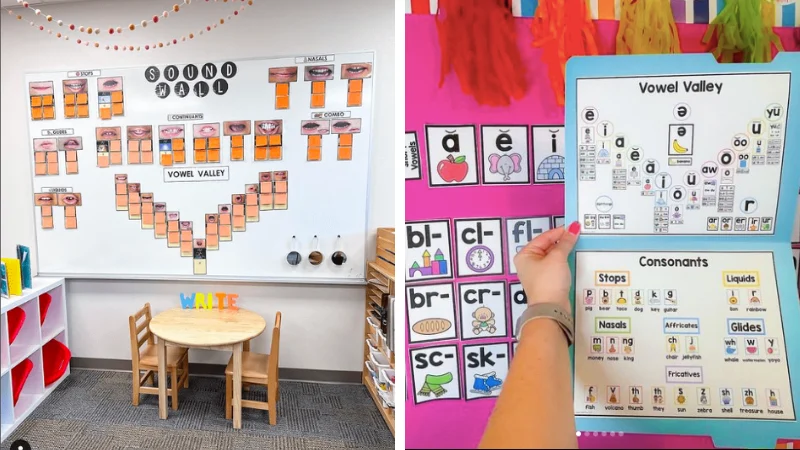
The traditional elementary school classroom has long been defined by the alphabet line—a static, linear display of letters from A to Z. However, a significant shift in pedagogical practice is currently sweeping through K-5 literacy instruction. Educators are increasingly replacing or augmenting these traditional displays with "sound walls," a dynamic, science-based tool designed to map the 44 phonemes of the English language. Central to this transition is the "vowel valley," a specialized component of the sound wall that helps students navigate the complex, often subtle differences between vowel sounds through articulation and visual feedback.
The Science Behind the Shift
The move toward sound walls is deeply rooted in the "Science of Reading," a body of research that emphasizes the importance of explicit, systematic instruction in phonemic awareness and phonics. Unlike traditional word walls, which categorize words by their initial letters, sound walls organize language by speech sounds—phonemes—and their corresponding graphemes, or written representations.
The theoretical foundation for this approach is built upon the work of noted researchers such as Dr. Louisa Moats, whose research into speech-to-print instruction highlights that reading is not a natural process but a learned one that requires the brain to bridge the gap between spoken language and written symbols. Furthermore, Dr. Linnea Ehri’s studies on articulation instruction have demonstrated that when students understand the physical mechanics of speech—how the mouth, tongue, and throat form specific sounds—their reading and spelling performance improves significantly.
Anatomy of a Sound Wall and the Vowel Valley
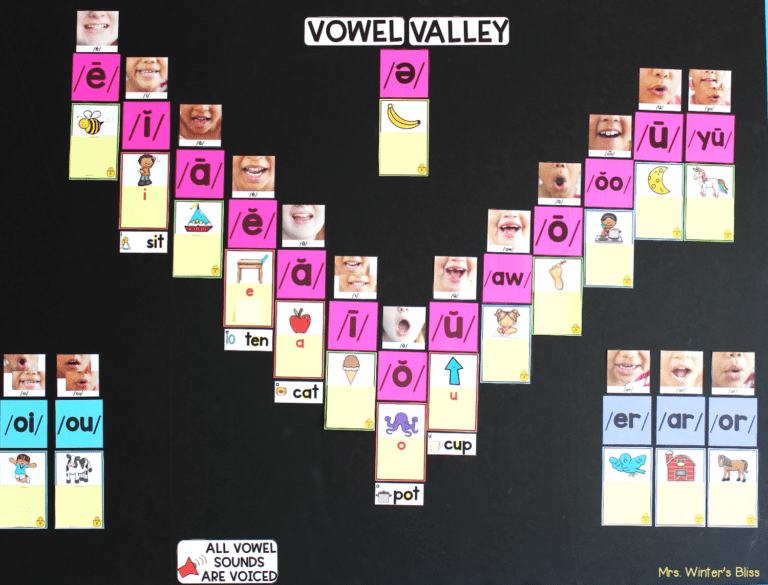
A comprehensive sound wall is divided into two primary domains: the consonant section and the vowel valley. Consonants are typically grouped by "place" and "manner" of articulation—how the sound is blocked or released in the mouth. The vowel valley, conversely, is arranged according to the physical movement of the jaw and tongue.
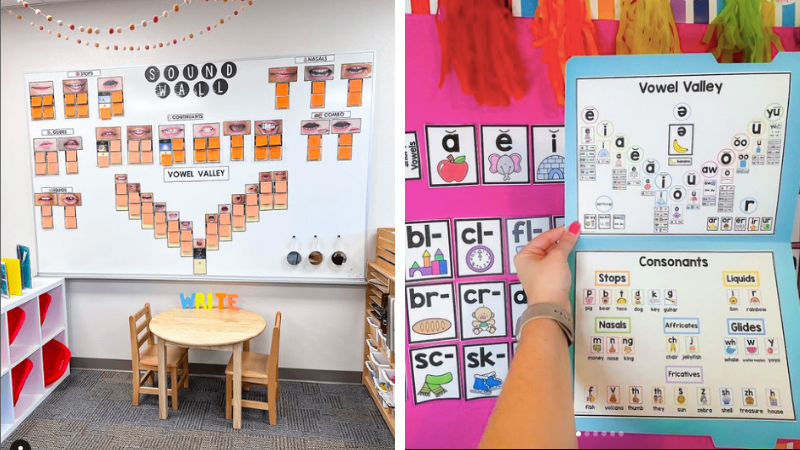
The "valley" shape is not arbitrary. It represents a physical reality: when a speaker articulates vowels from the top of the mouth (like the /i/ sound in "see") to the bottom (the /ah/ sound in "hot") and back up (to the /u/ sound in "boot"), the jaw naturally drops and then rises. By using mirrors, students can observe these physiological changes in real-time, providing a tactile and visual anchor for abstract auditory concepts.
Historical Context and Adoption Timeline
The adoption of sound walls has accelerated rapidly over the last five years, largely in response to declining literacy rates and a nationwide movement to align classroom instruction with cognitive science. While phonics instruction has always been a staple of the American curriculum, the "whole language" or "balanced literacy" approaches that dominated the late 20th century often deemphasized the granular connection between individual phonemes and their spellings.
Around 2018, as states began implementing "Right to Read" legislation, school districts started auditing their curricula. Many found that traditional word walls were failing students who struggled with the irregularities of English orthography. By 2021, professional development resources—led by experts like Melanie Brethour and Rachel Sorsel—began appearing on platforms like Instagram and Teachers Pay Teachers, providing templates for educators to construct their own vowel valleys. Today, this practice is considered a hallmark of evidence-based intervention for both general education classrooms and specialized dyslexia support.
Pedagogical Implementation: A Systematic Approach
Expert educators emphasize that a sound wall is not a static piece of wall art; it is an evolving, functional tool. The most effective implementation occurs incrementally, following a class’s specific phonics scope and sequence.
When a teacher introduces a new phoneme, such as the long "a" sound, they do not simply post a card. Instead, they guide students through a multi-step discovery process:
- Auditory Identification: The teacher says the word, and students isolate the target sound.
- Articulation Awareness: Students use handheld mirrors to observe the position of their lips and tongue.
- Classification: Students identify where the sound belongs in the vowel valley.
- Grapheme Mapping: The class explores the different ways that sound can be spelled (e.g., "a-e," "ai," "ay"), adding these to the display as they are mastered.
This "build-as-you-go" methodology prevents cognitive overload. For kindergarteners, the wall might only contain the most common short and long vowel sounds. By second grade, the wall evolves to include complex patterns such as r-controlled vowels and diphthongs. Some classrooms even use "locks"—small, physical coverings placed over sounds that have not yet been introduced—to create a sense of anticipation and mastery as the curriculum progresses.
The Role of Articulation in Complex Sounds
The vowel valley is particularly useful for teaching the most challenging aspects of English phonics, such as diphthongs, r-controlled vowels, and the schwa.
Diphthongs—sounds that glide from one vowel position to another, like the "oi" in "coin"—are notoriously difficult for young learners to transcribe. By mapping these on the vowel valley, teachers can show students that these sounds are essentially a journey between two points in the mouth.
The schwa—the "lazy" vowel sound that accounts for a vast number of unstressed syllables in English—is perhaps the most important inclusion. Because the schwa is a neutral, central sound, it is placed in the center of the valley. This visual placement helps students understand that almost any vowel letter can represent the schwa, a realization that significantly reduces frustration during spelling exercises.
Impact on Diverse Learner Populations
The efficacy of the sound wall extends beyond the general student population. For students with speech and language disorders, the sound wall acts as a bridge between the speech-language pathologist’s office and the classroom. While a sound wall does not replace clinical therapy, it provides a consistent language for teachers and therapists to discuss sounds, ensuring that students receive reinforced instruction throughout the day.
For multilingual learners (MLLs), the impact is equally profound. English has a significantly larger vowel inventory than many other languages. For example, Spanish utilizes only five primary vowel sounds. A Spanish-speaking student learning English may struggle to differentiate between the "short i" and "long e" sounds because those phonemic boundaries do not exist in their native language. The vowel valley provides a concrete, visual roadmap that helps these students physically perceive the distinctions, reducing the likelihood of common spelling errors and improving pronunciation.
Data and Future Outlook
While longitudinal, peer-reviewed studies specifically isolating the "sound wall" as a standalone variable are still in the early stages, the underlying principles are supported by robust data. Schools that have transitioned to explicit, systematic phonics instruction—the framework within which sound walls exist—have seen measurable improvements in standardized reading scores.
According to data from the National Assessment of Educational Progress (NAEP), the emphasis on decoding skills is critical for bridging the "literacy gap." The sound wall serves as a physical representation of this decoding priority. As schools continue to prioritize "structured literacy," the expectation is that the sound wall will move from being an "innovative" teaching aid to a standard feature of every primary classroom in the United States.
Conclusion: A Tool for Problem Solving
The ultimate success of a vowel valley is measured not by how it looks, but by how it is used. When a student encounters a word they cannot spell, the teacher’s role is no longer to simply provide the correct letters. Instead, they can ask, "What is your mouth doing when you say that word? Where do we see that on the wall?"
This shift transforms the student from a passive recipient of rules into an active linguistic investigator. By turning the classroom into a laboratory of sounds, the vowel valley empowers students to unlock the mechanics of the English language, one phoneme at a time. As the educational community continues to refine its approach to reading instruction, the sound wall stands as a testament to the power of integrating physical, visual, and auditory learning to ensure that all students have the tools they need to succeed.
