
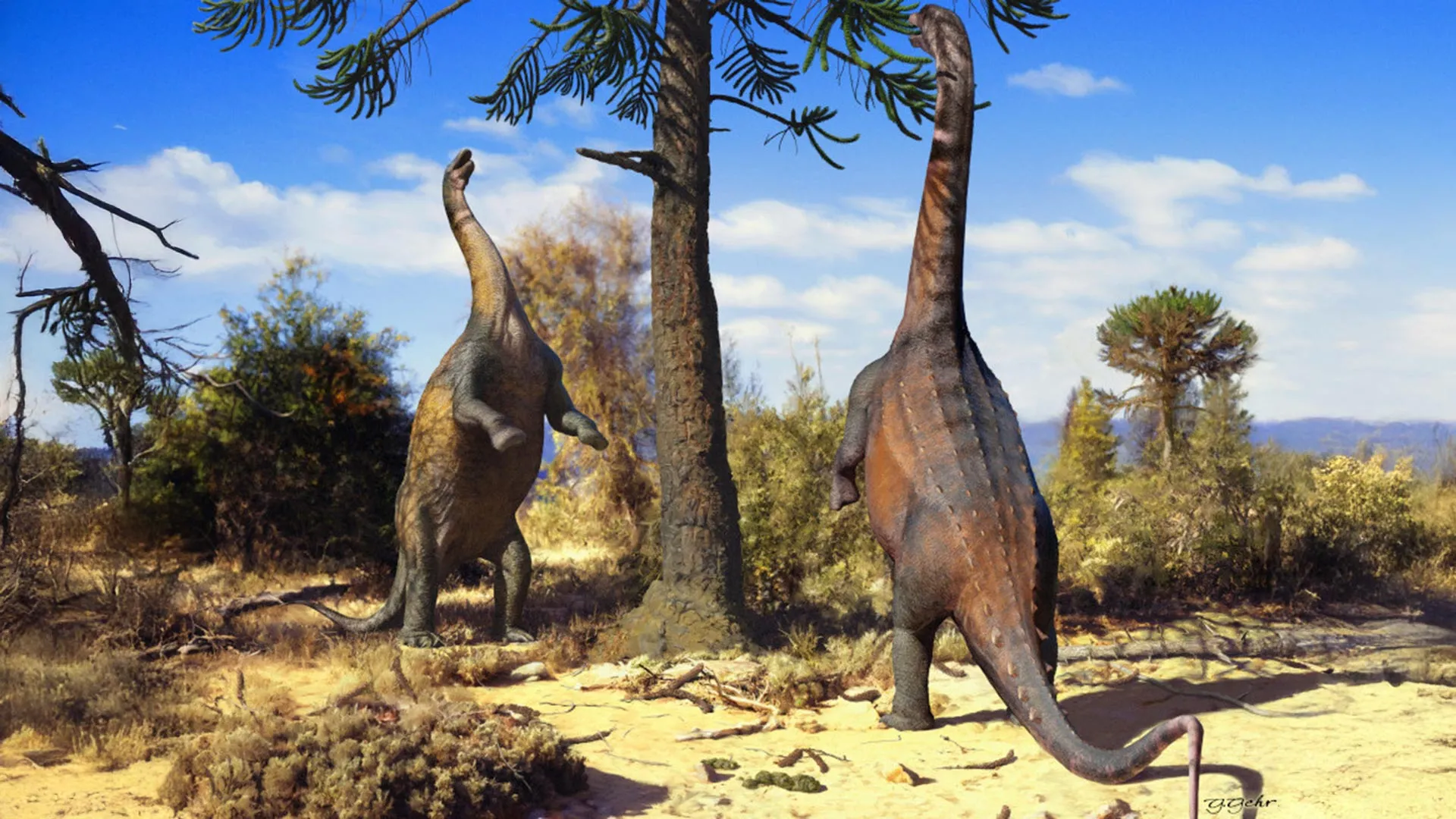
The immense scale of sauropod dinosaurs, with their famously elongated necks and colossal bodies, has long led paleontologists to envision them as perpetually grounded giants. However, groundbreaking new research is challenging this perception, suggesting that some of these long-necked behemoths, particularly those in South America, possessed a remarkable, albeit age-dependent, ability to stand on their hind legs. This newfound understanding, derived from sophisticated engineering simulations applied to fossilized bones, opens a fascinating window into the complex behaviors and survival strategies of these ancient creatures, approximately 66 million years ago during the Late Cretaceous period.
Engineering Insights into Ancient Biomechanics
At the heart of this revelation is the application of finite element analysis (FEA), a computational method typically employed in modern engineering to assess the structural integrity of bridges, buildings, and complex machinery. In this paleontological context, FEA was used to dissect the biomechanical stresses placed upon the femur, or thigh bone, of sauropods when they shifted their considerable weight onto their hind limbs.
The international research team, comprising scientists from Brazil, Germany, and Argentina and supported by the São Paulo Research Foundation (FAPESP), focused their detailed digital reconstructions on the femurs of seven sauropod species. These selections were deliberate, aiming to encompass a diverse range of evolutionary lineages, body sizes, and distinct anatomical features. The digital models were meticulously crafted from fossilized specimens housed in natural history museums across the globe.
The FEA simulations were designed to replicate two critical scenarios: the "extrinsic" scenario, which modeled the forces exerted by gravity and the dinosaur’s own body weight on the femur when standing upright, and the "intrinsic" scenario, which simulated the forces generated by the animal’s muscles acting upon the femur. By combining the data from these two simulations, the researchers could estimate the total stress experienced by the femur in each species under bipedal stance.
South American Giants Showed Superior Bipedal Aptitude
The most striking findings emerged from the analysis of two South American sauropods: Uberabatitan ribeiroi from Brazil and Neuquensaurus australis from Argentina. These species, while modest in size compared to the truly colossal sauropods like Argentinosaurus or Patagotitan, were still comparable in mass to modern elephants. Adult Uberabatitan individuals, in particular, are estimated to have reached lengths of up to 26 meters, making them the largest dinosaurs ever discovered in Brazil.
For these two species, the simulations revealed significantly lower stress levels on their femurs when adopting an upright posture. This suggests they were far more capable of supporting themselves on their hind legs for extended periods. The key to this capability lay in their exceptionally robust femurs. Their thigh bones were thicker and sturdier, designed to effectively distribute the immense forces generated by standing on two legs. This structural advantage would have allowed them to maintain an upright posture with greater ease and for longer durations than many of their larger relatives.
"Smaller sauropods like these had a bone and muscle structure that allowed them to stand more easily and for longer on their two hind legs," explained Julian Silva Júnior, a postdoctoral researcher at the School of Engineering of São Paulo State University (FEIS-UNESP) and the study’s lead author. "Larger ones were probably also able to stand, but for a shorter time and with less comfort, since the position caused a lot of stress on the femur." Silva Júnior conducted this crucial research during an internship at the University of Tübingen in Germany, facilitated by a FAPESP scholarship.
Age and Size Dictated Bipedal Capacity
A critical nuance revealed by the study is the role of age and growth in dictating bipedal capability. The research indicates that the ability of these sauropods to stand upright likely diminished as they matured and their bodies increased in mass. Younger animals, with their relatively lighter frames, were better equipped to balance and support themselves on two legs. As they grew larger, the increasing weight would have placed considerably more strain on their skeletal structure, making prolonged bipedalism a more challenging and potentially uncomfortable endeavor.
This was particularly true for adult Uberabatitan individuals. While the juvenile specimen studied exhibited a high capacity for upright standing, fully grown adults would have carried substantially more weight. This increased mass would have subjected their femurs to stress levels more akin to those experienced by other giant sauropods, even if they retained the physical ability to stand. The implication is that larger sauropods, while perhaps capable of rising onto their hind legs, would have done so for shorter durations and likely only when absolutely necessary due to the inherent discomfort and strain.
Evolutionary Advantages of Standing Tall
The enhanced bipedal capabilities of species like Uberabatitan and Neuquensaurus would have conferred significant evolutionary advantages, contributing to their survival and reproductive success.
-
Foraging for High-Value Vegetation: As herbivores, sauropods relied on plant matter for sustenance. Standing upright would have allowed them to access foliage in the upper reaches of trees, a food source inaccessible to shorter herbivores. This could have been a crucial advantage in environments with dense vegetation or during periods of food scarcity.
-
Defense Against Predators: A taller posture would have made these dinosaurs appear even more imposing and formidable to potential predators. By lifting their heads and forebodies into the air, they could have intimidated attackers, presenting a much larger and more threatening silhouette.
-
Mate Attraction and Reproduction: Bipedalism may have played a role in courtship rituals. Males could have used upright displays to attract females or engage in visual competitions with rivals. In some cases, the upright stance might have been necessary for successful mating.
-
Tripodal Stability: When supported by their hind legs and tail, these sauropods could have achieved a stable tripodal stance. This three-point contact would have provided a solid foundation, allowing them to maintain their balance for extended periods while performing various activities.
Limitations and Future Directions
While the FEA study provides compelling insights, the researchers acknowledge certain limitations in their modeling. The simulations did not account for the cushioning and shock-absorbing properties of cartilage, the flexible tissue found in joints. Cartilage would have played a role in distributing stress and could have enhanced the dinosaurs’ ability to withstand upright postures. Furthermore, the precise contribution of the tail in providing stability during a tripodal stance was not explicitly modeled.
The researchers made a simplifying assumption that cartilage played a similar role across all studied species, as its preservation in fossils is rare. This means the study is more effective for comparative analysis between species rather than providing absolute stress measurements for each individual animal. "The tool we use is very efficient for comparisons, even if the answer isn’t exact for each one," Silva Júnior stated. "By comparing representatives from different lineages, we can get a fairly accurate picture of how these animals behaved millions of years ago."
Despite these limitations, the study represents a significant advancement in our understanding of sauropod biomechanics. The fusion of paleontological evidence with sophisticated engineering tools offers a powerful new paradigm for investigating the physiology and behavior of extinct animals. Future research could expand the number of species analyzed, incorporate more detailed anatomical data, and potentially develop more nuanced models that account for soft tissues and dynamic movements. Such endeavors promise to further refine our picture of these magnificent creatures and their place in the ancient world.
The findings of this study, published in the journal Palaeontology, are a testament to the interdisciplinary nature of modern scientific inquiry, demonstrating how tools and concepts from seemingly disparate fields can converge to unlock long-held mysteries of Earth’s prehistoric past. The image of the lumbering sauropod is now augmented by the possibility of these giants, at least at certain stages of their lives, engaging in a more dynamic and upright existence, a testament to the evolutionary ingenuity of life on Earth.

