
Social-emotional learning, commonly referred to as SEL, has emerged as a fundamental pillar of modern pedagogy, defined as the systematic process through which children and adults acquire and apply the knowledge, skills, and attitudes to develop healthy identities, manage emotions, and achieve personal and collective goals. As educational institutions worldwide grapple with the long-term psychological impacts of global disruptions and the increasing complexity of the digital age, the integration of SEL into daily curricula is no longer viewed as an elective "soft skill" but as a critical requirement for academic success and lifelong well-being. According to insights from Meg Price of the ei experience, the efficacy of SEL lies in its ability to be woven directly into the fabric of every lesson, rather than being treated as a standalone subject. This approach allows students to internalize these skills in real-time, transforming theoretical concepts into positive, actionable habits.
The historical trajectory of SEL reveals a significant evolution in how educators perceive the relationship between emotional health and cognitive performance. While the roots of social and emotional education can be traced back to ancient philosophical traditions, the contemporary framework began to take shape in the late 1960s with the work of Dr. James Comer at the Yale Child Study Center. By 1994, the Collaborative for Academic, Social, and Emotional Learning (CASEL) was established, providing a unified definition and a research-based advocacy platform. Over the last three decades, the movement has transitioned from experimental school-based programs to a mainstream educational standard adopted by thousands of districts globally. The current emphasis on SEL is driven by a growing body of longitudinal data suggesting that students with strong social-emotional foundations are more likely to graduate from high school, secure stable employment, and maintain better mental health throughout adulthood.
The Five Core Strategies for Classroom Integration
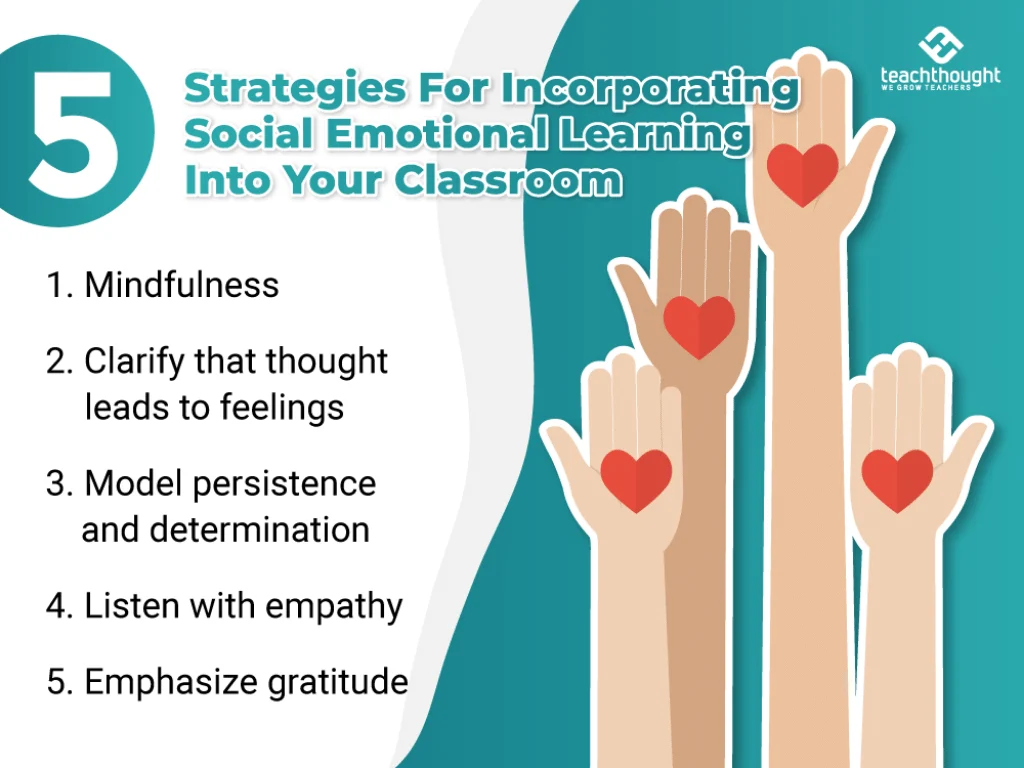
To effectively implement SEL, educators are encouraged to utilize a multi-faceted approach that addresses the internal and interpersonal dynamics of the classroom environment. Research suggests five primary strategies that can be seamlessly integrated into various subjects, from mathematics to humanities.
1. The Implementation of Mindfulness Practices
Mindfulness, defined as the act of paying attention to the present moment with intention and without judgment, has moved from the realm of wellness retreats into the core of the classroom. The integration of mindfulness practices helps students regulate their nervous systems, which is a prerequisite for higher-order learning. When a student is in a state of stress or "fight or flight," the prefrontal cortex—the area of the brain responsible for logic and problem-solving—is effectively offline.
By starting lessons with mindfulness activities, such as focused breathing or sensory awareness exercises, teachers can help students transition into a "ready-to-learn" state. Data from neurological studies indicate that regular mindfulness practice can lead to increased gray matter density in regions of the brain associated with learning, memory, and emotional regulation. In practice, this can be as simple as utilizing free digital resources or meditation apps to facilitate a two-minute grounding exercise at the start of each period.
2. Establishing the Link Between Thoughts and Feelings
A critical component of emotional intelligence is the understanding of cognitive appraisal—the idea that our interpretation of an event, rather than the event itself, dictates our emotional response. This is a sophisticated concept that, when taught early, empowers students to take agency over their internal lives. Resilient students are those who can challenge their own negative thought patterns. For instance, if a student fails a quiz, the thought "I am bad at math" leads to feelings of despair. However, if the thought is reframed to "I haven’t mastered this specific concept yet," the resulting feeling is one of motivated persistence.
Educators can model this by listening for emotional cues in student dialogue. When a student expresses frustration, the teacher can assist them in tracing that emotion back to the underlying thought. This "cognitive coaching" helps students realize that while they cannot always control external circumstances, they possess significant influence over their reactions.
3. Modeling Persistence and Determination
The concept of "grit," popularized by psychologist Angela Duckworth, is intrinsically linked to SEL. Academic achievement is often less about innate talent and more about the ability to persevere through challenges. In an SEL-focused classroom, the process is prioritized over the final product. Teachers can model this by sharing their own stories of professional or personal hurdles and how they overcame them.
Praise plays a pivotal role here; researchers emphasize the importance of "process praise" (praising effort and strategy) over "person praise" (praising intelligence or talent). By setting "stretch goals"—objectives that are just beyond a student’s current reach—teachers can provide a safe environment for students to experience and navigate the discomfort of temporary failure, which is essential for building long-term determination.
4. Fostering Empathetic Listening and Social Connection
Social-emotional learning is not an individual pursuit; it is inherently relational. Developing empathy requires students to move beyond their own perspectives and "listen to be surprised." This involves active listening techniques where the goal is to understand the speaker’s intent and emotion rather than preparing a rebuttal.
In the classroom, this can be facilitated through structured peer-to-peer interactions. For example, when conflicts arise during group work, teachers can guide students to reframe their language. Replacing accusatory "why" questions with collaborative "how" or "what" questions can de-escalate tension. This shift in communication style fosters a harmonious classroom culture where students feel seen and heard, which is a primary driver of student engagement.
5. The Science of Gratitude
Recent psychological research has identified gratitude as one of the most effective tools for increasing subjective well-being. Regular expression of gratitude is linked to lower levels of cortisol (the stress hormone) and higher levels of dopamine and serotonin. In an educational context, gratitude shifts the focus from what is lacking to what is working.
Meg Price suggests incorporating a reflection period at the end of each class. By asking students to identify what they enjoyed, who they appreciated working with, and what they are curious to learn next, teachers can end the session on a positive cognitive note. This practice trains the brain to scan the environment for positives, a habit that significantly reduces the risk of burnout for both students and teachers.
Supporting Data and Economic Impact
The push for SEL is supported by robust economic and academic data. A landmark 2011 meta-analysis of 213 school-based SEL programs involving over 270,000 students found that those who participated in SEL programming saw an 11-percentile point gain in academic achievement compared to those who did not. Furthermore, these students demonstrated significantly improved social behaviors and reduced levels of emotional distress.
From an economic perspective, a study by researchers at Columbia University found that for every dollar invested in SEL programming, there is a return of eleven dollars. This "ROI" is measured through long-term outcomes such as reduced costs for remedial education, lower crime rates, and higher lifetime earnings. These figures have caught the attention of policymakers, leading to increased federal and state funding for SEL initiatives in the United States and abroad.
Official Responses and Implementation Challenges
While the benefits are clear, the implementation of SEL is not without challenges. Some educators express concern over "curriculum squeeze," fearing that time spent on emotional well-being detracts from core academic subjects. However, organizations like the National Education Association (NEA) argue that SEL is the "foundation upon which academic learning is built," noting that a student who cannot manage their emotions cannot effectively engage with complex academic material.
School administrators have also noted that for SEL to be effective, it must be supported by teacher well-being. "Teachers cannot pour from an empty cup," noted one district superintendent during a recent educational summit. "The strategies we teach students—mindfulness, gratitude, and resilience—must also be integrated into the professional lives of our staff to prevent the high rates of attrition we are currently seeing in the profession."
Broader Implications and Future Outlook
The integration of SEL into classrooms has implications that extend far beyond the school gates. The World Economic Forum has identified social and emotional skills—such as empathy, collaboration, and adaptability—as the most critical competencies for the future workforce in an era dominated by artificial intelligence. As technical tasks become increasingly automated, the "human" skills of the SEL framework become the primary value proposition for the next generation of workers.
Furthermore, SEL is being recognized as a tool for equity. By teaching students how to navigate social complexities and build self-efficacy, schools can help level the playing field for students from marginalized backgrounds who may face systemic stressors outside the classroom.
As education continues to evolve, the distinction between "academic" and "social" learning is likely to disappear. The classroom of the future is envisioned as a holistic environment where the development of the mind is inseparable from the development of the heart. By adopting strategies like mindfulness, cognitive reframing, persistence, empathy, and gratitude, educators are not just teaching a lesson; they are equipping students with the essential tools for a flourishing life. In the final analysis, the goal of education is to prepare students for the "test of life," not just a life of tests. Learning, when integrated with social-emotional intelligence, becomes an engaging, joyful, and deeply human endeavor.

