
For decades, the Advanced Placement (AP) program has served as the ultimate benchmark for academic rigor in American high schools. As grade inflation has steadily pushed high school GPAs to record heights, college admissions officers have historically viewed AP exam scores as the last reliable, objective measure of a student’s readiness for university-level work. However, recent data suggests that this "gold standard" is undergoing a significant transformation. The College Board, the nonprofit organization that administers the AP program, has implemented a new scoring methodology that has resulted in a dramatic surge in high scores across its most popular subjects. This shift has sparked a growing debate among educators and admissions experts about whether these gains represent genuine student achievement or a strategic "dumbing down" of standards to maintain market dominance and financial growth.
The Magnitude of the Score Surge
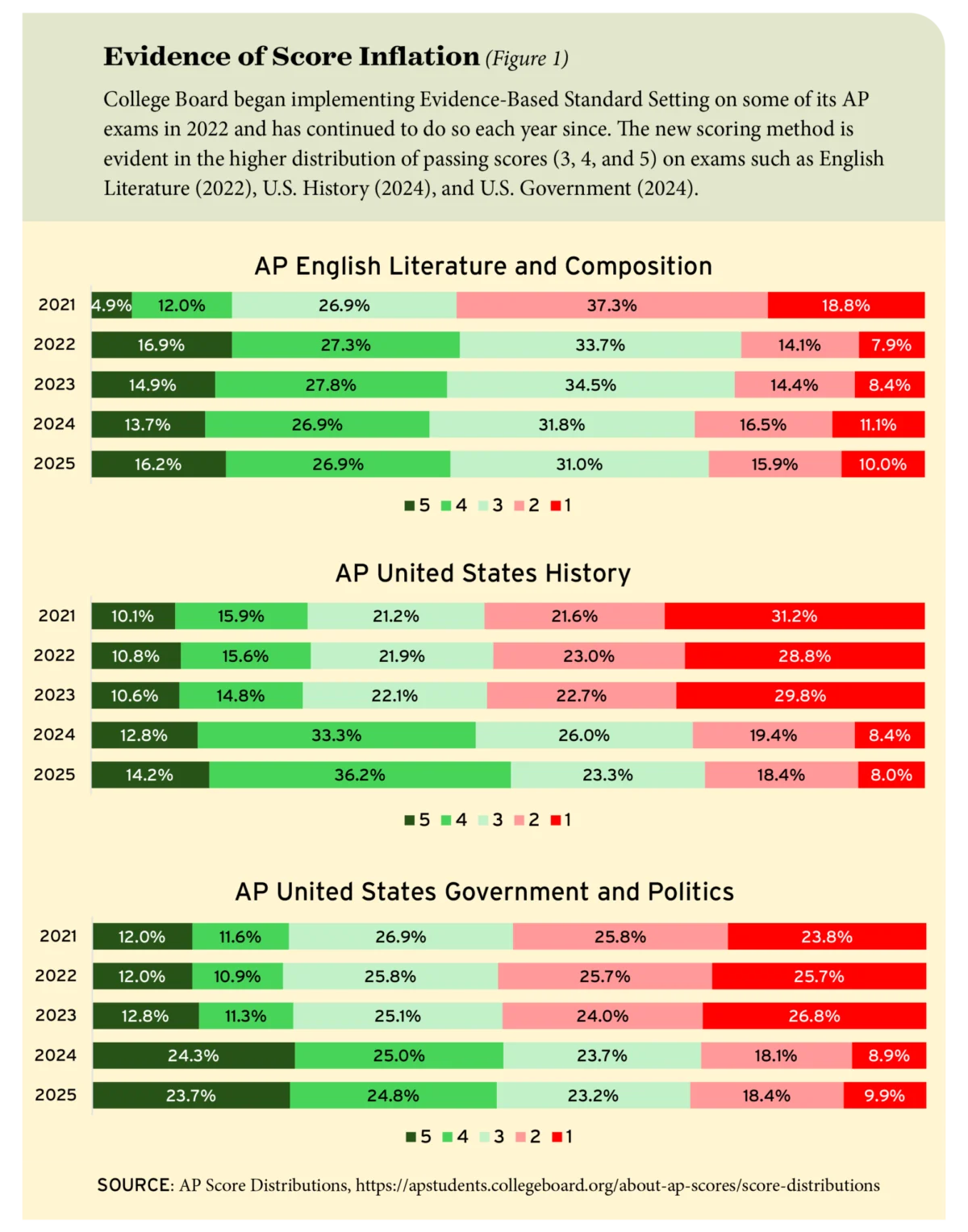
The data regarding recent AP performance reveals a sharp departure from historical norms. Between 2021 and 2025, the College Board phased in a new scoring system for nine of its most frequently taken exams, including high-volume subjects such as AP Biology, AP U.S. History, and AP World History. The results have been nothing short of transformative. According to a detailed analysis of recent score distributions, the percentage of students receiving the top score of 5 on these nine exams has jumped by an average of 61 percent in just four years.
Furthermore, the "pass rate"—defined as students receiving a score of 3 or higher, which is the threshold most colleges use to grant credit—has risen by 37 percent across these same subjects. In 2025, the average passing rate for these nine exams reached 71 percent. This stands in stark contrast to less common AP exams, such as Music Theory, Art History, and Physics (Electricity and Magnetism), which continue to be scored under the traditional system and have not shown similar upward trajectories. The disparity suggests that the "improvement" in student performance is not a universal trend across all academic disciplines, but is instead localized to the subjects where the College Board has altered its grading criteria.
A Chronology of the Methodological Shift
The transition away from traditional grading standards began in earnest following the disruptions of the COVID-19 pandemic. Prior to 2022, the College Board utilized a consistent, expert-driven procedure to set score distributions. This "Expert Judgment" system relied on a small, carefully selected panel of university professors and master teachers who reviewed the exams and determined the raw scores necessary to achieve a 1, 2, 3, 4, or 5. This process was designed to ensure that an AP score represented a stable level of mastery that was comparable to a specific grade in an equivalent college course.
Starting in 2022, the College Board began replacing this model with a new approach called "Evidence-Based Standard Setting" (EBSS). Under EBSS, the College Board significantly expanded the pool of evaluators, consulting hundreds of college instructors rather than a concentrated panel of experts. These instructors were asked to recommend what proportion of students should receive each score. In practice, this broader, more dispersed group has recommended standards that are substantially more lenient than those established by the previous panels. By 2025, this system was fully integrated into the grading of the most popular exams, effectively raising the floor for student success and significantly increasing the frequency of top-tier results.
The Academic Paradox: AP Gains vs. National Declines
The sudden surge in AP scores presents a striking paradox when viewed alongside other indicators of American student achievement. If the 61 percent increase in AP "5s" reflected a genuine leap in student learning, one would expect to see corresponding improvements in other standardized measures. However, the opposite is true.
Data from the National Assessment of Educational Progress (NAEP), often referred to as "The Nation’s Report Card," shows that student proficiency in reading and mathematics has reached its lowest levels in decades. Similarly, the Program for International Student Assessment (PISA) has recorded a steady decline in the performance of American 15-year-olds relative to their international peers. Even the College Board’s own SAT scores, along with ACT results, have shown a downward trend or stagnation over the same period.
This disconnect suggests that the "improvement" in AP results is an artifact of the scoring system rather than a reflection of enhanced teaching or learning. Critics argue that while the test questions themselves may remain difficult, the "cut scores"—the number of correct answers required to earn a 3, 4, or 5—have been lowered to the point that the exams no longer provide a rigorous distinction between average and exceptional students.
Official Responses and the College Board’s Defense
Trevor Packer, the Senior Vice President in charge of AP programs at the College Board, has been the primary defender of the new scoring system. In public statements and written essays, Packer has dismissed claims of score inflation as "entirely false" and "misleading." He maintains that the exams remain as rigorous as ever and that the College Board uses "well-established equating processes" to ensure consistency from year to year.

Packer’s defense rests on a technical distinction: while the difficulty of the questions (the exam "form") may not have changed, the conversion of raw points into scaled scores has been recalibrated. He has acknowledged that the College Board aimed to bring success rates for all exams into a range of 60 to 80 percent, arguing that previous standards were perhaps too punitive. Packer has also pointed to the International Baccalaureate (IB) program as a benchmark, noting that IB success rates hover around 80 percent.
However, educational analysts point out that the comparison to IB is flawed. The IB program is typically a comprehensive, two-year curriculum taken by a highly self-selected group of students who must meet rigorous prerequisites. In contrast, the College Board has spent the last decade aggressively marketing the AP program as an "open-access" initiative, encouraging students of all achievement levels to enroll. To maintain high success rates while simultaneously expanding the program to a broader, less-prepared student population, the only logical lever to pull is the relaxation of scoring standards.
Financial Motivations and Market Competition
To understand the shift in AP scoring, one must also look at the institutional and financial context of the College Board. Despite its status as a nonprofit, the College Board operates with the scale and incentives of a major corporation. In recent years, the organization has reported annual revenues exceeding $1.1 billion, with a significant portion of that income generated by AP exam fees. In 2025 alone, over 1.3 million students paid $99 per exam for a total of more than 4.8 million tests.
The financial stakes are also reflected in the organization’s leadership compensation. Tax filings show that top executives at the College Board, including CEO David Coleman and Trevor Packer, receive annual compensation packages in the seven-figure range, with some exceeding $1.3 million.
Maintaining these revenue streams requires the AP program to remain attractive to students, parents, and school districts. If passing rates were to drop or remain low, the perceived value of the $99 investment would diminish, potentially driving students toward competitors like dual-enrollment programs at local community colleges or the IB program. By ensuring that more than two-thirds of test-takers "succeed," the College Board protects its market share and ensures continued participation from schools that are increasingly judged by their AP "pass rates."
Implications for Higher Education and Admissions
The inflation of AP scores has significant implications for the transition from high school to college. For admissions officers, the utility of the AP score as a "tie-breaker" or a measure of true academic excellence is being eroded. If a "5" is now 61 percent more common than it was four years ago, it no longer carries the same weight in a holistic review process.
Counselors and admissions committees are now being advised to look beyond the raw score and examine the context of the achievement. This includes:
- Subject Differentiation: Recognizing that scores in subjects like Biology or U.S. History may be less indicative of elite performance than scores in Music Theory or Physics C, where traditional standards remain.
- Year-over-Year Comparisons: Noting whether a student’s high scores were achieved before or after the implementation of EBSS in 2022.
- Alignment with Other Data: Checking if a student’s AP scores are supported by their SAT/ACT results and their performance in non-weighted core classes.
For students, the danger of score inflation is the "false sense of security." A student who receives a 4 or 5 on a relaxed AP exam may enter a competitive university believing they have mastered the foundational material, only to find themselves underprepared for the next level of coursework.
Conclusion
The evidence of score inflation in the Advanced Placement program represents a pivotal moment for American education. While the College Board frames the changes as a move toward "precision" and "alignment" with college standards, the data tells a story of a lowered bar during a period of documented academic decline. As the AP program continues to expand, the tension between accessibility and rigor has never been more apparent. For those who rely on AP scores to make high-stakes decisions—from college admissions to the granting of university credit—the "gold standard" now requires a much more critical and nuanced evaluation. Without a return to stable, expert-driven standards, the AP exam risks becoming another victim of the very grade inflation it was designed to counteract.

