
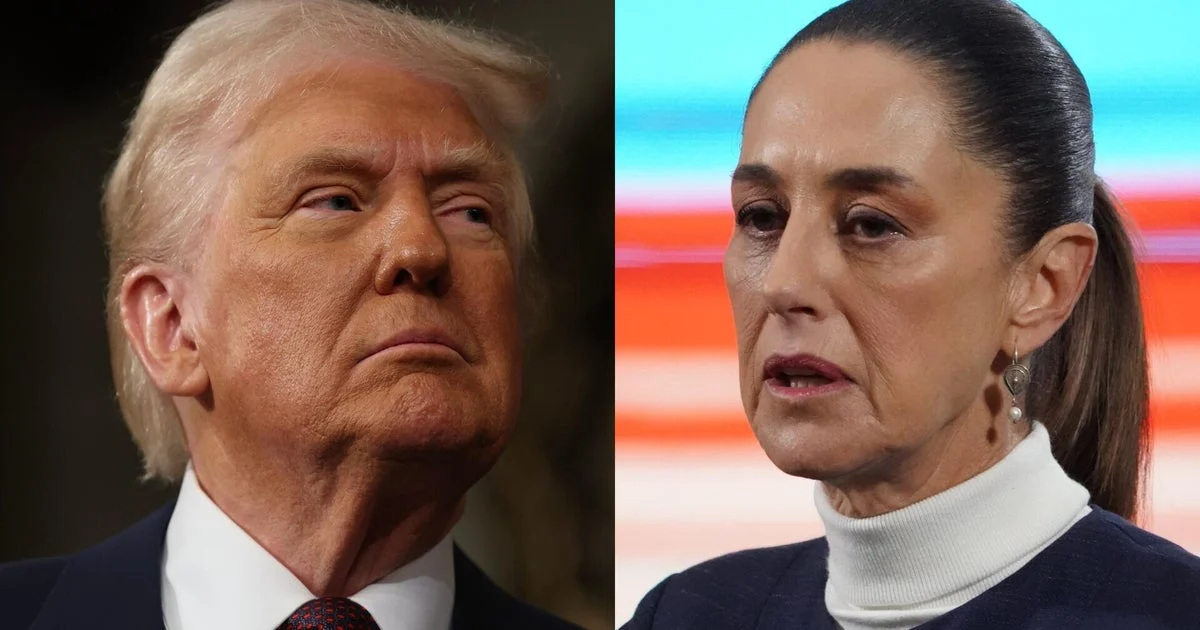
Mexican President Claudia Sheinbaum has confirmed her attendance at Sunday’s FIFA World Cup final in New Jersey, accepting a direct invitation from U.S. President Donald Trump. This upcoming encounter marks their first face-to-face meeting since December 2025, following a period characterized by heightened verbal sparring and significant bilateral tensions across crucial areas such as security and trade. The high-profile sporting event, jointly hosted by the United States, Mexico, and Canada, is set to become an unexpected stage for diplomatic engagement between the North American leaders.
Sheinbaum’s decision to attend the final, where defending champions Argentina will face Spain, carries considerable weight given the recent turbulence in U.S.-Mexico relations. Her presence contrasts with her earlier choice to forgo the World Cup’s opening match in Mexico City, where her national team secured a 2-0 victory against South Africa. On that occasion, President Sheinbaum famously donated her ticket to a young Indigenous woman, a move widely interpreted as a gesture prioritizing domestic focus and grassroots connection over high-level international sporting spectacle. However, the direct invitation from President Trump for the final appears to have shifted her calculus, as she told Mexican media, "I decided to go because it is a direct invitation from the president of the United States. Canadian Prime Minister (Mark) Carney will also be there, and tomorrow I will record a message with more details."
The Diplomatic Stakes: A Meeting Under Scrutiny
The World Cup final, to be held in a yet-to-be-disclosed stadium in New Jersey, is more than just a championship match; it is poised to be a critical, albeit informal, diplomatic rendezvous. The relationship between President Sheinbaum and President Trump has been particularly fraught in recent months. While both leaders have publicly committed to cooperation, their administrations have also engaged in open exchanges of barbs, underscoring deep-seated disagreements. The gathering will also include Canadian Prime Minister Mark Carney, highlighting the trilateral nature of North American affairs and the complexities inherent in their interdependent relationships. Spain’s King Felipe VI is also expected to attend, adding another layer of international gravitas to the event.
The setting itself, a major global sporting event, offers a unique opportunity for leaders to interact outside the rigid confines of formal diplomatic protocol. Such occasions often serve as crucial icebreakers or platforms for informal discussions that can pave the way for more substantive negotiations. The question for observers is whether this high-stakes photo opportunity will genuinely foster a thaw in relations or merely serve as a temporary pause in ongoing disputes.
A Chronology of Mounting Tensions
The period leading up to this World Cup final has been marked by a series of events that have steadily eroded trust and cooperation between Washington and Mexico City. The last direct encounter between Sheinbaum and Trump was at the World Cup draw in December 2025, a relatively ceremonial event. Since then, the diplomatic climate has deteriorated significantly:
-
May 2026: State Department Review of Mexican Consulates: In a striking move, the U.S. State Department announced it was initiating a comprehensive review of all 53 Mexican consulates operating within the United States. This unprecedented action followed the tragic deaths of two Central Intelligence Agency (CIA) officers during an operation in northern Mexico. The incident underscored profound security concerns and raised questions about the level of cooperation and intelligence sharing between the two nations. For decades, security cooperation has been a cornerstone of the bilateral relationship, particularly in combating drug trafficking, organized crime, and border security. The deaths of U.S. personnel in what was likely a sensitive operation sent shockwaves through diplomatic circles, prompting the U.S. to signal its deep dissatisfaction through the consulate review. Such a review is often a precursor to potential diplomatic actions or re-evaluations of existing agreements, indicating a serious breach of confidence.
-
June 2026: USMCA Trade Pact Under Threat: Weeks after the consulate review, President Trump made a significant declaration regarding the United States-Mexico-Canada Agreement (USMCA), the foundational trade pact governing North American commerce. He stated unequivocally that the United States would not extend the agreement until 2042. The USMCA, which replaced NAFTA, is critical for the integrated economies of the three nations, facilitating billions of dollars in trade annually and supporting millions of jobs. Trump’s declaration introduced immense uncertainty into the business landscape, threatening to destabilize supply chains, impact foreign direct investment, and potentially trigger a trade war. The agreement includes a review clause that allows for its extension, and Trump’s refusal to commit to its long-term future signaled a willingness to use economic leverage as a tool in broader diplomatic disputes.
-
July 18, 2026: World Cup Final Invitation: Against this backdrop of escalating tensions, President Trump’s direct invitation to President Sheinbaum for the World Cup final emerges as a pivotal moment. It suggests a recognition, at least on the U.S. side, that despite the public acrimony, direct engagement is necessary.
Security and Trade: Pillars of a Strained Relationship
The two core areas of contention – security and trade – are inextricably linked to the prosperity and stability of both nations.
Security Concerns: The deaths of the two CIA officers in northern Mexico are not isolated incidents but reflect the persistent challenges posed by powerful transnational criminal organizations. Mexico’s northern border regions have long been battlegrounds for cartel violence, and the U.S. has invested heavily in security assistance and intelligence sharing to combat these threats. The State Department’s review of Mexican consulates could imply a belief that these diplomatic outposts might not be adequately supporting U.S. security objectives, or worse, that there are concerns about their operational integrity. Such a move places immense pressure on Mexico to demonstrate robust commitment to security cooperation and to address U.S. concerns regarding the safety of its personnel operating within Mexican territory. For President Sheinbaum, who campaigned on a platform emphasizing social programs and addressing root causes of crime, balancing this approach with direct enforcement and intelligence cooperation with the U.S. is a delicate act.
Trade Disruptions: The USMCA is more than just a trade agreement; it represents the deep economic integration of North America. Industries such as automotive manufacturing, agriculture, and energy rely heavily on the free flow of goods and services across the U.S.-Mexico-Canada border. Trump’s refusal to extend the USMCA until 2042 sends a strong signal that the U.S. is prepared to renegotiate or even withdraw from the agreement if its demands are not met. This could have catastrophic consequences for businesses that have structured their operations around the pact’s provisions, potentially leading to job losses, increased consumer costs, and a significant reshuffling of supply chains. For Mexico, the U.S. remains its largest trading partner, and any instability in the trade relationship directly impacts its economic growth and stability. The specter of trade tariffs or other protectionist measures looms large, further complicating the bilateral agenda.
Sheinbaum’s Domestic and International Balancing Act
President Sheinbaum’s initial decision to give away her opening match ticket was lauded by many of her supporters as a populist move, aligning with her image as a leader focused on the welfare of ordinary Mexicans, particularly marginalized communities. It underscored a potential desire to prioritize domestic issues and project an image of independence from external pressures. Her subsequent decision to attend the final, citing a direct invitation from President Trump and the presence of Prime Minister Carney, suggests a pragmatic recognition of the necessity of engaging with key international partners, especially the United States. Navigating the complex relationship with the U.S., Mexico’s powerful northern neighbor, is arguably the most critical foreign policy challenge for any Mexican president. Sheinbaum must balance the need to assert Mexico’s sovereignty and protect its national interests with the imperative of maintaining a functional and cooperative relationship with its largest economic and security partner.
The Trilateral Dimension: Canada’s Role
The presence of Canadian Prime Minister Mark Carney at the final underscores the trilateral nature of many North American challenges and opportunities. Canada, as the third signatory to the USMCA and a joint host of the World Cup, has a vested interest in the stability of U.S.-Mexico relations. Any significant disruption to the USMCA would also impact Canada’s economy, given the integrated nature of North American supply chains. Carney’s attendance provides a platform for trilateral discussions, potentially allowing Canada to play a mediating role or at least to ensure its own interests are represented amidst the U.S.-Mexico dynamic. The joint hosting of the World Cup itself stands as a symbol of North American unity, an aspiration that contrasts sharply with the political realities unfolding between Washington and Mexico City.
The Grand Spectacle and its Undercurrents
Beyond the political drama, the World Cup final itself promises to be a spectacular event. The match between defending champions Argentina and Spain pits two footballing powerhouses against each other for the coveted trophy. The choice of New Jersey as the venue for the final highlights the global reach and economic significance of the United States in hosting such an event. The demand for tickets has been extraordinary, with the cheapest seats on FIFA’s official site listed at nearly $10,000 by Saturday afternoon, reflecting the immense global interest and the premium placed on witnessing such a historic sporting contest. The gathering of world leaders and royalty, including Spain’s King Felipe VI, further elevates the event’s profile, turning a football match into a truly global spectacle with significant geopolitical undercurrents.
Implications and Future Outlook
The World Cup final meeting between Sheinbaum and Trump is unlikely to resolve the complex issues plaguing U.S.-Mexico relations overnight. However, it offers a crucial opportunity for direct dialogue and a potential reset. The true test of this informal engagement will come just two days after the final, when officials from the U.S. and Mexico are scheduled to meet for another round of bilateral negotiations specifically focused on trade issues. These talks will be critical in determining whether President Trump’s strong rhetoric on the USMCA will translate into concrete policy shifts or if a path to compromise can be found.
For President Sheinbaum, demonstrating her ability to manage this vital relationship while upholding Mexico’s sovereignty will be a key measure of her leadership. For President Trump, engaging with Mexico is essential for managing border security, migration, and economic stability in a region that remains critical to U.S. national interests. The World Cup final, therefore, transcends its sporting context, becoming a focal point for North American diplomacy, where the stakes extend far beyond the pitch. The world will be watching not just the game, but the interactions in the VIP box, hoping for signs of de-escalation and a renewed commitment to cooperation between two indispensable neighbors.

