
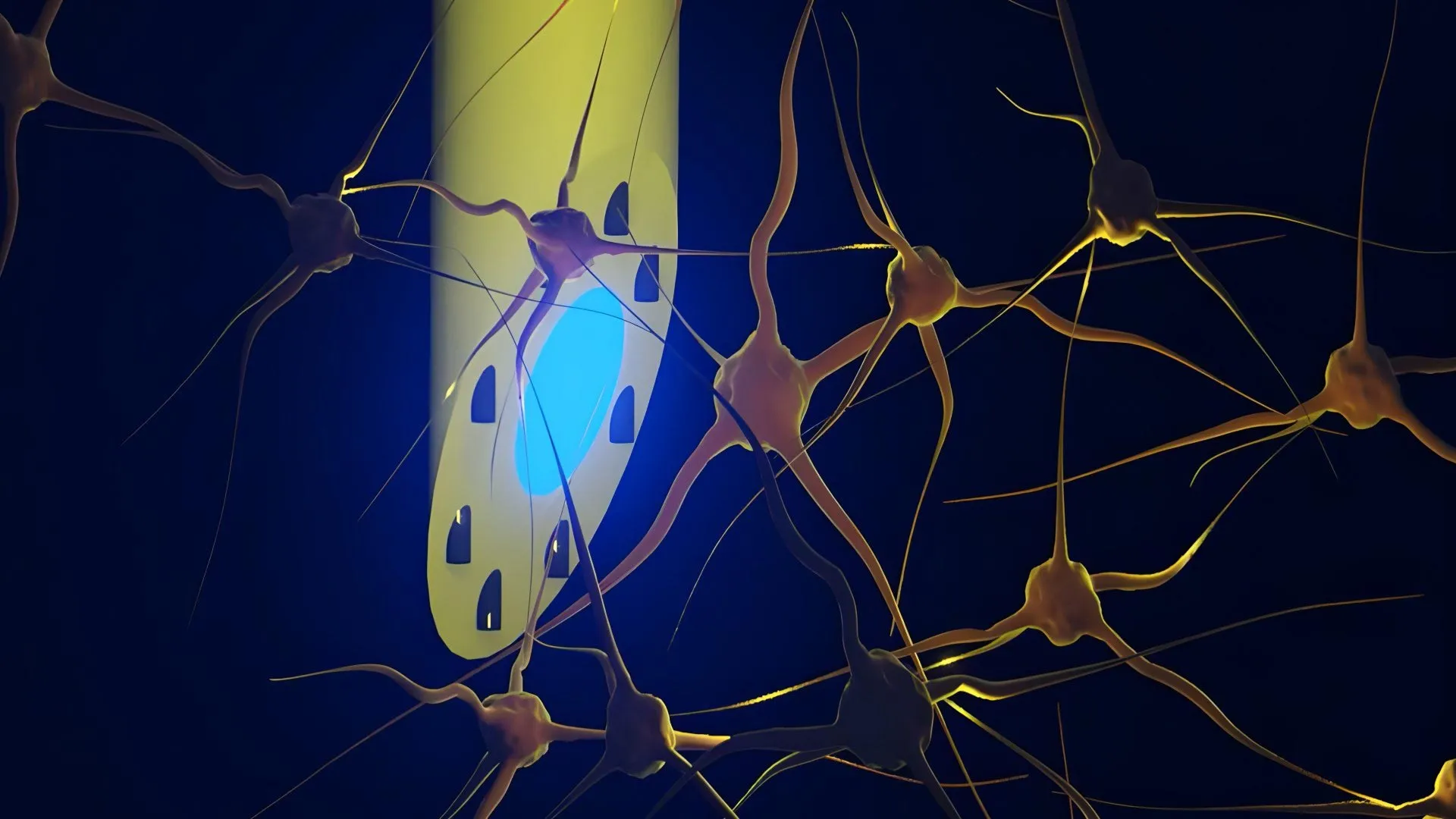
The landscape of neuroscience and neurological medicine may be on the verge of a profound transformation, courtesy of an international consortium of researchers who have engineered a novel brain implant. Published in the peer-reviewed journal Advanced Science, the breakthrough introduces the microfluidic Axialtrode, or mAxialtrode—a needle-thin, highly flexible device capable of simultaneously recording neural activity, delivering precise doses of medication, and applying light or electrical stimulation across multiple depths of the brain. Developed through a collaborative effort involving the Technical University of Denmark (DTU), the University of Copenhagen, and University College London (UCL), among other academic institutions, this multifaceted instrument addresses long-standing limitations in neuroscientific instrumentation. While currently deployed as an advanced research apparatus to study complex neurological dynamics such as those underlying epilepsy, memory formation, and decision-making, the implant’s long-term implications stretch toward clinical translation, offering a glimmer of hope for more targeted treatments of intractable neurological disorders.
Chronology and Collaborative Development of the mAxialtrode
The genesis of the mAxialtrode traces back to an ambitious engineering and biological collaboration aimed at overcoming the mechanical and functional rigidity of traditional neuro-implants. Postdoc Kunyang Sui and Associate Professor Christos Markos of DTU initially conceptualized the device, recognizing that contemporary neuroscience was bottlenecked by tools that could not safely execute multiple modalities—such as fluid delivery, optical stimulation, and electrical recording—along a single, continuous insertion tract.
To bring the concept to fruition, Sui and Markos forged a multidisciplinary partnership with neurophysiologists and clinical researchers, including Associate Professor Rune W. Berg from the University of Copenhagen and Associate Professor Rob C. Wykes from University College London. This fusion of material science and systems neuroscience allowed the team to rapidly transition from theoretical design to physical prototyping. Following initial benchtop validations, the team advanced to in vivo testing using living murine models. These preclinical trials were crucial for demonstrating that the polymer-based implant could function within a biological environment without inciting the acute immune rejection typically provoked by rigid silicon arrays. Building upon the success of these animal trials, the consortium has moved to secure intellectual property rights, initiating patent filings for the core technology while mapping out the arduous regulatory and developmental pathway toward human clinical trials.
Technical Anatomy: Moving Beyond Conventional Optical Fibers
To appreciate the functional leap represented by the mAxialtrode, one must examine the limitations of the technology it aims to supersede. For decades, neuroscientists investigating brain circuitry have relied heavily on flat-ended optical fibers fabricated from glass or hard plastics. These fibers serve as the backbone of optogenetics—a revolutionary technique enabling researchers to genetically target and modulate specific neuronal populations using light.
However, conventional optical fibers suffer from a fundamental topological constraint: their interaction with neural tissue is strictly confined to the distal tip, or the terminal "nose" of the fiber. Consequently, light emission and electrical or chemical sensing occur at a single, isolated focal point. When studying phenomena as intricate as multi-layered cortical processing or deep-brain loop circuits, researchers have historically been forced to implant multiple discrete probes, compounding tissue damage and complicating data interpretation.
The mAxialtrode resolves this spatial dilemma through an ingenious manufacturing process and architectural design. The device begins its lifecycle as a macroscopic polymer rod, which researchers heat and draw into an exceptionally fine strand—a process analogous to pulling delicate spun sugar, albeit executed with micrometric precision. The resulting fiber measures less than half a millimeter in diameter, rivaling the thickness of a human hair.
Embedded within this polymer matrix is a central light-conducting core enveloped by eight microscopic microfluidic channels. These capillaries are capable of transporting minute quantities of liquid medications, neuromodulators, or chemical agents directly to targeted brain strata. Furthermore, these very channels can house ultra-thin metallic micro-wires designed to record electrical potentials from surrounding neurons. Because the entire apparatus is constructed from soft, flexible polymers rather than rigid silicon, it possesses a mechanical compliance that closely mimics soft brain tissue. This flexibility allows the implant to micro-displace synchronously with natural intracranial movements, drastically mitigating the chronic glial scarring and inflammatory responses that have historically plagued long-term neural recording endeavors.
Preclinical Validation in Living Subjects
The empirical validation of the mAxialtrode required rigorous testing within active biological systems. During in vivo experiments conducted alongside the University of Copenhagen and UCL teams, the DTU researchers implanted the microfluidic electrode into the brains of living mice. The implants were subsequently interfaced with external blue and red light sources, electrophysiological recording hardware, and miniature fluid-delivery pumps.
The results confirmed the device’s multi-modal efficacy. The mAxialtrode successfully stimulated targeted nerve cells using dual-wavelength light pulses while simultaneously recording electrical oscillations from both shallow cortical layers and deeper subcortical structures, such as the hippocampus. Most notably, the researchers demonstrated the capability to inject distinct biochemical substances at disparate vertical depths along the same probe, with delivery ports spaced nearly three millimeters apart. Throughout these complex procedures, the mice carried the lightweight, integrated fiber array with no observable behavioral impairments or signs of physical distress, underscoring the device’s biocompatibility and ergonomic design.
Supporting Data and Industry Context
The development of the mAxialtrode arrives at a critical juncture in neuroengineering. According to market data from the global neurotechnology sector, the brain-computer interface and neural implant market is projected to expand significantly over the next decade, driven by an aging global population and an rising prevalence of neurodegenerative and neuropsychiatric disorders. Epilepsy alone affects an estimated 50 million people worldwide, according to World Health Organization (WHO) statistics, with approximately one-third of patients failing to achieve seizure control through pharmacological interventions alone.
Traditional deep brain stimulation (DBS) systems have proven effective for a subset of drug-resistant epilepsy and Parkinson’s disease patients, yet current DBS hardware relies on bulky metallic electrodes that deliver broad electrical currents. These legacy systems lack the capacity for localized chemical drug delivery or multi-depth optical control. By consolidating fluidic, optical, and electrical channels into a sub-millimeter polymer footprint, the mAxialtrode addresses a major translational gap in neuro-therapeutics: the need for closed-loop systems that can monitor pathology and administer localized chemical interventions precisely where and when they are required.
Official Perspectives and Expert Analysis
Speaking on the broader implications of the research, the development team has emphasized both the immediate utility of the device for fundamental science and the distant horizon of clinical application.
"Most current brain implants are based on hard materials such as silicon, which can irritate the brain and trigger inflammatory reactions in the tissue," explained Kunyang Sui during an overview of the structural design. "The new implant differs in that it is made of soft, plastic-like optical fibers and has a specially angled tip that makes it smaller and reduces the damage caused when it is placed in the brain."
Sui and his co-investigators are quick to temper public expectations regarding immediate medical availability. The transition from murine models to human neurosurgery involves navigating a stringent regulatory landscape. Comprehensive biocompatibility profiling, long-term chronic safety studies in larger animal models, and exhaustive clinical trials must precede any commercial or therapeutic deployment.
Nevertheless, independent neuroscience analysts note that the architectural versatility of the mAxialtrode could accelerate basic research into the pathophysiology of network-level disorders. By permitting researchers to observe how electrical signals propagate through distinct cerebral laminae while concurrently manipulating those circuits via localized pharmacology or optogenetics, the device provides an unprecedented window into the working mammalian brain.
Broader Implications and Future Outlook
The implications of the mAxialtrode extend far beyond academic laboratories, pointing toward a paradigm shift in how neuroscientists conceptualize brain-machine interfaces. If subsequent translational phases prove successful, future iterations of the implant could serve as the foundation for autonomous, closed-loop therapeutic devices. Imagine an apparatus capable of detecting the aberrant electrical signatures preceding an epileptic seizure, immediately suppressing the abnormal neural firing via localized optical stimulation, and, if necessary, releasing an anticonvulsant medication directly into the affected focal zone—all through a single, flexible filament that causes negligible tissue disruption.
As the research consortium proceeds with patent protection and lays the groundwork for clinical-grade manufacturing, the scientific community awaits further peer-reviewed data regarding the device’s chronic implantation durability. While clinical availability remains years away, the mAxialtrode stands as a remarkable convergence of advanced polymer engineering, optics, and neurophysiology—signaling a future where invasive brain research and treatment are markedly more precise, less destructive, and infinitely more capable.

