
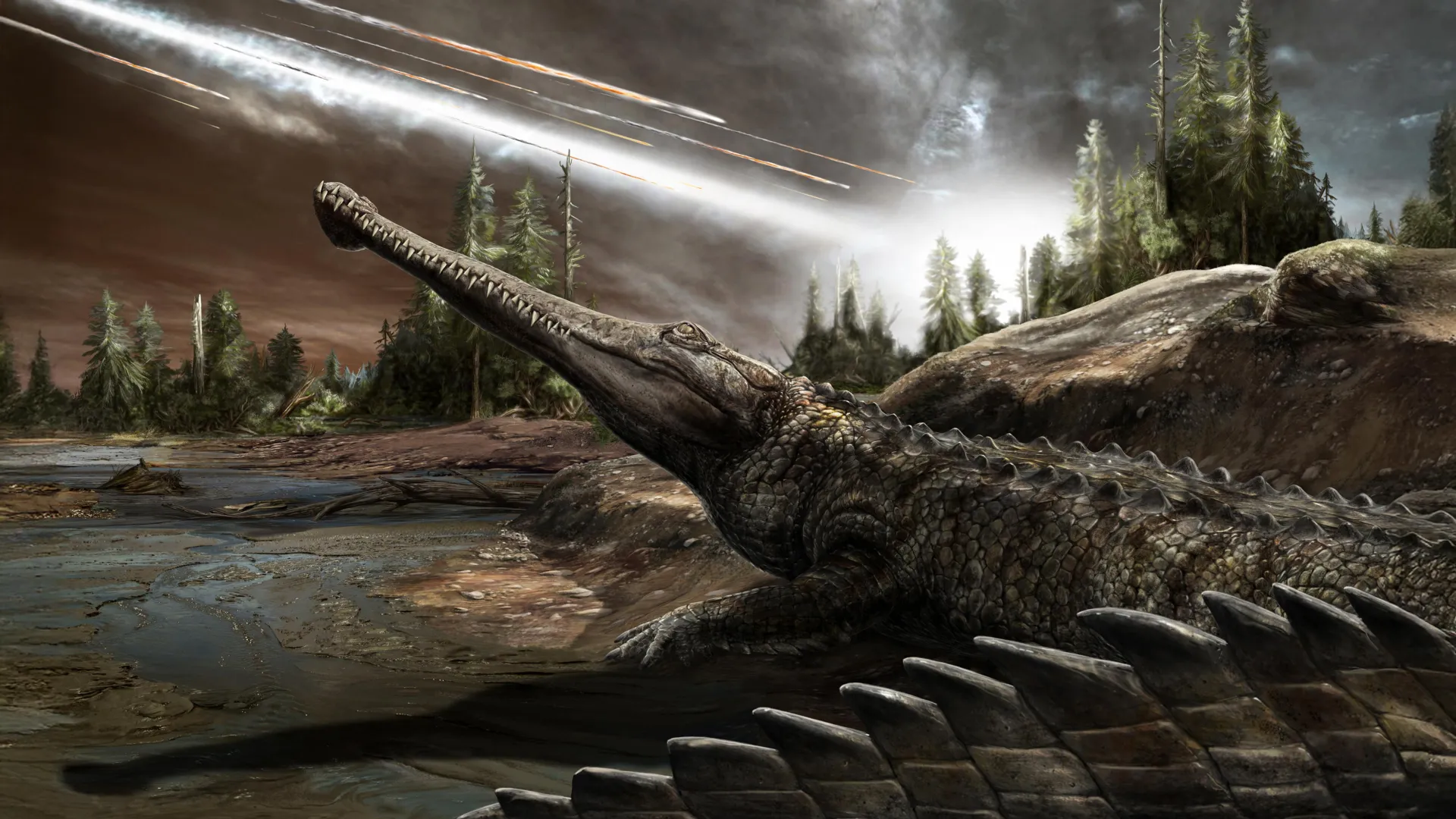
The dramatic extinction event that occurred 66 million years ago, triggered by the Chicxulub asteroid impact, serves as one of the most significant biological filters in Earth’s history. While the non-avian dinosaurs—the dominant terrestrial vertebrates of the Mesozoic Era—were wiped out, the ancestors of modern crocodiles managed to persist. New research led by scientists at University College London (UCL) indicates that this survival was not merely a matter of chance. Instead, it was the result of a 250-million-year-old evolutionary strategy centered on thermal stability and a rigid adherence to specific climatic niches. By tracking the movement of these reptiles across geological time, researchers have identified that their preference for warm, tropical environments provided a critical buffer against the catastrophic environmental collapse that followed the asteroid strike.
The Chronology of an Evolutionary Survivor
To understand how crocodiles navigated the K-Pg (Cretaceous-Paleogene) extinction, one must first look at their expansive history. The lineage, known as Pseudosuchia, diverged from the ancestors of dinosaurs during the Triassic Period, roughly 250 million years ago. Throughout the subsequent eons, while dinosaurs were evolving into diverse forms—ranging from the bus-sized predators of the Jurassic to the specialized herbivores of the Cretaceous—the crocodile lineage was undergoing its own remarkable radiation.
The study, published in Science Advances, synthesized data from over 7,000 fossil records spanning 400 species. This immense dataset allowed researchers to reconstruct the environmental preferences of these animals over a quarter-billion years. The chronology reveals a consistent pattern: when the Earth entered warm cycles, crocodile relatives expanded their geographic range significantly. During the early Eocene, approximately 50 million years ago, global temperatures were roughly 10°C higher than contemporary levels. In this greenhouse climate, these reptiles were found in high-latitude regions, including the polar reaches of North America, Europe, and even Antarctica.
Conversely, when the planet cooled, their range contracted toward the equator. This "thermal tracking" behavior became the defining feature of their evolutionary history. By remaining within a narrow temperature band, they ensured their metabolic and reproductive success, a strategy that remained remarkably consistent despite the extreme morphological diversity that characterized the group—from the 12-meter-long Sarcosuchus to the agile, terrestrial Postosuchus.
The Chicxulub Impact: A Climate Stress Test
The asteroid impact of 66 million years ago introduced a "nuclear winter" scenario. The resulting dust, ash, and soot injected into the stratosphere blocked significant portions of solar radiation, causing a rapid decline in global temperatures and disrupting primary productivity. For the non-avian dinosaurs, which had evolved to occupy a vast array of ecological niches, this contraction of suitable habitat proved fatal.
The UCL research team employed advanced climate modeling to simulate the post-impact environment. By mapping the temperature requirements of ancient crocodilians against these simulated conditions, the study demonstrates that the equatorial belt acted as a global life-raft. While the rest of the planet saw temperatures plummet beyond the tolerance of these ectothermic organisms, the tropics remained relatively stable.
The models suggest that even with a 5% to 10% reduction in sunlight, the regions near the equator maintained a climate that allowed these reptiles to persist. This indicates that the asteroid impact did not create a uniform "kill zone." Instead, it created a geographical lottery where the winners were those already situated in the most stable climates. The ancestors of crocodiles were effectively "pre-adapted" for the aftermath of the impact by virtue of their long-standing tropical fidelity.
Supporting Evidence and Metabolic Advantages
While climate preference was the primary driver of survival, it was likely bolstered by the physiological traits inherent to the crocodilian lineage. As ectotherms, crocodiles possess a low-energy metabolism compared to the high-energy, active lifestyles typical of many dinosaurs. Their ability to go long periods without food and their capacity to utilize both aquatic and terrestrial environments provided a buffer that high-energy predators simply did not have.
The researchers note that this "slow-burn" lifestyle allowed them to survive the initial shock of the extinction event and the subsequent ecosystem instability. Unlike their dinosaur contemporaries, who often required vast amounts of biomass to support their metabolic needs, the ancestors of crocodiles were well-equipped to wait out the periods of ecological famine that followed the K-Pg event.
Scientific Analysis: Exceptions to the Rule
The study also highlights that the crocodile lineage was not entirely static. The researchers identified two critical deviations from their typical thermal behavior. The first occurred 94 million years ago during the Cretaceous Thermal Maximum, where a specific branch of the family tree adapted to extreme heat that would have been lethal to their ancestors. The second occurred 34 million years ago in Australia, where a lineage adapted to arid, desert-like conditions during a period of continent-wide cooling and drying.
These exceptions demonstrate that while the lineage favored warmth, they were not biologically incapable of evolutionary innovation. However, these adaptations were rare. The overarching trend remained a conservative adherence to warm, stable climates. This makes the group a unique case study in evolutionary biology—a lineage that combined high morphological plasticity (diverse body shapes) with high climatic conservatism (stable environmental requirements).
Implications for Modern Climate Change
The findings carry significant weight for modern conservation biology. For millions of years, the survival of the crocodile lineage depended on their ability to migrate in response to changing temperatures. If the climate became too hot or too cold, they simply relocated to more favorable latitudes.
However, the modern era presents a fundamental challenge to this strategy. Dr. Alfio Alessandro Chiarenza, the lead author of the study, notes that the pathways for such migration are now largely obstructed. "If crocodiles mostly coped with past climate change by moving towards suitable habitats, today’s species will need room to move as the planet warms," he stated. The expansion of urban environments, intensive agricultural development, and the construction of transport infrastructure have created fragmented landscapes.
This creates a "trap" for modern species. As global temperatures rise, the habitats that would have historically been the next frontier for these animals are now occupied by human activity. The survival strategy that allowed crocodiles to weather the asteroid impact is being rendered ineffective by the rapid pace of anthropogenic land-use change.
Conclusion and Future Outlook
The story of the crocodile is not merely a tale of a "living fossil" that happened to survive the end of the Cretaceous. It is a nuanced record of a biological lineage that successfully navigated the most volatile periods in Earth’s history by maintaining a precise, if narrow, ecological niche. The research underscores that survival during mass extinction is as much about location and climate affinity as it is about the raw fitness of the species.
As the scientific community continues to refine these climate models, the case of the crocodile serves as a stark reminder of the limitations of evolutionary adaptation in a changing world. While they survived the asteroid, the current, rapid alteration of the Earth’s surface—combined with a warming climate—presents a challenge that may prove more difficult to overcome than the aftermath of a cosmic collision. The legacy of the crocodiles remains a testament to the power of thermal stability, but their future now rests on the capacity of modern society to provide the spatial connectivity necessary for such ancient survivors to continue their journey through time.

