
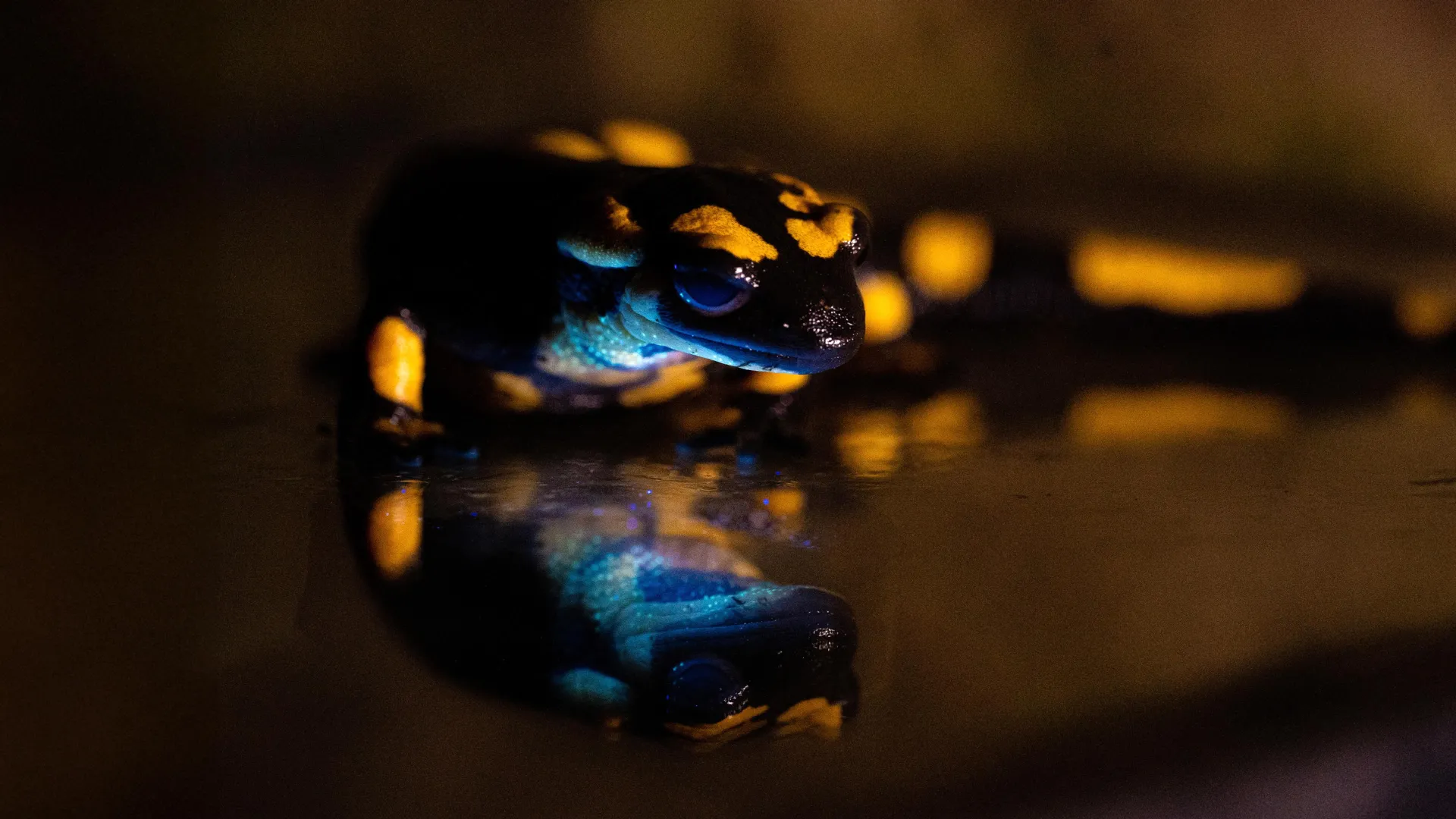
The fire salamander (Salamandra salamandra), an iconic amphibian recognized across Europe for its striking high-contrast black and yellow skin, has long been a subject of intense scientific inquiry. Known for its potent chemical defenses—specifically the secretion of toxic steroidal alkaloids known as samandarines—the species has traditionally been studied through the lenses of toxicology and behavioral ecology. However, recent breakthroughs in biological imaging have unveiled a previously hidden dimension of their physiology: the ability to glow under ultraviolet (UV) light. This phenomenon, known as biofluorescence, has opened a new chapter in the study of amphibian biology, challenging long-held assumptions about the visual ecology of terrestrial vertebrates.
The discovery, led by a collaborative team of researchers from the Museum of Natural Sciences in Barcelona, the Max Planck Institute for Chemical Ecology, the Institute of Subtropical Biology, and the Catalan Society of Herpetology, suggests that the "vulnerable" status of the fire salamander on the IUCN Red List makes understanding every facet of its biology more urgent than ever. As habitat fragmentation and environmental degradation continue to squeeze populations, this new knowledge of their interaction with light may provide critical insights into their survival mechanisms.
A Chronology of Discovery and the Shift in Perspective
For over a century, the fire salamander was viewed as a creature defined by its warning colors—a textbook example of aposematism. Scientists have understood since the late 19th century that their vivid patterns serve as a visual signal to predators that the animal is toxic. However, the scientific community’s perception of fluorescence in terrestrial animals remained stagnant for decades. Until relatively recently, biofluorescence was considered a trait almost exclusively reserved for marine life, such as coral and certain jellyfish, with the notable exception of scorpions.
The shift began in the early 21st century as researchers started applying UV-imaging technology to a wider array of terrestrial species. The study of the fire salamander followed this trend, moving from anecdotal observation to rigorous empirical testing. In recent years, researchers began documenting fluorescent properties in birds, reptiles, and amphibians, systematically dismantling the idea that this trait was limited to aquatic environments. The current findings represent the culmination of these advancements, where researchers utilized specialized UV lighting to observe that the salamanders’ yellow markings and skin secretions emit a vivid green and cyan glow.
Crucially, the study found that these secretions remain fluorescent for more than 24 hours after they have been expelled from the salamander’s skin. This persistent glow suggests that the phenomenon is not merely a transient biological byproduct, but a stable chemical characteristic of the salamander’s defensive secretions.
Unpacking the Mechanics of Biofluorescence
To understand this discovery, one must distinguish between bioluminescence and biofluorescence. Bioluminescence is an active process wherein an organism produces its own light through internal chemical reactions, such as the oxidation of luciferin in fireflies. Conversely, biofluorescence is a passive process. The fire salamander’s skin contains specific compounds that absorb high-energy, short-wavelength ultraviolet light—which is invisible to the human eye—and re-emit it as lower-energy, longer-wavelength visible light, such as green or cyan.
The research indicates that the fluorescence is most intense in the glands responsible for secreting toxins. When exposed to moonlight, which contains a higher proportion of UV light than sunlight, these salamanders may effectively "light up" in the dark forest understory. This raises a significant question: if the glow is visible under natural nocturnal conditions, what evolutionary pressure maintains this trait?
Hypotheses on Evolutionary Function
The scientific team has proposed several theories regarding the adaptive value of this fluorescence. The most prominent hypothesis concerns intraspecific communication. In the dense, low-light environments of mountainous forests, identifying a potential mate or a conspecific can be a difficult task. The fluorescence could serve as a visual marker, allowing fire salamanders to recognize one another in the dark, effectively acting as a beacon that only those with the appropriate visual sensitivity can perceive.
Another compelling theory is the extension of aposematism. If the fluorescence makes the already-conspicuous yellow markings even more vivid to predators with UV-sensitive vision—such as certain species of birds or other nocturnal hunters—it would reinforce the animal’s warning signal. By "glowing" against the dark, damp backdrop of the forest floor, the salamander may ensure its toxicity is advertised more effectively, thereby reducing the likelihood of a fatal attack.
Dr. Martin Kaltenpoth, a co-author of the study and director at the Max Planck Institute for Chemical Ecology, notes that fluorescence meets several key criteria for a communicative function. The fact that the glow is tied to toxic secretions suggests a multi-layered defense strategy: the physical warning of color, the chemical warning of toxins, and potentially a light-based warning that functions specifically under the spectral conditions of the night.
The Chemical Mystery
Despite the successful identification of the fluorescence, the precise molecular identity of the compound remains an enigma. For decades, the chemical profile of salamander skin secretions has been mapped to identify samandarines, but these known alkaloids do not account for the fluorescent properties observed by the research team.
"Everything indicates that it is a molecule unknown until now in this species," says Salvador Carranza of the IBE (CSIC-UPF). The team is currently engaged in the laborious process of chemical characterization. Identifying this molecule is not merely an academic exercise; it is essential for understanding the metabolic cost of the trait and whether the fluorescence is an intentional evolutionary adaptation or a serendipitous byproduct of their complex chemical defense system. The discovery that such a well-studied species could harbor a hidden chemical trait highlights a profound reality: our biological inventory of the natural world remains incomplete.
Conservation Implications and Future Research
The discovery of biofluorescence in fire salamanders arrives at a precarious time. As the species faces increasing pressure from habitat fragmentation and the ongoing threat of chytridiomycosis—a devastating fungal disease impacting amphibian populations globally—every new piece of information regarding their behavior is valuable for conservationists.
The research team, which includes contributors to a pioneering amphibian conservation project in Catalonia supported by the Barcelona Zoo Foundation, emphasizes that understanding the sensory world of the fire salamander is vital for effective habitat management. If these animals rely on fluorescence for social interaction or predator avoidance, environmental changes that alter the ambient light levels or the visual landscape of their habitats could have unforeseen consequences on their ability to survive and reproduce.
Furthermore, this study serves as a powerful argument for the continued application of advanced imaging and analytical tools in field biology. By re-examining "familiar" species through the lens of new technology, scientists can uncover functional traits that have remained hidden for centuries.
Broader Impact on Terrestrial Biology
The broader implications of this research extend beyond the fire salamander itself. As more terrestrial species are found to possess fluorescent traits, the scientific community is beginning to reconstruct the evolutionary history of vision and signaling. The transition from marine-dominated theories of biofluorescence to a more nuanced understanding of terrestrial biofluorescence reflects a maturation of the field.
The fire salamander, once thought to be fully understood, is now recognized as a participant in a complex, light-based ecological dialogue. As the research team moves forward with the chemical characterization of the fluorescent compounds, the international biological community awaits the results, which may bridge the gap between simple warning signals and the sophisticated, multi-modal communication systems that define animal behavior.
This discovery serves as a reminder that the natural world is rarely as simple as it appears to the naked human eye. With the proper tools, the "hidden" signals of the forest floor can be decoded, offering a deeper appreciation for the evolutionary ingenuity of species that have shared our planet for millions of years. As conservation efforts intensify, this knowledge will undoubtedly play a role in ensuring that the fire salamander—and its mysterious glow—continues to inhabit the damp, shadowed corners of Europe’s forests for generations to come.

