
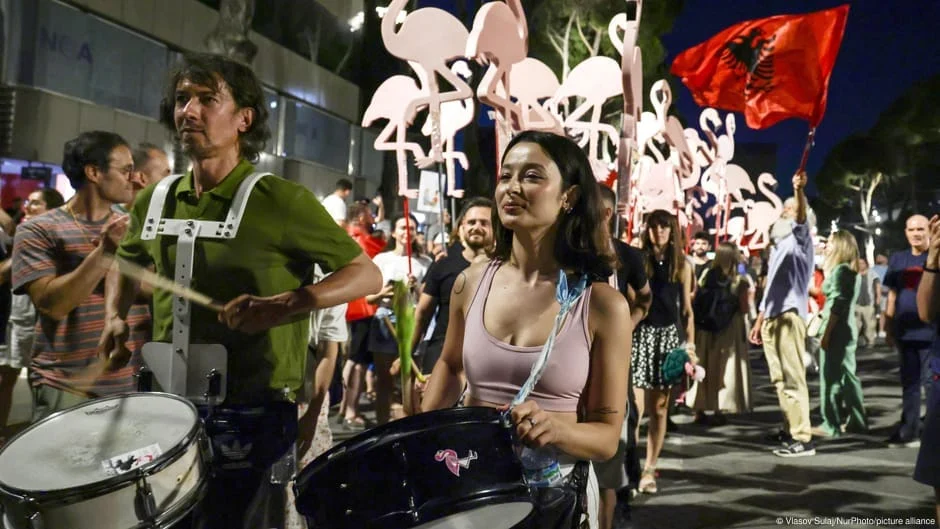
In mid-October, the streets of Tirana became the stage for a potent act of political theater when students set a suitcase on fire and hurled it into the courtyard of the Education Ministry, a visceral protest against the systemic emigration that has hollowed out the Albanian population for over a decade. This act of defiance was not merely a reaction to education policy but a symbolic rejection of the status quo that has seen roughly 420,000 citizens—nearly 15% of the total population—depart the country between 2011 and 2023. For a generation of young Albanians, the suitcase represented the "exit strategy" that has defined their lives; by burning it, they signaled a paradigm shift: they no longer intend to leave, but rather to stay and dismantle the system that forced their predecessors into exile.
The Genesis of the Flamingo Revolution
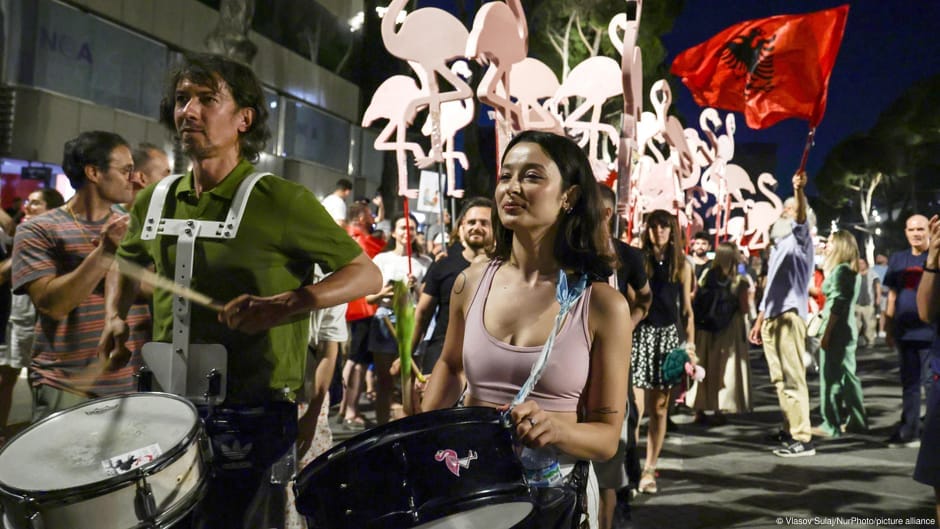
The roots of the current unrest, now widely known as the "Flamingo Revolution," trace back to May 2024. The movement initially coalesced around local environmental concerns regarding a proposed luxury resort project in a protected coastal reserve—a development linked to business interests involving Ivanka Trump and Jared Kushner. What began as a niche, issue-specific demonstration against environmental degradation quickly metastasized into a broader national reckoning.
By mid-summer, the grievances had expanded to encompass a comprehensive indictment of the political establishment. Protesters targeted the deep-seated corruption perceived to be endemic within Prime Minister Edi Rama’s government and his Socialist Party, as well as the broader, entrenched political class that has dominated the country since the transition from communism. The protests maintained a largely peaceful, rhythmic cadence for four months, with thousands marching through Tirana every evening. However, the atmosphere shifted on October 13, when student-led demonstrations escalated into direct confrontations with law enforcement. Since that date, the city has witnessed a cycle of unrest characterized by the deployment of tear gas, water cannons, and rubber bullets, resulting in hundreds of arrests and a significant number of injuries on both sides.
A Chronology of Declining Trust
The erosion of public confidence in Albanian institutions is not a recent phenomenon but a gradual decline accelerated by specific structural issues.
- 2005–2013: The entrenchment of the two-party system. Edi Rama ascended to the leadership of the Socialist Party in 2005, while Sali Berisha remained the dominant force of the Democratic Party. This period solidified a political binary that critics argue prioritized party loyalty over public service.
- 2008 Constitutional Reform: A pivotal moment occurred when Rama and Berisha collaborated on constitutional and electoral reforms. These changes granted party leaders exclusive power to select candidates for Parliament, effectively severing the traditional ties between elected officials and their local constituencies.
- 2013–2024: The "Rama Era." Since taking office in 2013, Prime Minister Rama has overseen significant economic growth and a boom in the tourism sector. However, the benefits of this growth have been largely perceived as unevenly distributed, fueling accusations that taxpayer funds are channeled toward well-connected companies via opaque public-private partnerships.
- May 2024: The Flamingo Revolution begins.
- October 2024: The movement reaches a boiling point, culminating in the burning of the suitcase and subsequent violent clashes with police.
Economic Realities and Demographic Shifts
The data paints a sobering picture of why the protests have gained such widespread traction. According to the Albanian Institute of Statistics (INSTAT), the median monthly salary after taxes for half of the workforce is less than 60,000 lek (approximately €620 or $680). When contrasted against a cost-of-living index where food prices often exceed the European Union average and real estate prices in the capital have doubled since 2018, the math of survival becomes untenable for many young professionals.
The emigration trend has been a structural safety valve for the government for years, but that safety valve is now failing. Between 2018 and 2024, the number of Albanian citizens residing in Germany alone more than doubled to nearly 120,000. For the protesters, these figures are not just statistics; they are the lost potential of an entire generation. By demanding systemic change, they are attempting to address the root causes—low wages, high inflation, and the "pay-to-play" culture in business procurement—that make staying in Albania a financial impossibility for the middle class.
Political Impasse and the Democratic Deficit
The political structure of Albania has been described by organizations like Freedom House as "partly free," noting that political parties are frequently organized around individual personalities rather than policy platforms. The 2025 parliamentary elections served as a flashpoint for this dissatisfaction. While the Organization for Security and Co-operation in Europe (OSCE) deemed the elections "professionally managed," they simultaneously highlighted a "highly polarized environment" and a lack of a "level playing field," citing instances of intimidation and the misuse of public resources.
The opposition Democratic Party, led by figures like Sali Berisha, has frequently alleged electoral fraud. Meanwhile, the protesters have shown a notable skepticism toward both the government and the established opposition. Calls for the resignation of Prime Minister Rama have been met with a firm refusal; the Prime Minister has instead called for dialogue, a gesture the protest movement has thus far rejected as an attempt to neutralize their demands. Rama has also deflected criticism by alleging that "foreign hands" are fueling the unrest, though there has been little evidence provided to substantiate the existence of a foreign orchestrator. Instead, the unrest appears to be a homegrown reaction to the stagnation of democratic norms and the perception of a government that is more responsive to private developers than to the public interest.
Implications for EU Aspirations
The standoff places Albania’s European integration in a precarious position. Prime Minister Rama has argued that his government is the only path toward Albania’s goal of joining the European Union by 2030. However, the protestors argue that the government itself is the primary impediment to EU standards, particularly regarding the rule of law and anti-corruption measures.

The irony of the current situation is that both the government and the protesters claim to represent the pro-European aspirations of the Albanian people. For the government, accession is a project of administrative alignment and economic partnership. For the protesters, accession is a moral and systemic imperative—a way to ensure that Albania adopts the transparency and accountability standards that would end the culture of impunity.
The Path Forward: A Question of Participation
The success or failure of the Flamingo Revolution will likely depend on whether it can successfully transition from the streets to the ballot box. Historical precedents, such as the student-led movements in Serbia that successfully challenged long-standing regimes, suggest that political energy must eventually be codified into electoral power to effect lasting change.
The structural barriers remain formidable. The current electoral system heavily favors the status quo, and the entrenched political dynasties have shown a high degree of resilience. However, the symbolic burning of the suitcase serves as a point of no return. By rejecting the option to leave, the youth of Albania have forced the political establishment to confront a citizenry that is, for the first time in decades, choosing to hold its leaders accountable at home.
As the protests continue to ripple through the streets of Tirana, the international community remains an observer of a volatile experiment in democratic renewal. Whether this results in a genuine institutional overhaul or a return to the status quo remains to be seen. What is clear, however, is that the era in which Albanian leaders could rely on the "suitcase" as a solution to domestic dissent has come to a definitive end. The luggage is gone, and the country is now forced to face the reality of its own internal contradictions.

