
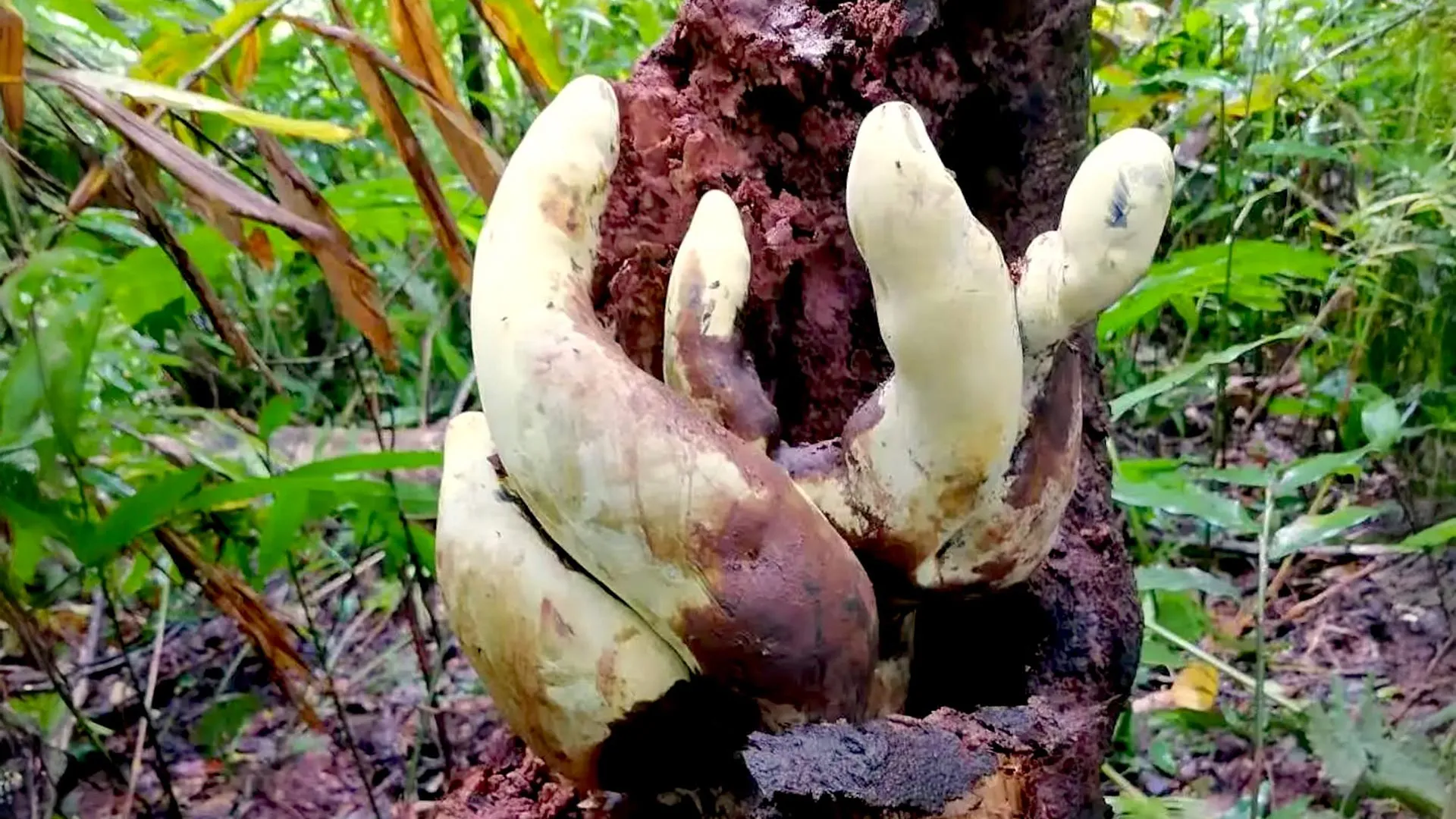
In the dense, verdant understory of Yunnan’s temperate and tropical forests, researchers from the Kunming Institute of Botany have unearthed a biological marvel that is forcing mycologists to rethink the physical limitations of the fungal kingdom. The discovery, a massive species named Dianjunus rex—affectionately dubbed "D-Rex" by the scientific team—represents not merely a new species, but an entirely new family of fungi, Dianjunaceae. With fruiting bodies reaching heights of 50 centimeters and weighing up to 2.2 kilograms, D-Rex currently stands as the largest known member of the phylum Ascomycota, shattering previous records held by fungi in the 20-to-30-centimeter range.
A Landmark Discovery in Yunnan
The identification of Dianjunus rex was the culmination of extensive biodiversity surveys conducted across diverse ecosystems in China’s Yunnan province. The research team focused their efforts on high-altitude temperate coniferous forests near Damaidi and Yipinglang, as well as the humid, complex environments of tropical rainforests near Nanbang. It was within the rhizosphere—the intricate, nutrient-rich soil zone surrounding the roots of Chinese cork oak trees—that the team first encountered the unusually large, whitish reproductive structures known as stromata.
Unlike the common mushrooms familiar to the public, which belong to the phylum Basidiomycota, D-Rex belongs to the Ascomycota, the largest phylum of fungi, encompassing over 64,000 described species. These organisms do not produce traditional gills or caps; instead, they generate spores within microscopic, sac-like structures embedded in their massive fruiting bodies. The scale of the D-Rex stromata, emerging directly from woody roots, immediately signaled to the researchers that they were observing a rare evolutionary outlier.
Taxonomic Classification and Evolutionary Significance
The formal classification of D-Rex involved a rigorous, multi-step validation process. Upon collection, specimens were preserved at the Germplasm Bank of Wild Species at the Kunming Institute of Botany. Laboratory analysis, which included the successful cultivation of spores and a comprehensive sequencing of the fungus’s genome and protein-coding genes, confirmed that the organism possessed unique morphological and genetic markers.
These results led to the establishment of the genus Dianjunus and the family Dianjunaceae, situated within the order Xylariales. While the order is well-known for its role in decomposing plant matter through the secretion of specialized enzymes, the scale of D-Rex is unprecedented. Its closest evolutionary relative, Graphostroma platystoma, is a comparatively modest fungus found on dead hardwood in the Northern Hemisphere. The divergence between the two suggests a long, independent evolutionary path for the Dianjunaceae family, one that has remained hidden from modern science until now.
The 65-Million-Year Connection
Perhaps the most compelling aspect of the discovery is the estimated timeline of the family’s origin. By employing "molecular clock" analysis—a technique that compares the genetic divergence of a species against known evolutionary histories—the research team traced the emergence of the Dianjunaceae family to approximately 65 million years ago.
This date is significant as it aligns closely with the aftermath of the Cretaceous-Paleogene (K-Pg) mass extinction event, the cataclysm that wiped out non-avian dinosaurs. The environmental vacuum created by this global extinction resulted in a massive influx of dead plant biomass. Dr. Indunil C. Senanayake, corresponding author of the study published in Frontiers in Fungal Biology, suggests that this abundance of decaying organic material provided a unique "ecological opening." In the chaotic, rapidly changing landscape of the early Paleogene, ancestors of the Dianjunaceae may have evolved to specialize in the rapid decomposition of large-scale wood debris, a niche that persisted and eventually gave rise to the gargantuan D-Rex.
Biological Strategy: The Cost of Stature
The question of why D-Rex evolved to such an immense size remains a subject of intense scientific debate. In the biological world, size is almost always a trade-off between growth and energy expenditure. Producing a 50-centimeter structure requires a massive investment of metabolic resources.
The researchers propose a hypothesis based on spore dispersal efficiency. In the thick, multi-layered environment of a subtropical forest, ground-level spore release is often hindered by dense foliage and a lack of air circulation. By extending its reproductive structures well above the forest floor, D-Rex may gain a significant competitive advantage. These "towers" allow the fungus to catch air currents that can carry its spores far beyond the immediate vicinity of the host tree, facilitating colonization of new, nutrient-rich root systems. The energy cost of constructing such a large stroma, therefore, is viewed as an investment in the long-term reproductive success of the species.
The Hidden Biodiversity of East Asia
The discovery of D-Rex is a poignant reminder of the "cryptic" nature of fungal biodiversity. Despite the critical roles fungi play in nutrient cycling, carbon sequestration, and forest health, they remain among the most understudied organisms on the planet.
Several factors have contributed to this knowledge gap:
- Geographic Barriers: Many of China’s most biodiverse regions feature rugged, remote, and difficult terrain that hinders consistent, long-term field studies.
- Seasonal Ephemerality: Fungal fruiting bodies are often only visible for a fraction of the year, making them easy to miss during standard biodiversity surveys.
- Historical Bias: Academic and commercial research has historically prioritized fungi with direct economic or medicinal applications, such as culinary mushrooms or those used in pharmaceuticals, often neglecting the ecological "workhorses" of the forest.
The Kunming Institute of Botany team believes that the Yunnan region is a "hotspot" for fungal evolution. The combination of climatic stability, which acts as a buffer against extinction, and the region’s complex biotic interactions creates a laboratory for natural selection. As ecosystems continue to face pressure from climate change and land-use shifts, the identification of families like Dianjunaceae provides a vital baseline for conservation.
Implications for Future Mycology
The revelation of D-Rex has set a new precedent for what mycologists should look for in the field. If such a large, conspicuous organism could remain undiscovered for so long, it suggests that there may be other "giant" fungi lurking in the under-sampled forests of Southeast Asia and beyond.
Furthermore, the study of D-Rex’s enzyme production could have significant biotechnological implications. Members of the order Xylariales are renowned for their ability to break down complex plant polymers. If D-Rex possesses unique enzymes optimized for decomposing the woody material of the Chinese cork oak, these compounds could eventually be leveraged for industrial processes, such as biofuel production or the breakdown of agricultural waste.
As Dr. Senanayake and his colleagues continue their work, the focus will likely shift to the ecological interactions between D-Rex and its host trees. Determining whether this fungus acts as a strictly saprotrophic decomposer or if it maintains a more complex, perhaps symbiotic, relationship with the oak trees remains a priority.
The story of D-Rex is far from over. It is a story that bridges the deep past—the dawn of the age of mammals—with the present-day reality of forest conservation. By challenging our assumptions about the maximum size of ascomycetes, this fungus has provided a rare, macroscopic view into the hidden evolutionary mechanics of our planet’s forests. As researchers push deeper into the temperate and tropical landscapes of China, the "D-Rex" may well be the first of many record-breaking discoveries waiting to be brought to light.

