
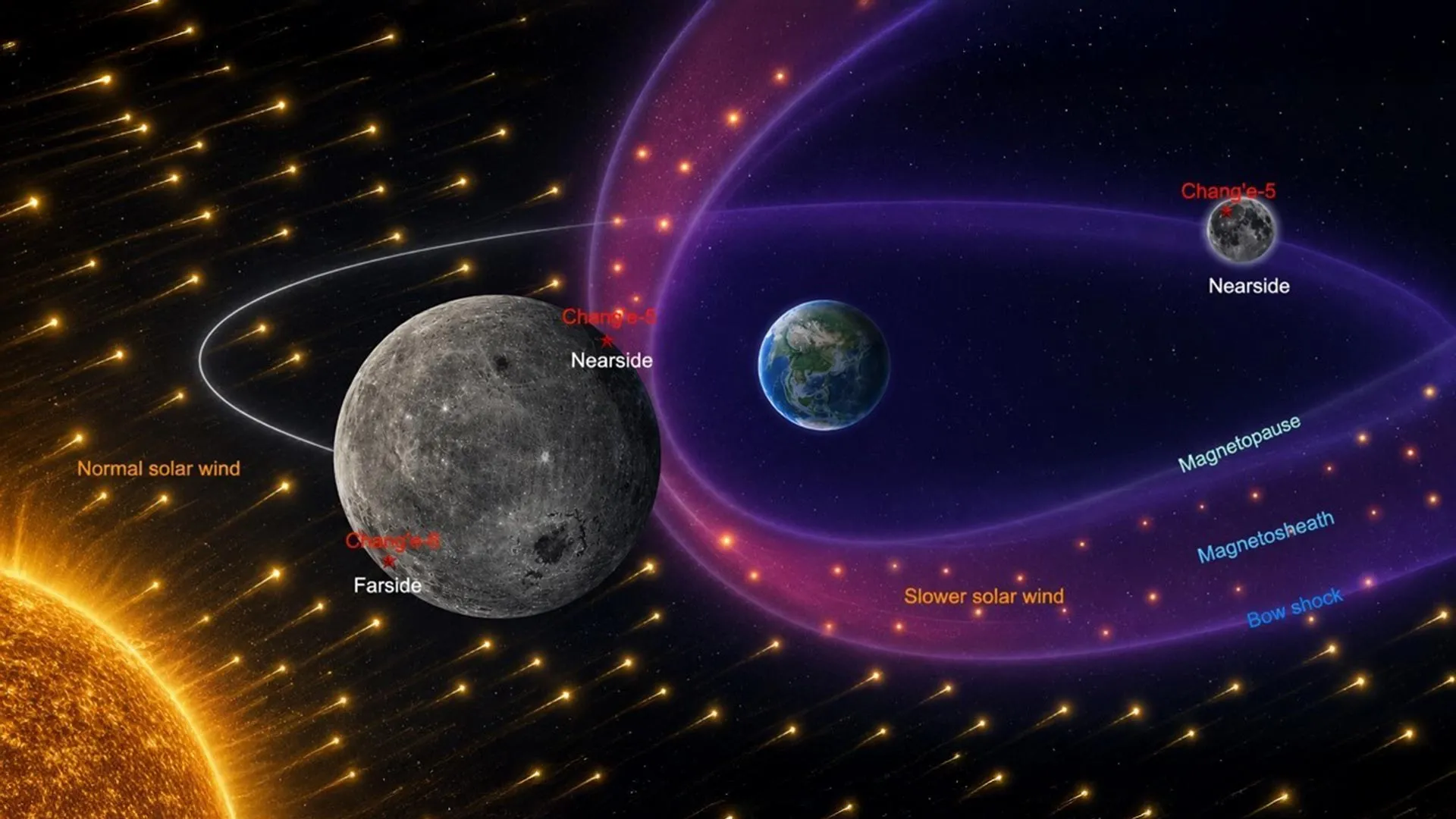
The Moon, a silent sentinel in Earth’s orbit for billions of years, has long been understood to be a passive recipient of the Sun’s relentless solar wind. However, groundbreaking analysis of lunar samples returned by China’s Chang’e 6 mission has unveiled a profound asymmetry in this ancient bombardment, demonstrating that the Moon’s near and far sides have experienced vastly different energetic interactions with these charged solar particles. This disparity, as detailed in a recent publication in the prestigious journal Nature Geoscience, is primarily attributed to the protective embrace of Earth’s magnetosphere, a phenomenon that has left an indelible record within the lunar regolith.
Lunar Dust: A Cosmic Chronicle of Solar Wind Implantation
The solar wind, a continuous stream of energetic charged particles – primarily protons and electrons – emanates from the Sun’s corona and travels outwards through the solar system. Unlike Earth, which possesses a robust global magnetic field and a substantial atmosphere that deflects most of this plasma, the Moon’s near-vacuum environment and lack of a global magnetic field render its surface directly exposed. This constant barrage has profound implications for the lunar regolith, the layer of loose dust and rock that blankets the Moon’s surface.
Over eons, this lunar soil has acted as a passive archive, trapping and preserving volatile materials delivered by the solar wind. Among the most significant of these are the noble gases, a group of inert elements including helium (He), neon (Ne), argon (Ar), krypton (Kr), and xenon (Xe). Their chemical inertness makes them exceptionally reliable tracers, allowing scientists to meticulously reconstruct the history of solar wind implantation – how these particles arrived and accumulated within the lunar soil.
Historically, the scientific community’s understanding of solar wind interaction with the Moon was largely confined to samples obtained from the near side, the hemisphere perpetually facing Earth. The inability to directly study material from the far side meant that a critical question remained unanswered: did the solar wind’s impact truly differ between the two hemispheres? The advent of China’s Chang’e 6 mission has dramatically altered this landscape. The mission successfully collected approximately 1.935 grams of lunar regolith from the South Pole-Aitken basin, a vast impact crater on the far side, providing the first tangible opportunity to directly compare the solar wind’s depositional history across both sides of the Moon.
Chang’e 6 Samples Unveil a Striking Isotopic Imbalance
A dedicated team, spearheaded by researchers at the Institute of Geology and Geophysics (IGG) of the Chinese Academy of Sciences (CAS), undertook the intricate task of analyzing the collected Chang’e 6 material. Their meticulous examination focused on the concentrations and, crucially, the isotopic compositions of the noble gases: helium, neon, argon, krypton, and xenon. This endeavor was led by Xuhang Zhang, a postdoctoral researcher at IGG, under the guidance of Professor HE Huaiyu. The collaborative effort also drew expertise from the University of Science and Technology of China and members of the Chang’e 7 volatile payload team, underscoring the international significance of this research.
One of the most compelling revelations emerged from the analysis of neon isotopes. The Chang’e 6 regolith exhibited an average 20Ne/22Ne ratio of 11.34 ± 0.22. This value is notably lower than that observed in all previously analyzed near-side samples. Crucially, this diminished ratio aligns closely with theoretical predictions for strong solar wind fractionation, a process where different isotopes of an element are preferentially separated. The implication is stark: the lunar far side has experienced a more intense isotopic fractionation, leading to a relative enrichment of the heavier neon isotope, 22Ne, in its soil.
Solar Wind Penetration Depth: A Tale of Two Hemispheres
The isotopic anomalies in neon were further corroborated by the behavior of heavier noble gases, krypton and xenon, providing additional compelling evidence that the two lunar hemispheres were subjected to solar wind particles of differing energies.
During stepwise heating experiments, a technique where lunar samples are heated incrementally to release trapped gases at specific temperature ranges, the xenon delivered by the solar wind from the Chang’e 6 material was predominantly released at high temperatures. This resulted in a distinct, singular high-temperature peak in the release profile. In stark contrast, samples from the Chang’e 5 mission, which landed on the near side, displayed a different pattern: substantial amounts of xenon were released at both low and high temperatures.
This divergence in xenon release profiles suggests a significant difference in the depth to which solar wind particles penetrated the lunar regolith. Deeper implantation is intrinsically linked to higher-energy particles. Therefore, the observed pattern strongly indicates that the far side of the Moon was exposed to a faster and more energetic solar wind compared to the near side.
Earth’s Magnetosphere: The Unseen Guardian of the Near Side
The researchers attribute this asymmetry in solar wind implantation to the "speed-governing" effect exerted by Earth’s magnetosphere. As the Moon orbits Earth, it periodically traverses the magnetosheath, a dynamic region that acts as a buffer zone surrounding the magnetosphere. Within this magnetosheath, the otherwise unimpeded solar wind, which typically travels at speeds of around 400 kilometers per second, is significantly decelerated, slowing down to approximately 200 kilometers per second.
This reduction in solar wind speed has a disproportionate impact on the Moon’s near side, the hemisphere that consistently faces Earth. Lower-energy particles, being less penetrating, deposit their energy closer to the surface of the regolith, resulting in shallower implantation. The far side, conversely, perpetually faces away from Earth and is thus largely shielded from this magnetospheric influence. It remains exposed to the full, unimpeded force of the solar wind, allowing these faster, more energetic particles to delve deeper into the lunar soil.
The scientific team has estimated that approximately 25% of the total solar wind exposure recorded at the Chang’e 5 landing site was influenced by this slower solar wind flow. In stark contrast, the Chang’e 6 landing site on the far side exhibited no discernible evidence of having experienced this protective effect, confirming its direct exposure to the undisturbed solar wind.
Implications for Understanding Earth’s Magnetic Past
The analysis of the Chang’e 6 samples provides the first direct, tangible evidence that Earth’s magnetosphere plays a crucial role in modulating the energy of solar wind particles reaching different regions of the Moon. This influence is not transient; it is permanently imprinted within the lunar regolith, both in the depth of particle implantation and in the isotopic signatures of the trapped noble gases.
Beyond shedding light on current lunar processes, the researchers propose a revolutionary concept: that the heavy noble gases preserved within lunar soil could serve as invaluable "fossil records" of ancient interactions between the solar wind and Earth’s magnetosphere. When studied in conjunction with paleomagnetic evidence – the record of Earth’s past magnetic field preserved in rocks – these noble gas archives could offer an entirely novel avenue for reconstructing the long-term evolution of Earth’s magnetic environment.
A New Perspective on the Sun-Earth-Moon System
The findings from the Chang’e 6 mission fundamentally challenge previous assumptions about the uniformity of solar wind interaction with the Moon. They reveal a more intricate and dynamic relationship among the Sun, Earth, and Moon than previously understood. The Moon, long considered a passive observer, has been actively recording the subtle yet significant influence of Earth’s magnetic field over billions of years.
This research opens up exciting new frontiers in lunar science and planetary research. By deciphering the hidden narratives within lunar regolith, scientists are poised to gain unprecedented insights into the history of Earth’s magnetic field, its protective capabilities, and its evolution. The implications extend to understanding the habitability of planets and the conditions necessary for life to emerge and persist, as a stable magnetic field is a critical factor in shielding planetary surfaces from harmful cosmic radiation.
The success of the Chang’e 6 mission and the subsequent analysis of its precious cargo underscore the importance of continued lunar exploration and sample return missions. Each grain of lunar dust holds secrets waiting to be unlocked, offering a unique window into the cosmic history that has shaped our solar system and, by extension, our own planet. The Moon’s far side, once a mysterious frontier, has now become a vital archive, providing tangible proof of Earth’s ancient influence and a new roadmap for unraveling the planet’s magnetic past.

