
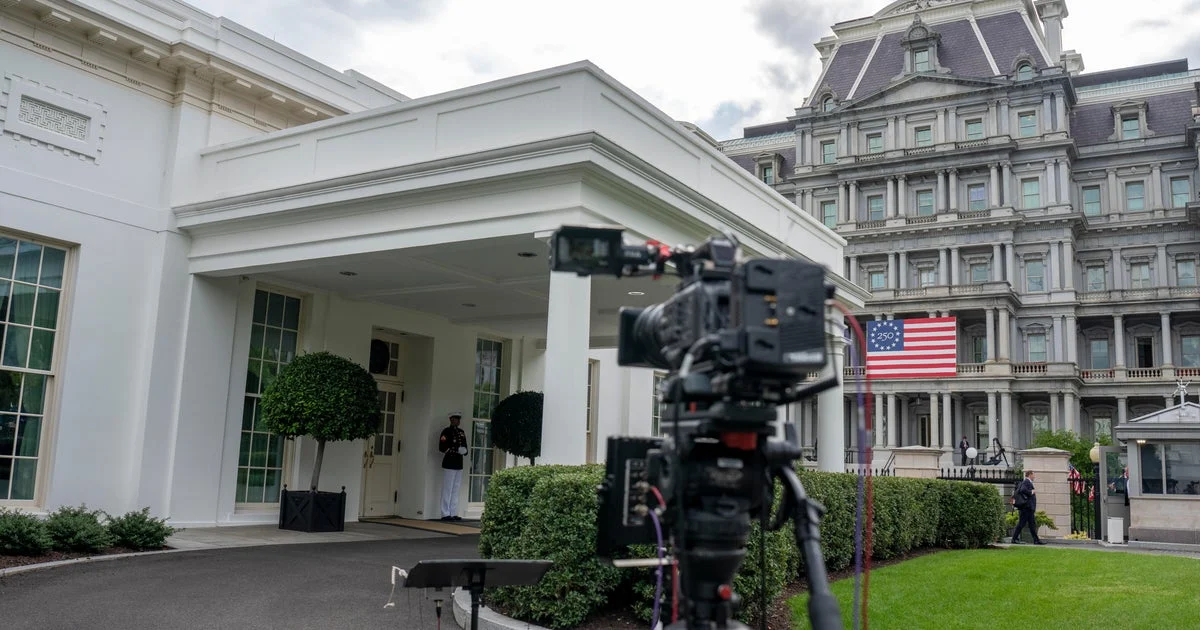
The traditional framework governing how the American press corps covers the commander-in-chief has reached an unprecedented standstill. The television press pool system responsible for documenting the official travel and public engagements of President Trump has been officially suspended following a sweeping administration directive that barred reporters and technical crews from CNN, MS NOW, and Politico from entering the White House complex. The decision to halt the decades-old cooperative broadcasting arrangement highlights a rapidly escalating confrontation between the executive branch and major media organizations over the constitutional boundaries of press access and First Amendment protections.
The suspension impacts a fundamental logistical mechanism that has served the American public and the executive office for nearly a century. Under the rotating pool system, major broadcast and cable networks—specifically ABC, CBS, CNN, Fox, and NBC—share the physical and financial burden of shadowing the president. When the president travels domestically or internationally, a single designated network embeds with the delegation, capturing real-time video footage, still photographs, and audio recordings. This material is then systematically distributed to other domestic and international news organizations to ensure continuous, independent documentation of the executive branch.
The immediate fallout of the suspension left the president’s high-profile diplomatic itinerary completely unmonitored by the standard network pool. CNN had been scheduled to spearhead the pool responsibilities on Monday, accompanying Mr. Trump on a high-stakes journey to New York City for the annual United Nations General Assembly. Because of the executive ban and the subsequent solidarity suspension by the remaining broadcast partners, no network television pool team traveled aboard Air Force One or secured visual documentation of the president’s initial engagements at the global summit. The disruption illustrates how administrative restrictions on a subset of media outlets can rapidly dismantle the logistical infrastructure designed to serve the entire press corps.
A Unified Response from the Broadcast Networks
In the wake of the access denials, executives from the five primary television networks issued a sharp, unified rebuke of the administration’s policy. The joint statement released Monday afternoon underscored the democratic necessity of an unfettered press corps.
The public has a vital interest in receiving accurate, independent information about its government, the network executives stated collectively. No administration should reject a news organization because it objects to its reporting.
This solidarity extended beyond the television networks into print and photographic journalism. The Washington Post announced a striking visual blackout in coordination with other photojournalism outfits covering the White House. In a statement released Monday afternoon, the prominent daily confirmed it would refrain from publishing any photographs of President Trump or his official events until after midnight on Tuesday. The voluntary withholding of imagery was described by editors as a collective demonstration of solidarity with the news organizations targeted by the White House exclusions.
The Genesis of the Ban and Immediate Legal Action
The crisis crystallized late last week when President Trump publicly announced intentions to block specific news organizations from the executive mansion. On Friday, the president declared that his administration would be barring what he characterized as fake news outlets—specifically naming CNN, MS NOW, and Politico—from the White House grounds, citing ongoing grievances regarding their news coverage and editorial tone.
The executive directive transformed from rhetoric into physical reality over the weekend. Reporters, producers, and technical staff from the targeted outlets arrived at the White House for credentialed reporting assignments only to be turned away by security personnel.
In response to the unprecedented blockade, legal representatives for CNN, MS NOW, and Politico filed a formal federal lawsuit on Monday morning seeking an emergency injunction to restore immediate access to the White House complex. The legal complaint argues that the administration’s sweeping ban constitutes a direct, unconstitutional assault on the First Amendment, asserting that the government cannot legally retaliate against media organizations or deny public property access based on the viewpoints or content of their reporting.
Industry Leadership and Historical Precedent
The White House Correspondents’ Association (WHCA), which serves as the primary liaison between the executive branch and the journalists who cover it, immediately condemned the administration’s actions. Jacqui Heinrich, serving as WHCA president and senior Fox News correspondent, issued a definitive statement on Saturday outlining the professional consensus within the press corps.
The White House cannot deny that access arbitrarily or based on the content of their reporting, Heinrich stated, emphasizing that physical access to the executive seat of government is a prerequisite for a functional democracy, not a privilege bestowed or revoked at the political whim of the administration.
The cooperative news-gathering pool system is a venerable institution within American journalism, tracing its modern roots back to the administration of Franklin D. Roosevelt. Designed initially to cope with the physical limitations of early transportation and communication technologies, the system evolved into an indispensable mechanism for democratic accountability. Separate, highly coordinated pools operate across television, print, radio, and digital photography.
Beyond safeguarding the public’s right to know, the pool system serves a critical logistical function. Modern presidential travel involves massive entourages, restricted spaces, and high-security environments. Facilities such as the dedicated press cabin aboard Air Force One or tight security perimeters at international summits simply cannot accommodate the hundreds of accredited journalists who wish to chronicle the president’s movements. The pool system bridges this gap, ensuring that every citizen has a designated window into the actions of their elected leader, regardless of whether a particular newsroom has the physical seat for a given day.
Implications for Governance and Other Officials
While the presidential television pool remains dark, the ripple effects have raised questions regarding the administration’s broader approach to media relations. Notably, network pool coverage for other high-ranking executive branch officials, including Secretary of State Marco Rubio and Vice President JD Vance, continued largely uninterrupted on Monday. However, media analysts and legal scholars suggest that the precedent set by the White House actions against CNN, MS NOW, and Politico could permanently alter the relationship between future administrations and the fourth estate.
The suspension of the presidential TV pool is more than a logistical inconvenience; it represents a profound fracture in the operational norms of the American presidency. As the federal courts prepare to hear arguments in the media organizations’ lawsuit, the nation’s capital finds itself navigating uncharted constitutional territory. The central question remains whether an administration can legally dismantle the centuries-old compact of open press access without fundamentally undermining the transparency required of a democratic government.

