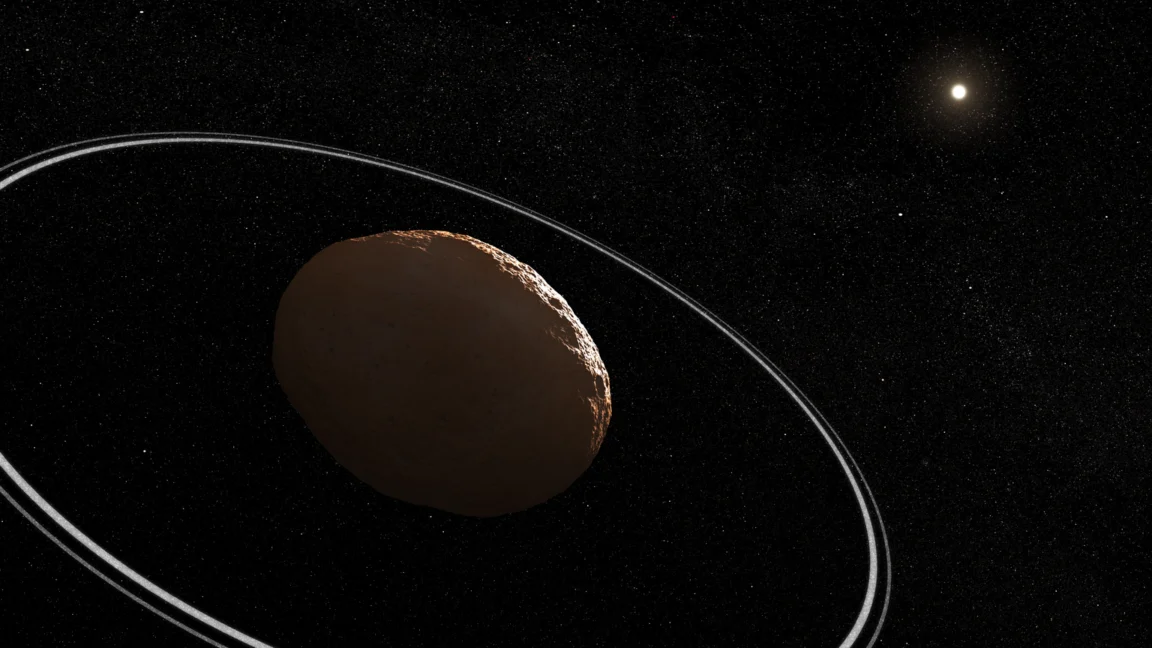
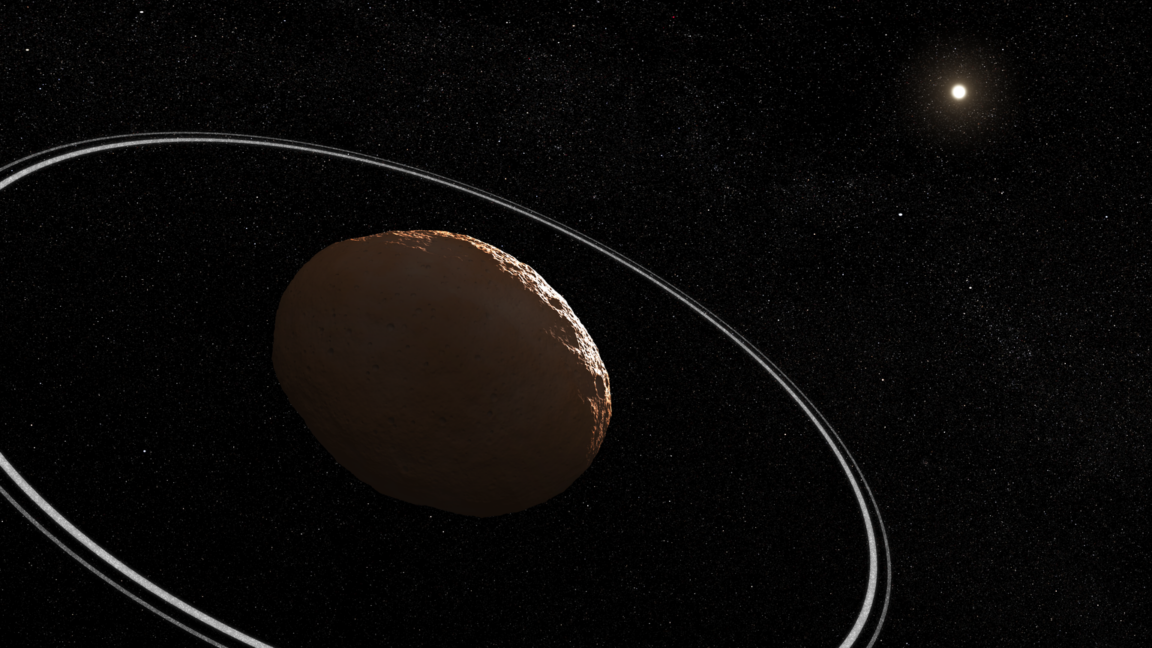
For centuries, humanity’s understanding of planetary rings was bound exclusively to the gas giants of our outer solar system. Saturn, with its dazzling, icy architecture, reigned as the quintessential textbook example, while Jupiter, Uranus, and Neptune quietly boasted their own faint, dusty hoops. Rings were long considered the birthright of colossal worlds—massive gravitational leviathans capable of tearing apart stray comets or moons that ventured too close. That paradigm-shifting assumption was shattered in 2013 when astronomers training their sights on a minor celestial body orbiting in the distant frontier between Saturn and Uranus discovered an entirely unexpected phenomenon: two narrow, distinct rings encircling an object barely 250 kilometers across.
That remarkable object, designated (10199) Chariklo, is the largest known member of the Centaur population—a dynamic and unstable class of icy planetoids orbiting the Sun between Jupiter and Neptune. When Chariklo passed in front of a distant background star in 2013, ground-based telescopes recorded a brief, multi-staged dimming event. The starlight blinked twice on either side of the primary occultation, revealing the unmistakable signature of two dense, razor-thin rings, subsequently cataloged as C1R and C2R.
The discovery stunned the astronomical community. It forced researchers to reconsider the mechanics of ring formation and stability around low-mass bodies, where gravity is vastly too weak to effortlessly trap orbiting debris. Ever since that serendipitous observation, a central question has driven the scientific discourse: What are these mysterious rings made of, and how long can such a precarious structure possibly survive in the harsh environment of deep space?
Now, more than a decade later, new data captured by the James Webb Space Telescope (JWST) has deepened the mystery while offering unprecedented insights. According to a recent study published in the journal Science Advances, an international team of astronomers has utilized JWST to observe another stellar occultation by Chariklo. The findings reveal that the object’s ring system is not a static relic of a long-ago collision, but a dynamic, rapidly evolving environment. One of Chariklo’s rings has grown remarkably denser, while the other has mysteriously faded toward invisibility.
The Mechanics of Stellar Occultation
To understand the nature of Chariklo and its elusive rings, astronomers rely on a technique known as stellar occultation. This method, while conceptually straightforward, demands extraordinary precision and timing. As minor bodies orbit the Sun, they occasionally pass directly in front of distant background stars from the perspective of Earth or space-based observatories. When this happens, the background star’s light is temporarily blocked or dimmed.
By precisely recording the light curve—the graph of the star’s brightness over time—astronomers can deduce the exact size, shape, and topography of the intervening object. Furthermore, if the body possesses rings or an atmosphere, those structures imprint their own subtle, secondary dips and spikes in the light curve before and after the main occultation event.
However, applying this technique to distant minor bodies presents formidable technical hurdles. Chariklo’s silhouette against the backdrop of the cosmos is minuscule, subtending an angle equivalent to observing a coin from hundreds of kilometers away. Accurately predicting when and where its shadow will fall on Earth requires extraordinarily precise orbital positioning data for both the Centaur and the target star.
Despite these challenges, ground-based observatories successfully mapped Chariklo’s twin rings in 2013. Researchers determined that C1R and C2R sat at distances of approximately 390 kilometers and 405 kilometers from the center of the body, respectively. Measuring just a few kilometers in width, the two rings were separated by a narrow gap of roughly 7 kilometers. Yet, ground-based observations are fundamentally limited by Earth’s atmosphere, which filters out critical infrared wavelengths and distorts high-resolution measurements. To truly dissect the ring system, astronomers needed to take the observation into space.
Taking JWST to the Edge: The October 2022 Campaign
Transitioning from ground-based telescopes to a space-based observatory like the James Webb Space Telescope introduced an entirely new tier of operational complexity. Positioned at the second Lagrange point (L2), roughly 1.5 million kilometers from Earth, JWST requires meticulous trajectory maintenance. Mission controllers must routinely execute small orbital adjustments every few weeks to keep the multi-billion-dollar observatory stable.
Preparing for Chariklo’s occultation in August 2022, lead researcher Pablo Santos-Sanz—an astronomer at the Instituto de Astrofísica de Andalucía in Granada, Spain—and his colleagues faced a daunting operational puzzle. Predicting the exact path of the shadow weeks in advance proved slippery. Between the initial prediction and one of the final navigational updates, the projected line of sight shifted by approximately 110 kilometers. This shift was more than enough to miss the tiny planetoid entirely.
Compounding the difficulty, JWST’s rigorous scheduling protocols require observation targets to be locked in at least 14 days prior to execution. The team was forced to proceed with incomplete precision. As Santos-Sanz noted, the endeavor felt like a blind shot in the dark: moving one of the most sophisticated scientific instruments ever constructed without absolute certainty of catching the alignment.
Fortunately, persistence and precise recalibrations paid off. On October 18, 2022, the occultation occurred precisely as calculated. Reconstructed geometry of the event revealed that JWST’s line of sight to the background star skimmed a mere 7.4 kilometers above Chariklo’s physical surface. While the telescope narrowly missed the main body of the Centaur itself, its sensitive instruments caught the outer periphery—the ring system—in stunning detail.
Unprecedented Infrared Observations
During the October 2022 event, JWST recorded the occultation simultaneously across two distinct near-infrared bands: 1.5 micrometers and 3.2 micrometers. This milestone marked the first time astronomers captured a minor body’s ring system at wavelengths exceeding three micrometers, a spectral regime completely inaccessible to ground-based telescopes due to atmospheric absorption by water vapor and carbon dioxide.
The data yielded immediate surprises. The inner ring, C1R, was unmistakably present, displaying sharp, abrupt boundaries. However, its optical properties had drastically shifted. When researchers averaged the normal opacity—the fraction of background starlight blocked by the ring—across roughly ten previous ground-based occultations, C1R’s opacity sat consistently around 0.303. JWST, however, measured the inner ring’s opacity at a staggering 0.431.
Initially, the research team was skeptical of the results. "We didn’t believe it at the beginning, so we fought a lot with the data," Santos-Sanz recalled. The most straightforward hypothesis to test was spatial non-uniformity. Planetary rings are rarely uniform sheets of matter; they contain clumps, waves, and density variations. It was entirely possible that JWST had simply sliced through an unusually dense clump of material within the inner ring rather than witnessing a global change.
To rigorously evaluate this possibility, the team constructed a complex, lumpy ring model and simulated 10 million individual stellar occultations. The statistical results were decisive: the probability of randomly reproducing an opacity as high as the one recorded by JWST was roughly 1 in 1,000 at the 1.5-micrometer band, and an astronomical 4 in 100,000 at the 3.2-micrometer band for a single measurement. Because the telescope successfully captured the ring twice—once as it entered the shadow and once as it exited—the statistical probability of a mere clumping artifact became vanishingly small.
The inescapable conclusion was that the inner ring had physically thickened or grown substantially denser over the span of a decade.
The Fading Outer Ring and Material Migration
While the inner ring grew more prominent, the outer ring, C2R, did precisely the opposite. C2R barely registered at the 1.5-micrometer wavelength and completely vanished at 3.2 micrometers, despite the telescope observing the exact same structural stretch of the ring simultaneously across both bands.
"At the beginning we didn’t even see the outer ring in the light curve," Santos-Sanz explained. "We had to use models. It was really barely visible, so we said, ‘What is happening here?’"
Faced with this asymmetry, the astronomy team investigated two primary explanations. The first was a wavelength-dependent scattering effect, wherein dust grains of specific sizes scatter infrared light differently at higher wavelengths, creating an illusion of fading. The second explanation was that the rings had undergone genuine, physical evolution.
Radiative transfer models strongly pointed toward the latter. Previous visible-light observations were consistent with a ring composition consisting of water ice mixed with silicate rock dust. However, when the new JWST infrared data points were integrated into the models, no combination of material composition or particle size distribution could reconcile the discrepancy under a static model assumption. The data necessitated a dynamic framework.

"We are witnessing a real evolution of the rings with time," Santos-Sanz stated, emphasizing that physical transformation remains the team’s preferred hypothesis. Furthermore, detailed mass-balance calculations revealed a puzzling imbalance: the material gained by the inner ring was roughly ten times greater than the material lost by the fading outer ring. If C2R was thinning out, its shed debris could not simply be migrating inward to pad C1R; an external or supplementary source of material was clearly at play.
The Ghost Moon Hypothesis
To account for the surplus material and the long-term structural integrity of the rings, researchers have turned to dynamical modeling. The leading hypothesis invokes the presence of an undiscovered shepherd satellite—a small, inner moonlet sharing or orbiting closely alongside the ring system.
In planetary ring dynamics, shepherd moons play a vital role. Their gravitational influence helps corral ring particles, maintaining sharp edges and preventing the ring from rapidly dispersing into space. Additionally, such a moonlet could be subjected to micro-meteoroid impacts, constantly ejecting fresh debris that subsequently feeds and replenishes the inner ring, C1R.
"This satellite has not been detected yet, if it exists," Santos-Sanz noted, acknowledging that observational confirmation remains elusive.
Computer models generated from the JWST dataset also provided preliminary clues regarding the compositional makeup of the two rings. The analysis suggests that the inner ring is predominantly composed of larger, boulder-sized particles, whereas the outer ring is dominated by finer, micron-scale dust. Nevertheless, the researchers urge caution, classifying this aspect of the study as an ongoing work in progress rather than a settled conclusion.
Broader Implications for Solar System Dynamics
The discovery that Chariklo’s rings are dynamic, changing structures carries profound implications for our understanding of small bodies throughout the solar system. Chariklo is no longer considered an isolated anomaly. In recent years, astronomers have confirmed the presence of ring systems around other Centaurs—most notably Chiron—as well as the distant dwarf planet Haumea and the trans-Neptunian object Quaoar.
It has long been established that the rings of giant planets are inherently unstable over medium-to-long timescales. Observations of Saturn have revealed that its tenuous D ring is actively shrinking, while the arcs of Neptune’s Adams ring continually rearrange their internal structures over months and years. The revelation that minor bodies experience similar evolutionary volatility suggests that ring systems across the solar system are universally subject to continuous, complex cycles of erosion, replenishment, and gravitational shaping.
To definitively separate genuine physical evolution from complex wavelength-dependent scattering effects, the research team is already planning future observation campaigns. The gold standard for verification will be capturing another stellar occultation of Chariklo using visible-light instrumentation to cross-reference against the JWST infrared dataset.
"I think this work is just a piece of the puzzle," Santos-Sanz concluded, "but it could be an important clue for broader studies about the rings around minor bodies and around giant planets." As astronomers continue scanning the outer darkness for new occultation opportunities, the quiet frontier of the Centaurs promises to rewrite our understanding of how cosmic debris organizes, transforms, and endures against the vast backdrop of space.