
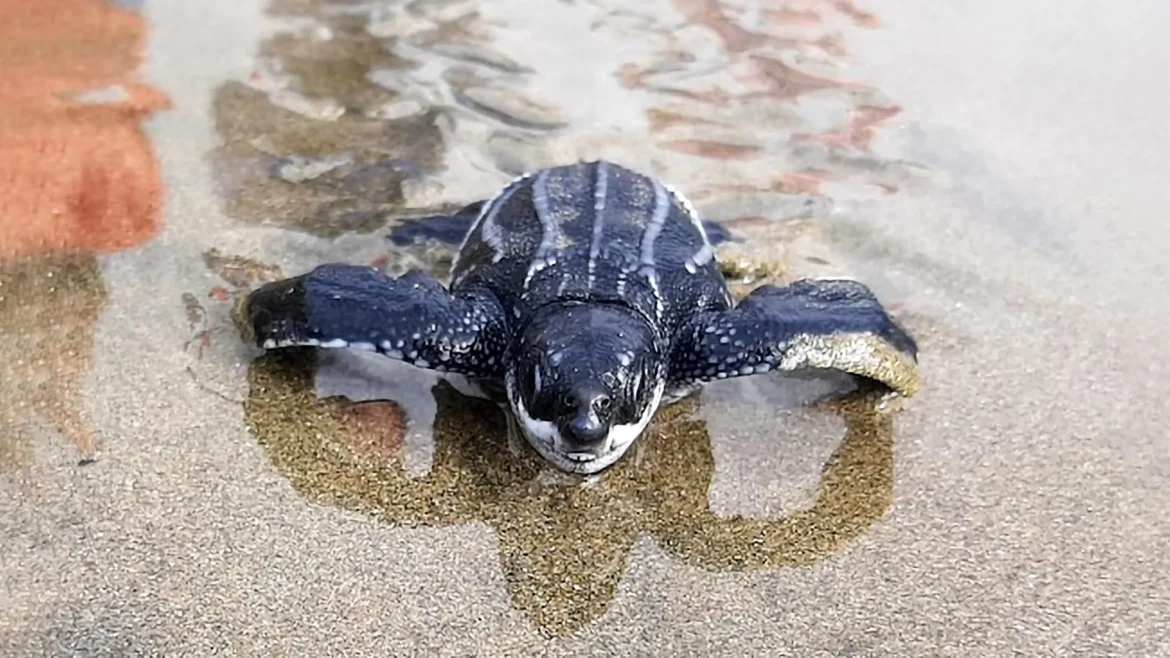
The sandy coastlines of Ecuador are emerging as an unlikely but vital sanctuary for the eastern Pacific leatherback sea turtle, a species currently teetering on the precipice of extinction. As researchers continue to monitor the 2025-2026 nesting season, an unprecedented surge in nesting activity has been documented across multiple Ecuadorian beaches. These sites, situated more than 1,000 miles south of the traditional, primary nesting grounds in Mexico and Costa Rica, represent a significant geographical shift in the life cycle of one of the world’s most ancient and vulnerable marine reptiles.
This development is being viewed by the scientific community not merely as a localized anomaly, but as a potential survival strategy—a biological pivot in response to a rapidly changing global climate. As ocean temperatures continue to reach record highs, the eastern Pacific leatherback, a subspecies that has seen its population plummet by over 90% since the 1980s, appears to be seeking refuge in the comparatively cooler, nutrient-rich coastal waters of South America.
A Chronology of Decline and Adaptation
The historical trajectory of the eastern Pacific leatherback is marked by a steady, harrowing decline. Throughout the 20th century, these massive creatures—which can grow up to seven feet in length and weigh over 1,500 pounds—maintained stable populations. However, the confluence of industrial fishing, habitat destruction, and the escalating frequency of El Niño events has devastated their numbers.
By the early 2000s, projections suggested that this specific population could face total extinction within 60 years. For decades, sightings of nesting females on Ecuadorian beaches were relegated to anecdotal reports or singular, rare events. However, a comprehensive analysis published in the journal Chelonian Conservation and Biology has now provided a longitudinal perspective. By examining 45 years of historical data—including stranding records, nesting attempts, and hatchling survival rates—researchers have identified a clear, upward trend in reproductive activity that correlates strongly with cooler sea surface temperatures.
The timeline of this shift aligns with the periodic oscillations of the El Niño-Southern Oscillation (ENSO). During La Niña phases, characterized by the upwelling of colder, nutrient-dense water along the Ecuadorian coast, leatherback activity intensifies. This observation suggests that the turtles possess an innate capacity for environmental assessment, allowing them to track thermal refugia as their traditional habitats in the northern tropics become increasingly inhospitable due to heat-induced embryo mortality.
The Case of Bella: A Symbol of Resilience
The recent success of a nesting female, identified by researchers as "Bella," serves as a poignant microcosm of the challenges and triumphs facing the species. In January 2026, Bella was observed attempting to nest at Playa de Crucita. Her journey was fraught with the hazards of modern coastal development; disoriented by artificial light pollution from nearby streetlamps, she wandered across a rocky breakwater and onto a sidewalk before retreating back to the ocean without depositing her eggs.
Her return two nights later to a quieter, more suitable stretch of beach highlights the adaptive nature of these animals. During this successful nesting event, Bella laid 47 eggs. Her reproductive output throughout the 2026 season was robust; she nested four to five times, producing a total of 146 eggs. Through a combination of in-situ nest protection and transfer to the San Jacinto hatchery, 134 of these eggs successfully hatched, resulting in a remarkable 91.8% success rate. This figure is statistically significant, often surpassing the hatching rates observed at the historically established northern colonies.
Scientific Analysis: Why Ecuador?
Dr. Juan José Alava, an adjunct professor at the School of Resource and Environmental Management at Simon Fraser University and a lead co-author of the study, notes that the leatherback’s ability to thrive in both subpolar and tropical environments is a unique evolutionary trait. These turtles are known to traverse thousands of miles, migrating from tropical nesting beaches to the subpolar waters off the coast of British Columbia, where they feed on jellyfish.
"Historically, observing female Eastern Pacific leatherbacks on Ecuador’s beaches was a rare or unusual event, but our findings suggest they are adapting their reproductive cycle to thrive and survive in coastal Ecuador," says Alava. "It signals new hope for a subspecies of leatherback on track for extinction in the eastern Pacific within 60 years. They are making their way alongside nature against all odds, representing hope for this species and other sea turtle species even as they reach tipping points."
The scientific implications of this shift are profound. If the Ecuadorian coast can provide a stable, cooler environment for egg incubation, it may serve as a natural buffer against the climate-driven failures of traditional nesting sites. However, experts warn that this does not eliminate the need for systemic conservation. The leatherback still faces significant mortality threats, including accidental capture in commercial fishing gear (bycatch), ingestion of plastic debris, vessel strikes, and the ongoing degradation of coastal nesting habitats.
Conservation and Policy Implications
Securing the long-term viability of these nesting populations requires a multi-pronged approach that extends beyond simple observation. According to the research team, conservation strategies must be integrated with local and traditional ecological knowledge.
"Management and conservation efforts should be championed in close consultation and participation with local and traditional ecological knowledge through coastal, community-grounded interventions," Alava emphasizes. This includes:
- Fishery Mitigation: Implementing mandatory bycatch reduction technologies, such as circle hooks and turtle excluder devices (TEDs) on fishing nets.
- Coastal Management: Regulating coastal development to minimize light pollution, which, as demonstrated by the case of Bella, can prove fatal or disruptive to nesting mothers and hatchlings.
- Hatchery Programs: Expanding managed hatchery initiatives, like the one at San Jacinto, to protect clutches from poaching and environmental hazards while they incubate.
- Continuous Monitoring: Establishing a permanent, well-funded monitoring network across the Ecuadorian coast to track nesting trends and identify potential threats to hatchling survival in real-time.
A Broader Environmental Context
The plight of the leatherback is an indicator of the health of the broader Pacific ecosystem. As apex predators, their disappearance would have cascading effects on the marine food web, particularly regarding the control of jellyfish populations. Conversely, their success in new habitats provides a roadmap for how other migratory marine species might attempt to adjust to the anthropogenic stressors of the 21st century.
Data from the past century shows that leatherbacks have been documented in Canadian waters more than 150 times between 1931 and 2024, demonstrating their extreme migratory range. The fact that they are now choosing to nest at the southern terminus of their migratory range in Ecuador suggests that the "climate envelope" for the species is shifting.
While the 90% decline since the 1980s remains a sobering statistic, the emergence of these new nesting sites offers a rare narrative of natural resilience. The survival of the eastern Pacific leatherback will ultimately depend on whether human activity can move fast enough to accommodate this shift. If conservationists, local governments, and coastal communities can create a safe corridor for these turtles, the "Bella" generation of hatchlings may represent the beginning of a recovery that was previously thought impossible.
As the world continues to grapple with the existential threats posed by climate change, the story of the leatherback in Ecuador serves as both a warning and a testament to the persistence of life. The challenges are clear—mitigating the impact of human-caused climate change, reducing industrial fishing pressure, and protecting the sanctity of the shoreline—but the biological evidence suggests that the leatherbacks are doing their part. The question remains whether the global community can provide the necessary support to ensure these prehistoric giants remain a part of our future.
