
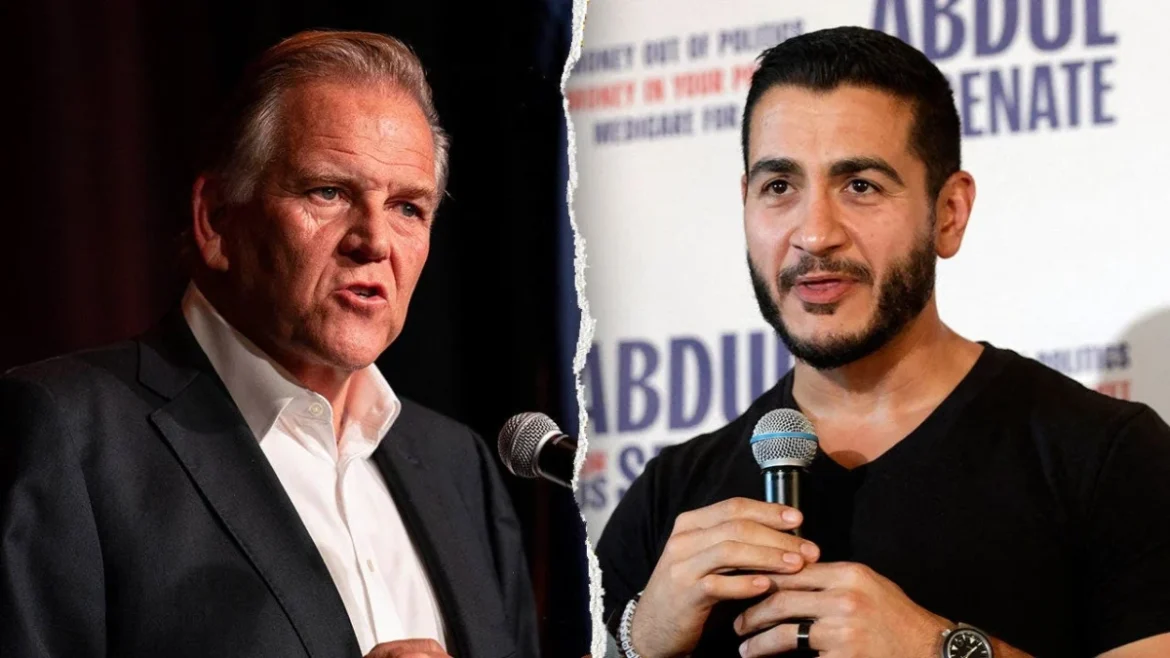
The race for the United States Senate in Michigan has reached a precarious stalemate, with the latest Fox News poll indicating that the contest between Democrat Abdul El-Sayed and Republican Mike Rogers is effectively a dead heat. As the election cycle enters its final, most critical phase, the survey reveals a electorate deeply divided by economic anxieties, ideological identity, and concerns regarding the candidates’ respective alignments with national political figures. Among likely voters, El-Sayed holds a razor-thin 50% to 49% advantage over Rogers, a margin well within the survey’s statistical margin of error.
This snapshot of the Michigan electorate highlights a political landscape characterized by high stakes and voter hesitation. While Democrats currently enjoy a broader 5-point lead in party preference regarding control of the Senate, that structural advantage is being mitigated by specific concerns surrounding the Democratic nominee’s policy platform and the persistent, if localized, influence of Republican messaging.
The Dynamics of a Shifting Electorate
The shift in momentum observed in this latest data point represents a notable departure from trends seen earlier in the summer. In August, registered voter data showed Rogers leading El-Sayed by four percentage points. The current reversal, with El-Sayed now leading 51% to 48% among registered voters, suggests that the Democratic campaign has successfully consolidated a portion of its base that had previously been drifting or undecided.
However, the "likely voter" metric—which filters respondents based on past participation and current enthusiasm—reveals the fragility of this lead. The fact that 15% of the total electorate indicates they could still change their mind before casting a ballot underscores the fluidity of the race. Rogers’ supporters, in particular, appear slightly more movable, with 18% saying they remain open to switching their vote, compared to 12% of El-Sayed’s supporters.
Chronology of the Campaign and Voter Sentiment
To understand the current deadlock, one must look at the progression of the 2026 cycle. Michigan, long considered a critical "Blue Wall" state, has seen its political identity tested by rapid shifts in industrial policy and regional economic stressors.
Early in the primary season, both candidates faced challenges in defining their brands to a broad, often skeptical, electorate. Abdul El-Sayed emerged from a contentious Democratic primary, a process that left some lingering friction with supporters of his primary rival, Haley Stevens. The poll indicates that 11% of those who backed Stevens are currently leaning toward the Republican challenger, a leakage that the El-Sayed campaign must plug if they are to hold the seat.
For Mike Rogers, the path to victory involves threading the needle between the MAGA base and the suburban independents who previously favored more moderate representation. His current standing—holding 99% of MAGA Republicans and 88% of non-MAGA Republicans—suggests a high level of party unity, yet he struggles to gain traction with voters who disapprove of Donald Trump’s influence on the party.
Economic Anxiety as the Primary Driver
Perhaps the most significant factor influencing the ballot box is the personal financial reality of Michigan families. The polling data paints a vivid picture of a state struggling with the cost of living. Nearly four in ten Michiganders report that they are "falling behind" financially. Among this specific cohort, El-Sayed enjoys a commanding 25-point lead, suggesting that the Democratic narrative regarding economic intervention resonates strongly with those most affected by inflationary pressures.
Conversely, those who describe their financial situation as "holding steady"—a group that represents nearly half of the survey respondents—tend to lean toward the Republican ticket, favoring Rogers by 13 points. This bifurcation illustrates a fundamental divide: the race is as much a referendum on personal economic stability as it is a choice between two distinct ideological visions for the country.
When asked about the importance of specific issues, 70% of voters identified the cost of living as an "extremely important" factor in their decision. El-Sayed currently leads on this issue by 13 points. However, Rogers finds his strongest footing on the issue of immigration, where he maintains a 26-point lead among the 44% of voters who prioritize border security and policy.
The Influence of National Figures
The shadow of Donald Trump continues to loom large over the Michigan ballot. The poll found that 39% of voters are "extremely concerned" that Rogers is too closely aligned with the former president, while 36% express similar apprehension regarding El-Sayed’s "too liberal" policy platform. These figures suggest that both candidates are suffering from a "negative partisanship" effect, where voters are motivated as much by their opposition to the other side’s associations as they are by their own candidate’s merits.
Furthermore, voter perception of the Biden-Harris administration adds another layer of complexity. With nearly 60% of Michiganders disapproving of the current administration’s performance, the environment is historically unfavorable for the Democratic candidate. That El-Sayed remains competitive—and indeed, leads—in spite of these headwinds speaks to the specific ideological weaknesses perceived in his opponent and the strong party-line loyalty that persists even in a state that has historically proven willing to split its ticket.
Comparative Races and Down-Ballot Implications
The Senate race is not occurring in a vacuum. The gubernatorial contest between Democrat Jocelyn Benson and Republican John James serves as a barometer for broader partisan leanings. Benson’s lead of 54% to 45% suggests that the Democratic brand remains resilient in Michigan, even when individual Senate candidates face scrutiny.
There is evidence of ticket-splitting, however. Twelve percent of voters who support Mike Rogers for the Senate are currently crossing party lines to support Benson for governor. This suggests that while the Senate race is hyper-polarized, the gubernatorial race is benefiting from a broader perception of state-level leadership that may not be fully tethered to the nationalized, high-stakes battle for the Senate.
Analytical Perspectives on the Path Forward
Republican pollster Daron Shaw, who oversaw this survey alongside Democrat Chris Anderson, notes that the race is a classic study in opposing political forces. "The Michigan Senate race is unique in that short-term political forces favoring the Democrats are somewhat offset by concerns about the Democratic candidate," Shaw observed. "The bad news for Rogers is El-Sayed has made progress shoring up Democratic support and has room to grow given voter concerns about the economy."
The implications for the national Senate balance are clear: if Democrats are to maintain or expand their majority, they must hold Michigan. If Republicans are to flip the chamber, they must peel away those few remaining suburban and independent voters who are currently leaning toward El-Sayed.
As the campaign enters its final stretch, the focus for both camps will inevitably shift toward voter turnout operations. With such a tight margin, the ability to mobilize low-propensity voters—specifically those in the urban centers for the Democrats and the rural northern reaches of the state for the Republicans—will likely determine the outcome.
Methodology and Data Reliability
The data presented in this report is derived from a survey of 1,203 Michigan registered voters, conducted between September 24 and September 28, 2026. The sample was selected from a statewide voter file and included interviews conducted via landline, cellphone, and online text-to-web outreach. The margin of error for the full sample of registered voters is plus or minus 2.5 percentage points, while the margin of error for the subset of 1,028 likely voters is plus or minus 3 percentage points.
Weights were applied to ensure demographic representation, including age, race, education, and geographic location, based on American Community Survey and voter file data. As the election approaches, the volatility inherent in these numbers serves as a reminder that in a closely divided state, the final result will likely be decided by the narrowest of margins and the effectiveness of final-hour get-out-the-vote initiatives.
