

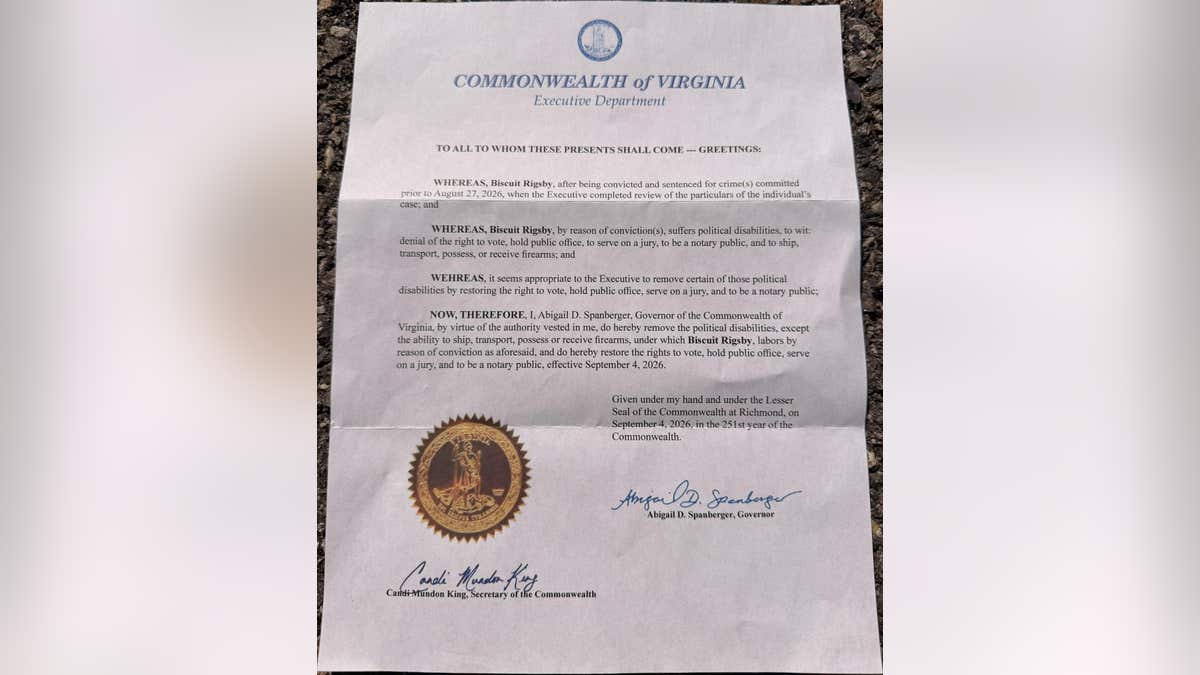
A formal inquiry into the administrative vetting processes of the Commonwealth of Virginia has been initiated by Del. Tom Garrett, R-Buckingham, following the revelation that a deceased family pet was issued an official state certificate restoring its voting and jury-service rights. The incident, which involves a beagle-hound mix named Biscuit that passed away five years ago in Goochland County, has ignited a fierce debate regarding the efficacy of the Governor’s office in managing the restoration of civil rights for formerly incarcerated individuals.
This development follows a series of administrative errors that have drawn scrutiny toward the current gubernatorial administration’s record-keeping and vetting protocols. The "Biscuit" incident, as it has been termed by critics, mirrors a recent controversy in Chesapeake where an individual identified only as "Betty No Last Name" was reportedly granted the restoration of voting rights despite a lack of verifiable identity information. These instances have converged just days before Virginia voters head to the polls to decide on a consequential ballot initiative that would render the restoration of voting rights for convicted felons an automatic, rather than discretionary, process.

A Chronology of Administrative Errors
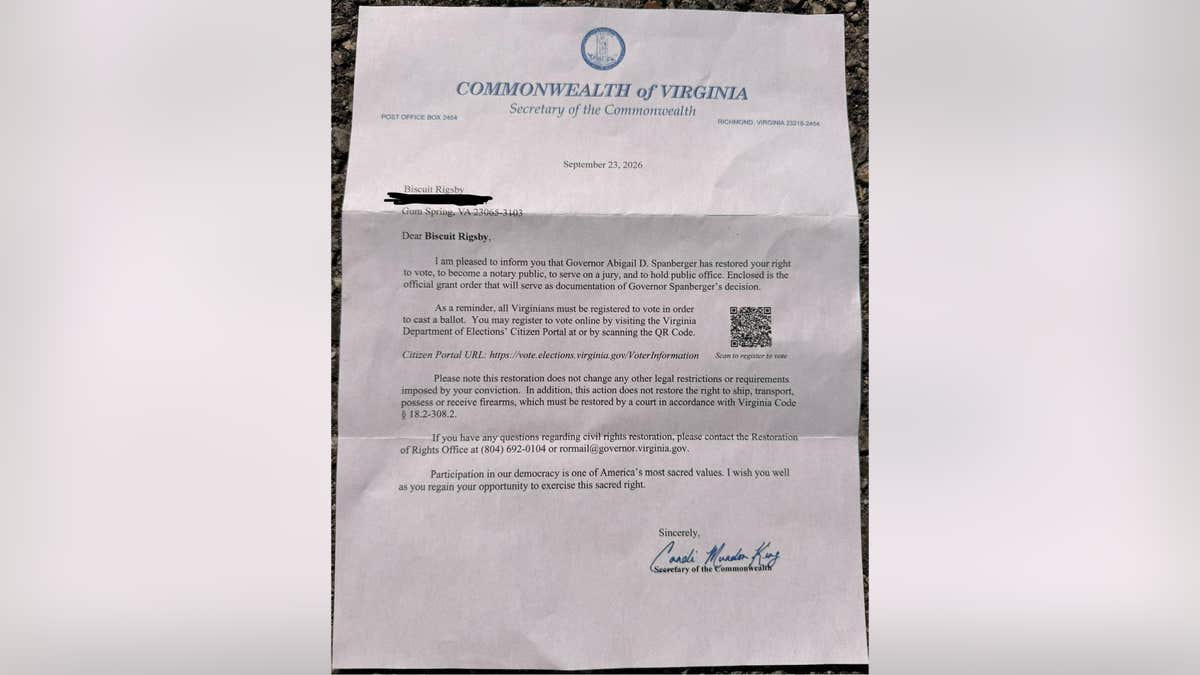
The documentation received by the constituent—the former owner of the dog—was an official notice from the Commonwealth asserting that the executive branch had conducted a thorough review of the individual’s criminal history before determining that their civil rights should be restored. For the owner, the arrival of the document was both a confusing and somber reminder of their pet, which had no history of criminal activity and, as the owner noted, "never showed any interest in voting."
The timeline of the administration’s "proactive" rights-restoration push began in earnest this year. In July, the administration announced that Secretary of the Commonwealth Candi Mundon-King would oversee a systematic effort to identify eligible Virginians who had completed their sentences and ensure their rights were restored. By August, Governor Abigail Spanberger announced that the initiative had successfully processed 100,000 individuals, a significant increase from the initial projection of 66,000.
However, as the scale of these restorations expanded, so did reports of anomalous entries in the state’s rolls. The case of "Biscuit" suggests that the high-volume approach to rights restoration may have outpaced the capacity for manual or algorithmic verification, leading to what critics describe as "rank incompetence" in the handling of sensitive government data.
Data Integrity and Vetting Protocols
The core of the issue centers on the verification process used by the Secretary of the Commonwealth’s office. According to the state’s public statements, the restoration process involves identifying individuals who have lost their rights due to felony convictions, confirming their release from incarceration, and ensuring their eligibility under state law.
The fact that a deceased dog was successfully processed through this system raises significant questions regarding the databases utilized by the Commonwealth. To issue a certificate of restoration, the system must, at a minimum, verify an individual’s name, their history of conviction, and their status as a resident of the Commonwealth. The inclusion of a pet in this database suggests either a deep flaw in the underlying data sources—such as public records being incorrectly mapped to animal registration or veterinary records—or a complete failure of the secondary review process that is meant to ensure that each certificate is issued to a legitimate human being.
Del. Tom Garrett, who also serves as an attorney in Fluvanna County, argues that the incident serves as a red flag for the entire system. "The document itself represents that the executive reviewed the particulars of each case," Garrett stated. "If a deceased family pet made it through that process as a convicted felon, then we need to know what was actually reviewed, what databases were used, what safeguards existed, and how many other erroneous restorations were issued."
The Political and Legal Stakes
The timing of this revelation is particularly sensitive. With the 2026 midterm elections approaching, the issue of voting rights for former felons has become a focal point of the campaign. The ballot measure supported by Richmond Democrats proposes a constitutional shift that would remove the Governor’s discretionary power in favor of an automatic process triggered by the completion of a sentence.
Supporters of the automatic restoration measure argue that the current system is overly bureaucratic and that the administrative errors are anecdotal, not systemic. They maintain that the goal of reintegrating former felons into the democratic process outweighs the risk of isolated clerical mistakes. However, opponents, led by lawmakers like Garrett, argue that the "Biscuit" case demonstrates that the state cannot currently be trusted to manage an even larger, automated system.
"This is not a question of whether people who have served their sentences deserve a second chance," Garrett noted. "This is a question of whether the Commonwealth is exercising one of the Governor’s constitutional powers with even the most basic level of review."

Implications for Future Policy
Beyond the immediate political fallout, the incident highlights a broader challenge for state governments: the modernization of voter registration and civil rights databases. In an era of digital integration, states are increasingly relying on cross-agency data sharing to streamline services. When these databases are not properly cleaned—or when they contain legacy records of deceased persons, pets, or duplicate entries—the risk of "zombie" registrations or fraudulent activity increases significantly.
Recent reports from various watchdog groups have warned that many state voter registration systems lack the necessary "clean-up" protocols to reconcile deaths with active voter rolls. The federal Treasury has previously lauded its own success in preventing millions of dollars in erroneous payments to deceased individuals, suggesting that such errors are avoidable with the application of rigorous anti-fraud technology.
Garrett has called for an immediate independent audit of the administration’s restoration actions. He is demanding that the Commonwealth disclose:

- The specific databases used to cross-reference candidates for rights restoration.
- The internal audit trail that led to the issuance of the certificate for "Biscuit Rigsby."
- A comprehensive count of all restorations issued to individuals who may not meet the basic criteria of being a living, human citizen with a relevant criminal record.
Official Response and Public Sentiment
As of the publication of this report, the Office of Governor Abigail Spanberger has not provided an official explanation for the error. The silence from the administration has left a vacuum filled by speculation and increasing demands for accountability from both sides of the aisle.
For the constituents of Virginia, the incident has served as a touchstone for concerns about government transparency. While the case of a deceased beagle is often treated as a humorous or absurd anomaly in political discourse, the underlying question—how a state agency could "review" a non-human entity and grant it the rights of a citizen—is a serious matter of public administration.
As voters prepare to decide on the future of voting rights in the Commonwealth, the case of Biscuit stands as a stark reminder of the complexities involved in government record-keeping. The upcoming election will not only decide the policy path for the state but will also likely serve as a referendum on the public’s confidence in the administrative competence of the current leadership.

The demand for an independent, third-party audit remains the central request from legislative critics. Whether such an audit will be granted before the Election Day vote remains uncertain, but the pressure on the administration to explain its vetting process is intensifying. Until a satisfactory explanation is provided, the case of the dog that was erroneously granted the right to vote will continue to symbolize the broader anxieties surrounding election integrity and the accuracy of state-maintained records in an increasingly automated world.

