
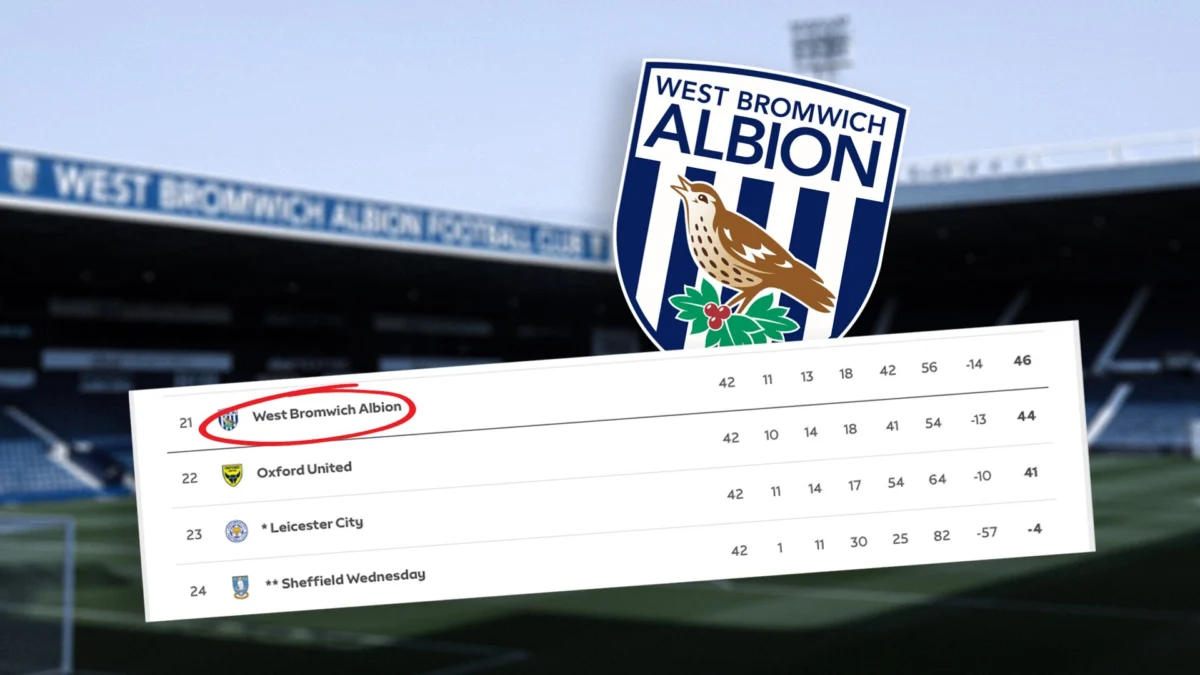
West Bromwich Albion have been officially charged by the English Football League (EFL) for an alleged breach of Profit and Sustainability Rules (PSR), plunging the club into a period of significant sporting and financial uncertainty as the Championship season enters its final stages. The charges, brought forward by the EFL’s Club Financial Reporting Unit (CFRU), suggest that the Baggies exceeded the permitted loss thresholds over a rolling three-year period. While the club has issued a firm denial and expressed its intention to cooperate fully with the investigation, the specter of a points deduction looms large, potentially altering the landscape of the relegation battle and the club’s long-term stability.
The Nature of the Alleged Breach
The intricacies of the EFL’s financial regulations are complex, but the core of the issue for West Bromwich Albion appears to stem from the accounting period ending in the 2023/24 season, with the relevant documentation having been submitted to the league on December 31, 2023. Under current PSR guidelines, Championship clubs are permitted to lose a maximum of £39 million over a three-year cycle, provided those losses are covered by secure owner funding. If a club does not have such backing, the allowable loss drops significantly to just £15 million over the same period.
According to reports from Sky Sports News and financial analysts monitoring the situation, the alleged breach is considered "marginal" rather than "flagrant." This distinction is critical in the world of sports law and financial regulation. A flagrant breach usually involves a deliberate attempt to circumvent rules or a massive overspend that provides a clear and unfair sporting advantage. In contrast, a marginal breach often involves disputes over what constitutes "allowable expenditure."
Clubs are permitted to deduct certain costs from their PSR calculations to encourage long-term sustainability and community growth. These deductions typically include spending on infrastructure, the club’s academy, community projects, and the development of women’s football. It is understood that West Bromwich Albion and the EFL have been engaged in protracted negotiations regarding these specific figures. A primary point of contention is believed to be the interest paid on loans during the tenure of the club’s previous majority shareholder, Guochuan Lai. Under Lai’s ownership, the club took out several high-interest loans, including a significant facility from MSD Holdings, to maintain liquidity. The EFL’s reporting unit may be arguing that the interest on these loans should be counted toward the loss limit, whereas the club may have attempted to categorize or offset them differently.
The Shadow of the Guochuan Lai Era
To understand the current predicament, one must look at the financial legacy of the previous ownership. Guochuan Lai’s period at the helm of West Bromwich Albion was marked by a lack of direct investment and a series of controversial financial maneuvers. This included a £4.95 million loan taken from the club by Lai’s company, Wisdom Smart Corporation Limited, which remained unpaid for years.
The reliance on external debt to fund operations created a precarious financial structure. While the club was successfully sold to Florida-based businessman Shilen Patel in February 2024, the PSR calculations look back at the three years preceding the current season. Consequently, the new ownership has inherited a financial "hangover" from the previous regime. While Patel’s arrival brought optimism and much-needed stability, it could not retroactively erase the balance sheets of the 2021-2023 period.
Potential Sanctions and Legal Precedents
If an independent commission finds West Bromwich Albion guilty of a PSR breach, the most likely punishment is a points deduction. The precedent set by other EFL cases suggests a sliding scale of severity. Earlier this season, Leicester City were informed of a potential six-point deduction for their own financial discrepancies, although their situation involved different complexities relating to their transition between the Premier League and the Championship.
Given that West Brom’s breach is described as marginal, legal experts suggest a deduction of approximately three points is more probable. This would align with the principle of proportionality, where the punishment fits the scale of the overspend. However, the commission retains the discretion to impose heavier or lighter sanctions based on aggravating or mitigating factors.
The club remains adamant that no rules were broken. In an official statement, a spokesperson for West Bromwich Albion said: "The club considers that it has fully complied with the P&S rules. The club will continue to co-operate with the EFL’s Club Financial Reporting Unit and looks forward to resolving this matter."
Impact on the Championship Relegation Battle
The timing of these proceedings has created a significant integrity issue for the Championship. West Bromwich Albion are currently embroiled in a desperate fight for survival. As the table stands, the club sits on 46 points, placing them just two points above the relegation zone. However, if a three-point deduction were applied immediately, they would fall into the bottom three, drastically changing their survival prospects and the morale of the squad.
The uncertainty does not just affect West Brom; it impacts every club in the bottom half of the table. Rival clubs such as Leicester, Oxford, Blackburn, and Portsmouth are all currently separated by a handful of points. None of these teams truly knows the "real" state of the league table. A club that finishes the season one point above West Brom may find themselves relegated if the Baggies win an appeal, or conversely, a club that finishes in the bottom three could be saved if West Brom’s deduction is confirmed after the final whistle.
This creates a scenario where "sporting integrity" is compromised. Football is a game where teams need to know exactly what is required of them in the final weeks of the campaign. The lack of clarity regarding the final points total makes strategic planning nearly impossible for managers and players alike.
The "Relegated Three" and the EFL’s Position
There is a growing and uncomfortable possibility that the three clubs relegated from the Championship this season could all be teams that have faced or are facing points deductions. Sheffield Wednesday, Leicester City, and West Bromwich Albion have all been under the financial microscope. Critics argue that this reflects poorly on the league’s management, suggesting that the "beautiful game" is being decided in boardrooms and courtrooms rather than on the pitch.
However, the EFL maintains that it is simply enforcing the rules that the clubs themselves voted for. In a collective effort to prevent clubs from spending beyond their means and risking total collapse—as seen in the cases of Bury and Macclesfield Town—EFL members agreed to strict PSR guidelines. One of the core principles agreed upon was that punishments should be served in the season immediately following the breach to ensure that the team that gained an unfair advantage is the one that pays the price.
Timeline of the Independent Commission
The EFL is under immense pressure to resolve this case before the conclusion of the 2024/25 season. The guidelines are clear: any punishment should be handed down in the season the accounts are submitted. However, the definition of the "end of the season" remains somewhat fluid. Does it mean the final day of the regular season? The conclusion of the play-offs? Or the date when the league constitution is formally set for the following year?
The process involves the EFL’s CFRU bringing the charge, followed by the appointment of an independent disciplinary commission. This commission, usually comprised of legal and financial experts, will hear evidence from both the league and the club. Given the complexity of West Brom’s "allowable expenditure" arguments, this process could take several weeks. If a verdict is reached in late April or early May, the club would still have the right to appeal, potentially pushing a final decision into the summer months.
Broader Implications for Football Governance
The situation at West Bromwich Albion is a symptom of a larger shift in English football. With the impending introduction of an independent football regulator, the EFL and the Premier League are tightening their internal controls to prove they can govern themselves effectively.
The focus on PSR is designed to protect clubs from ruinous debt, but it also creates a "glass ceiling" for clubs trying to compete with those benefiting from parachute payments or billionaire owners. For West Brom, a club that has spent much of the last two decades moving between the top two divisions, the current charges highlight the extreme difficulty of maintaining a competitive squad while adhering to strict financial limits in the Championship.
As the independent commission prepares to meet, the eyes of the football world remain on the West Midlands. The outcome will not only determine West Bromwich Albion’s divisional status for next year but will also serve as a landmark case for how "marginal" financial breaches are handled in an era of increasing scrutiny. For the fans at The Hawthorns, the hope is that the battle for survival can be won on the grass, rather than through the technicalities of a balance sheet.

