
The global imperative to transition to renewable energy sources is accelerating at an unprecedented pace. Driven by the dual ambitions of achieving energy independence and mitigating the escalating impacts of climate change, nations and corporations worldwide are engaged in a massive build-out of solar power and battery storage infrastructure. This monumental undertaking, however, is encountering a significant bottleneck: a burgeoning labor shortage in the construction sector, specifically for the skilled workforce required for solar installation. While industrial robotics has historically faced limitations in adapting to the unpredictable, unstructured environments typical of construction sites, a new generation of artificial intelligence models is poised to redefine this paradigm, offering a potential solution to this critical challenge.
Emerging from this confluence of necessity and technological advancement is Gritt, a startup founded by Carnegie Mellon-trained roboticists Puneet Puri (CEO) and Vishal Dugar (CTO). The company officially emerged from stealth mode this past Tuesday, announcing a substantial $26 million Series A funding round. This significant investment was spearheaded by Obvious Ventures, with crucial participation from Union Square Ventures and Active Impact Investment. This latest funding injection propels Gritt’s total raised capital to $34 million, building upon an earlier seed round that garnered support from prominent investors including First Round Capital, Climactic, Congruent Ventures, and VSC Ventures. Gritt’s core mission, as articulated by CEO Puneet Puri, is to "help civilization build infrastructure faster."
The foundational principle guiding Gritt’s strategy is the recognition that accelerating construction timelines necessitates an intelligent system capable of operating effectively in the dynamic and often chaotic outdoor environments characteristic of construction sites. Furthermore, this intelligence must possess a high degree of generalizability to adapt to the diverse conditions encountered across various projects. "Our thesis is that if we truly want to speed up construction, you need an intelligence which can work in the outdoor, chaotic environments of these construction sites, and it has to be generalizable enough that it can work in these varied environments," Puri elaborated in an interview.
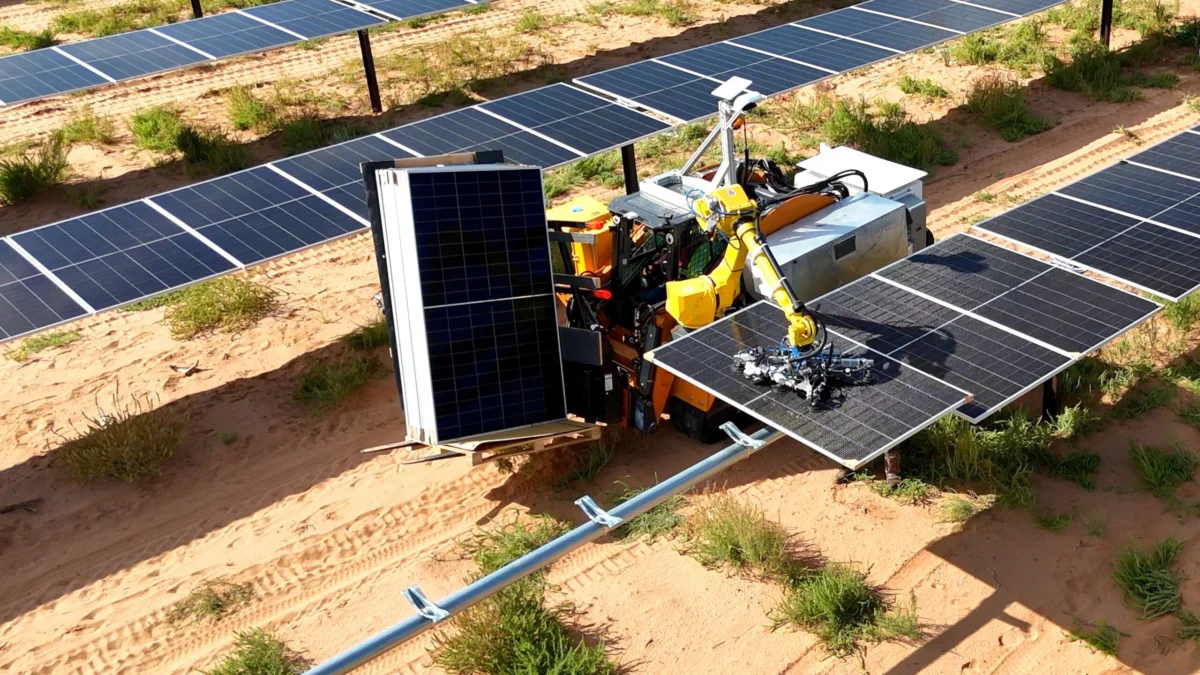
A key differentiator in Gritt’s approach is its strategic decision to leverage off-the-shelf hardware rather than developing proprietary robotic platforms from scratch. This pragmatic strategy allows for faster deployment and scalability. To date, Gritt has utilized rented equipment, including skidders and robotic arms sourced from established manufacturers such as Kawasaki. These commercially available hardware components are integrated with Gritt’s proprietary AI models, forming sophisticated platforms capable of executing complex tasks. The initial application of Gritt’s systems focuses on the precise and efficient unloading of large, glass solar panels. These panels are then transported to their designated metal frames and positioned with sub-millimeter accuracy, a crucial step that enables human workers to securely fasten them into place.
Andrew Beebe, a partner at Obvious Ventures who led the Series A round, highlighted the distinctive entrepreneurial spirit behind Gritt. "There are people who used to build rockets that went into space and had infinite budget for the smallest little part, and then there are people who know what it means to get into dirty, dull, and dangerous jobs and scale them like mad," Beebe remarked. "These guys are in the second camp, and that’s a special kind of entrepreneur that has the technical chops, the AI, and the machine vision skills to make it work." This perspective underscores the company’s focus on tackling fundamental, labor-intensive challenges with innovative technological solutions.
Currently, Gritt has two of its intelligent systems actively deployed in real-world construction environments. The data collected from these operational units is continuously fed back into the AI models, enabling ongoing refinement and improvement of their performance. The impact of Gritt’s technology on productivity is substantial. Puri noted that a typical eight-person crew can install approximately 800 solar panels per day. However, when augmented by Gritt’s robotic systems, the same crew can significantly boost their output, installing an estimated 3,000 to 4,000 panels daily. This represents a potential increase in installation efficiency of up to 400%.
The company’s growth trajectory appears robust. Gritt reports that it is currently contracted to facilitate the installation of 2.8 gigawatts of solar panels over the next 18 months. Its client roster includes three of the top ten solar construction companies in the United States, indicating strong market validation and trust from industry leaders. Looking ahead, Gritt aims to expand its operational footprint significantly, with plans to have 48 of its systems deployed within the next six months.
Enthusiasm for Gritt’s technology is evident among its customers. One client, who requested anonymity due to competitive considerations, expressed strong optimism regarding the system’s ability to enhance their operations. They anticipate particular benefits in remote project locations where attracting and retaining labor is a persistent challenge. Furthermore, the client foresees a notable reduction in workplace injuries, as the repetitive and physically demanding task of repeatedly lifting heavy solar panels overhead will be largely automated.
Gritt operates within a competitive landscape that includes other companies developing robotic solutions for solar panel installation. Notable competitors include Luminous Robotics and Cosmic, both based in the US, and Trinabot, a Chinese company. A key strategic difference, however, lies in Gritt’s choice to build its intelligent systems atop existing hardware platforms, in contrast to competitors who are developing their own bespoke robotic hardware. This strategy could potentially lead to faster scaling and a leaner cost structure for Gritt as demand for solar infrastructure continues to surge globally.
The company’s long-term vision extends beyond the initial task of panel installation. Gritt aims to equip its systems with the capability to perform a wider range of manipulation tasks on-site. This includes fastening the installed solar panels, drilling foundation posts, and constructing the very racks on which the panels are mounted. Further down the line, Gritt intends to broaden its scope to address other labor-intensive construction activities, such as the critical process of tying rebar before concrete is poured.
The acceleration of Gritt’s ambitious development roadmap has been largely enabled by recent breakthroughs in artificial intelligence. The founders point to the rapid advancements in new AI models as the primary catalyst. "Making a system for one solution was still possible to some extent five years ago, right?" Puri explained. "But now, AI is making that work generalizable—the same underlying pipeline can be reused and improve across tasks." He provided a compelling example: while training a system to stack cinder blocks previously took weeks, a similar demonstration involving rebar tying, using the same software pipeline, was accomplished in just a single day. This significant reduction in training time and increase in adaptability is a testament to the power of modern AI.
However, Gritt’s aspirations transcend mere task automation. The founders envision their systems, equipped with advanced sensor suites and AI intelligence, becoming integral to on-site management and decision-making processes. For instance, a Gritt system could potentially detect an open trench during an approaching storm and alert workers to cover it, thereby preventing potential damage to components from rain. Similarly, the system could identify missing inventory, streamlining project logistics. "Gritt becomes now this layer of physical AI, which is doing this dextrous, labor-intensive task, plus it can help you take decisions on the site," Puri stated, highlighting the dual role of their technology as both a physical workforce augment and an intelligent advisor.
The implications of Gritt’s technological advancements are far-reaching. By addressing the labor shortage in solar installation, the company has the potential to significantly accelerate the deployment of renewable energy infrastructure, a critical step in global climate change mitigation efforts. Furthermore, by improving efficiency and reducing the physical strain on human workers, Gritt contributes to a safer and more sustainable construction industry. The company’s focus on leveraging existing hardware, powered by adaptable AI, presents a compelling model for future automation in infrastructure development, promising scalability and cost-effectiveness in a rapidly evolving market.
Supporting Data and Context
The global solar energy market is experiencing exponential growth. According to the International Energy Agency (IEA), solar PV additions reached a record high of 220 gigawatts (GW) in 2022, accounting for two-thirds of all renewable capacity additions globally. Projections indicate this trend will continue, with the IEA forecasting that solar PV will become the largest source of electricity generation globally by 2025. This sustained growth underscores the critical need for efficient and scalable installation solutions.
The labor market challenge in construction is well-documented. In the United States, the construction industry has faced a persistent shortage of skilled workers for years, a situation exacerbated by an aging workforce and a lack of new entrants. This deficit directly impacts project timelines and costs, particularly for large-scale renewable energy projects. A report by the National Association of Home Builders indicated a significant gap between the demand for construction workers and the available supply.
Timeline of Developments
- Past: Traditional industrial robots struggled with unstructured outdoor environments.
- Recent: Advancements in AI models enable robots to operate more effectively in complex, dynamic settings.
- Present: Gritt emerges from stealth mode with $26 million Series A funding, focusing on AI-powered solar installation robotics.
- Immediate Future: Gritt aims to deploy 48 systems within six months and install 2.8 GW of solar capacity in 18 months.
- Long-Term Vision: Gritt plans to expand its capabilities to include fastening, drilling, rack building, and eventually other common construction tasks like rebar tying.
Broader Impact and Implications
Gritt’s innovative approach has the potential to not only expedite the solar energy transition but also to redefine the future of construction. By making infrastructure development faster, safer, and more efficient, the company contributes to a more sustainable and resilient global energy system. The success of Gritt could also inspire further investment and innovation in AI-driven robotics for other labor-intensive industries, paving the way for a more automated and productive future. The company’s ability to integrate with existing hardware and its focus on generalizable AI offer a flexible and scalable model that could be adopted across various construction and infrastructure projects worldwide.

