
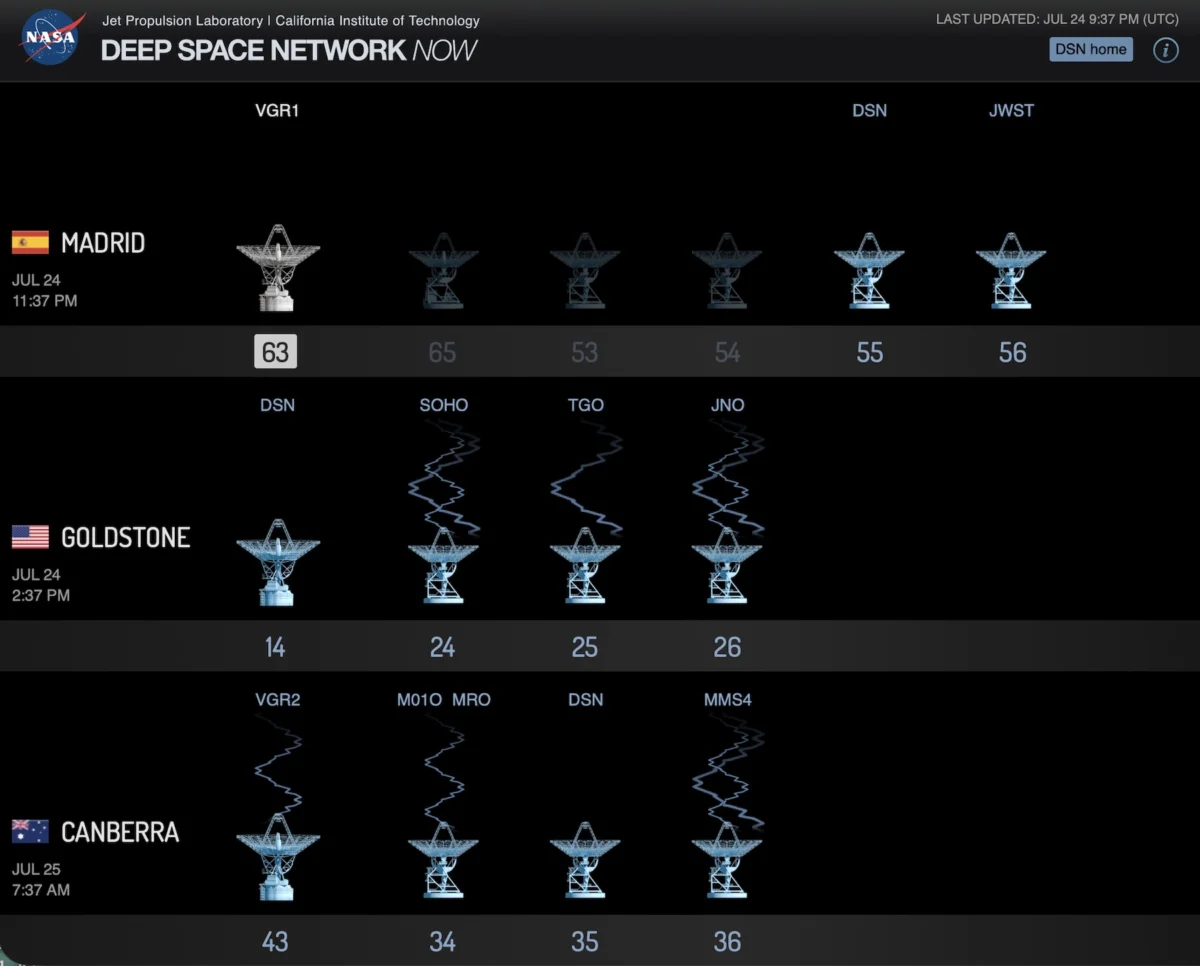
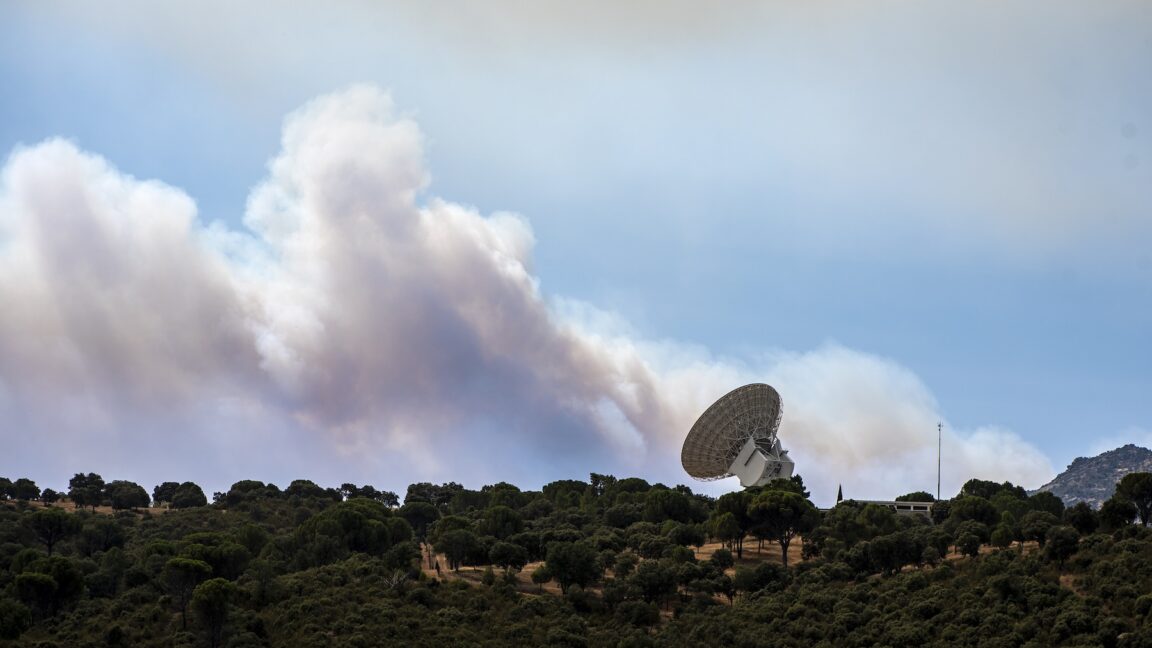
The critical global network responsible for communicating with deep space missions has been significantly hampered by devastating wildfires raging west of Madrid, Spain. As of Friday afternoon, the Madrid Deep Space Communications Complex, a vital node in NASA’s Deep Space Network (DSN), reported no activity, leaving the network critically reliant on its remaining two operational sites in California and Australia. This disruption comes at a time when the DSN is already facing challenges with a damaged antenna in California and as NASA prepares for future ambitious lunar missions.
Escalating Wildfire Crisis Impacts Space Communications
The immediate cause of the disruption is the rapid spread of wildfires that have forced widespread evacuations in the mountainous regions west of Madrid. Spanish authorities have ordered over 19,000 people to evacuate their homes as firefighting efforts intensify. More than 2,000 personnel and 10 aircraft are engaged in combating the blazes, fueled by a combination of a severe summer heatwave and prolonged drought conditions that have created tinderbox conditions across Spain and France.
NASA confirmed the operational status of its DSN complexes, stating, "The safety and well-being of our personnel is our highest priority, and our thoughts are with the families and neighbors who are also experiencing the impact of the wildfires in the surrounding communities. We will provide updates as conditions evolve." While the Madrid site was offline, antennas at the California and Australian facilities continued their vital work, maintaining communication links with several key NASA spacecraft. These include the venerable Voyager 2, currently exploring the interstellar medium billions of miles from Earth, and Juno, which continues its groundbreaking scientific observations of Jupiter and its intense magnetosphere.
The impact extends beyond NASA’s immediate operations. The Cebreros tracking station, a crucial facility owned and operated by the Spanish government and a part of the European Space Agency’s (ESA) Estrack network, was also evacuated due to the encroaching wildfires. Located just a few miles from NASA’s DSN facility in Robledo de Chavela, Cebreros plays a significant role in supporting ESA missions and other international space endeavors. Its temporary inoperability further strains the global space communication infrastructure.
Deep Space Network: A Fragile Global Backbone
The Deep Space Network is a vital, interconnected system of three large antennas located strategically around the globe: one in Goldstone, California; one in Canberra, Australia; and the now-affected site in Madrid, Spain. This global triangulation allows for continuous communication with spacecraft, ensuring that signals can be received and transmitted regardless of Earth’s rotation. Each complex is equipped with powerful radio antennas, including the iconic 70-meter (230-foot) dishes, capable of sending and receiving faint signals from missions traversing the vast expanse of the solar system and beyond.
The Madrid site’s current inactivity significantly diminishes the DSN’s capacity. With the Madrid complex offline, the network is reduced to a single operational 70-meter antenna in Australia. This situation is compounded by the prolonged outage of the 70-meter antenna at the Goldstone DSN complex in California. This antenna has been offline since last year following an accident where it "over-rotated," causing significant damage to internal cables and water lines. The malfunction led to a substantial flood at the antenna’s base, with approximately 200,000 gallons of water, contaminated with glycol, inundating the area – an environmental hazard that necessitated extensive cleanup and repair operations.
Repair and Upgrade Efforts: A Long Road Ahead
The extensive repair and upgrade work on the Goldstone 70-meter antenna is projected to be a costly undertaking, with estimates ranging between $4.1 million and $4.6 million. NASA officials have strategically chosen to combine these necessary repairs with already scheduled upgrades to the facility. This integrated approach aims to maximize efficiency and ensure the antenna is not only restored to full operational capacity but also enhanced for future missions. However, this ambitious project is expected to keep the antenna offline well into 2028, further highlighting the network’s current vulnerabilities.
The confluence of these issues – the wildfire-induced outage in Madrid and the extended repair of the California antenna – places unprecedented strain on the DSN’s ability to support ongoing and upcoming space exploration endeavors. The reliance on a single 70-meter antenna in Australia for certain critical communications presents a significant bottleneck.
Implications for Future Missions: Artemis and Beyond
While the current DSN situation presents challenges, the immediate impact on NASA’s upcoming lunar program, Artemis, may be somewhat mitigated by the mission timelines. The next Artemis mission to the Moon is still at least a couple of years away. Artemis missions, particularly those involving human spaceflight, place extremely high demands on the DSN, requiring substantial bandwidth for telemetry and imagery downlinks to support astronaut safety and scientific objectives.
Artemis III, the mission intended to be the first human lunar landing of the program, has been rescheduled. It will now focus on testing the Orion capsule in low-Earth orbit, integrating it with commercial lunar landers from SpaceX and Blue Origin. Artemis IV, the program’s first planned lunar landing with astronauts, is now targeted for no earlier than 2028. This revised timeline, while potentially pushed back, offers a crucial window for NASA to address the DSN’s current operational limitations and complete the necessary repairs and upgrades.
Historical Context and Resilience of the DSN
The Deep Space Network has been the lifeline for space missions since its inception in the late 1950s. Its three globally distributed complexes have enabled humanity’s most ambitious journeys into space, from the early lunar missions and the Voyager probes to the Mars rovers and the Parker Solar Probe. The network’s design inherently accounts for redundancy, with the three sites working in concert to provide near-continuous contact with spacecraft. However, the current scenario, with one site directly impacted by an environmental disaster and another undergoing extensive repairs, underscores the fragility of this vital infrastructure when multiple points of failure converge.
The Madrid complex, officially known as the Robledo Deep Space Communications Complex, has been a cornerstone of DSN operations for decades. Its strategic location in Spain provides crucial coverage for missions in the eastern hemisphere of the solar system and beyond. The facility houses multiple antennas, including a 34-meter (112-foot) dish and the powerful 70-meter antenna, making its absence a significant blow to the network’s overall capabilities.
Broader Impact and Future Preparedness
The incident highlights the growing vulnerability of critical infrastructure to environmental factors, exacerbated by climate change. The increasing frequency and intensity of extreme weather events, such as the current wildfires, pose a tangible threat to operations that underpin scientific discovery and national security.
For the DSN, this event serves as a stark reminder of the need for robust contingency planning and investment in resilient infrastructure. While the current situation is manageable due to the staggered timelines of major missions, any further disruptions or unforeseen delays in the repair of the Goldstone antenna could have far-reaching consequences for ongoing scientific endeavors.
Looking ahead, NASA and other space agencies will likely need to re-evaluate their strategies for maintaining the DSN’s operational readiness. This could involve accelerated repair timelines, exploring alternative communication technologies, or investing in additional, perhaps smaller, distributed ground stations to enhance redundancy. The resilience of the DSN is not just a technical challenge; it is fundamental to humanity’s continued exploration of the cosmos. The current crisis in Spain, while a testament to the bravery of emergency responders and the dedication of NASA personnel, underscores the critical need for a globally robust and resilient communication network for the future of space exploration. The coming months will be crucial as the DSN navigates these challenges, striving to maintain its unwavering connection to the frontiers of human discovery.

