
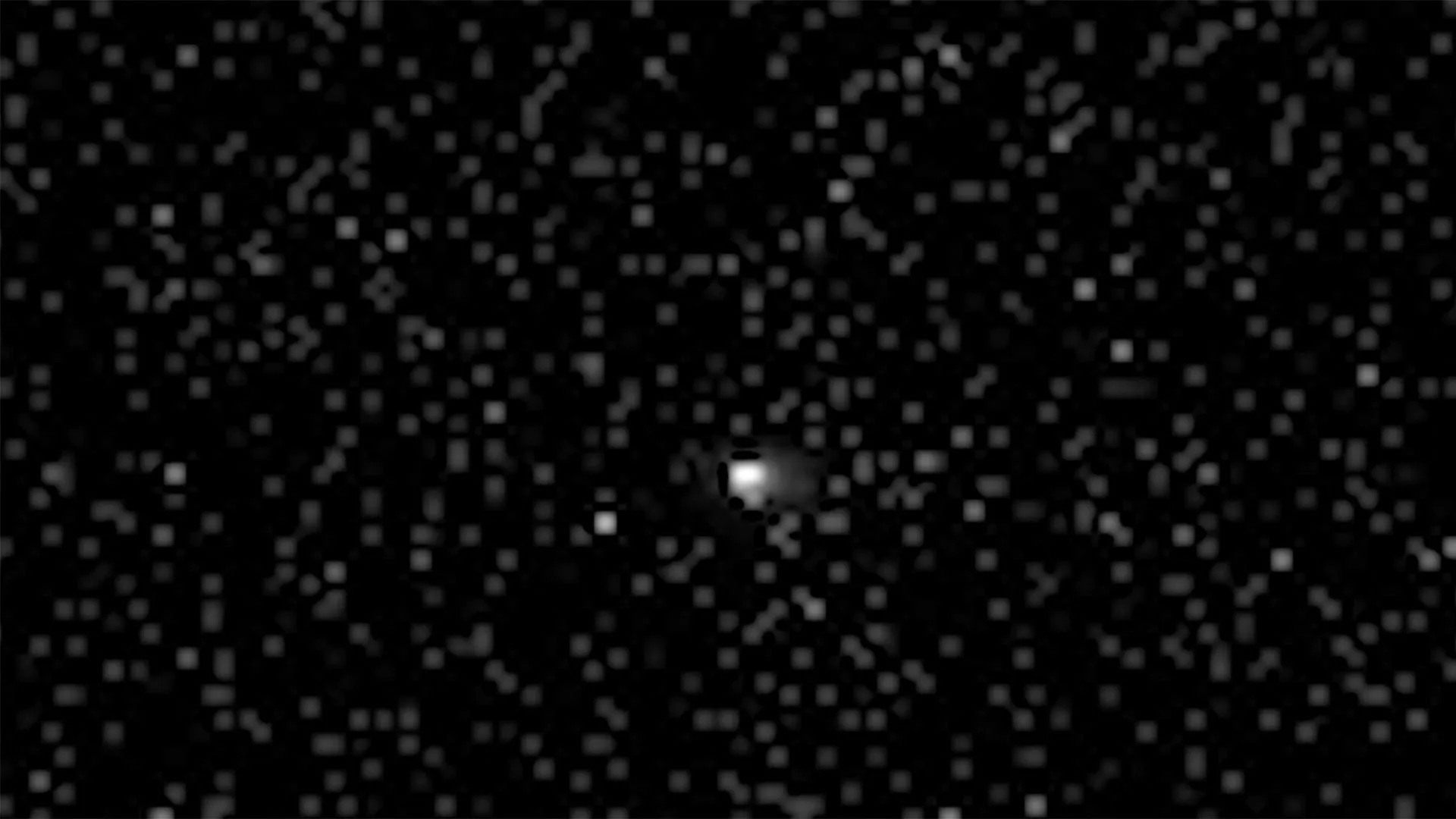
China’s ambitious Tianwen-1 mission, currently in orbit around Mars, has achieved a significant scientific milestone by capturing unprecedented images of the interstellar object 3I/ATLAS as it journeyed through the solar system. The China National Space Agency (CNSA) announced that the Tianwen-1 orbiter utilized its high-resolution camera to photograph the comet from an impressive distance of approximately 30 million kilometers (18.6 million miles). This remarkable feat, occurring during the comet’s transit near the Red Planet, provides invaluable data for understanding objects originating from beyond our solar system.
Tianwen-1 has been diligently orbiting Mars for an extended period, now exceeding four years and eight months, positioning it as one of the closest spacecraft to have observed 3I/ATLAS since its discovery. The comet, officially designated 3I/ATLAS, was first identified on May 7th, 2025, and its interstellar origin was confirmed shortly thereafter, marking it as a rare visitor to our celestial neighborhood. The Tianwen-1 orbiter’s keen eye has now contributed crucial visual evidence to the growing scientific understanding of this cosmic traveler.
Tianwen-1 Reveals the Comet’s Intricate Structure
The newly released images from Tianwen-1 offer compelling evidence supporting the classification of 3I/ATLAS as a comet. The photographs clearly depict a visible tail extending majestically behind the object, a characteristic hallmark of comets. Furthermore, a diffuse cloud of gas and dust, known as the coma, is observed to encircle the comet’s nucleus. These features are indicative of the volatile materials that sublimate and escape the nucleus as a comet approaches the Sun and warms up.
Scientists have meticulously processed multiple images to construct an animation that meticulously traces the comet’s trajectory. This animation showcases the object’s movement as it heads towards its closest approach to the Sun. The observational data gathered by Tianwen-1 adds substantial weight to the growing body of evidence suggesting that 3I/ATLAS is composed of water and other volatile substances. These materials, dormant in the frigid expanse of interstellar space, likely began to vaporize and escape as the comet warmed during its passage through the inner solar system.
The success of this observation extends beyond the immediate scientific findings. It also serves as a significant preview of the scientific endeavors planned for China’s future missions, particularly Tianwen-2. This forthcoming mission is slated to investigate a Near-Earth Asteroid (NEA) before embarking on a study of a comet, potentially building upon the observational techniques and experiences gained from the Tianwen-1 encounter.
The Challenge of Capturing a Distant and Swift Target
The team responsible for operating Tianwen-1’s High-Resolution Imaging Camera (HiRIC) commenced preparations for this unique celestial event in early September. Their rigorous work involved extensive simulations, sophisticated theoretical modeling, and thorough inspections of the instrument to ensure optimal performance. Capturing clear images of 3I/ATLAS presented a formidable challenge due to the object’s considerable distance and its relatively modest size, estimated to be around 5.6 kilometers (3.5 miles) in diameter.
Adding to the complexity was the comet’s immense speed. 3I/ATLAS was traversing space at approximately 58 kilometers per second (36 miles per second). Its relative velocity to the Tianwen-1 orbiter was even more significant, reaching an astonishing 86 kilometers per second (53.5 miles per second). This rapid motion demanded precise timing and advanced tracking capabilities from the spacecraft’s instruments.
The HiRIC camera itself was not originally designed for observing such faint and distant objects. Its primary purpose was to capture high-resolution imagery of the Martian surface, similar to the instruments employed on the European Space Agency’s Mars Express and ExoMars Trace Gas Orbiter (TGO) spacecraft. These instruments are optimized for imaging relatively bright features on planetary surfaces, making the task of detecting and photographing a dim, fast-moving interstellar object a considerable engineering feat.
European Orbiters Join the Observation Effort
In a coordinated effort to maximize scientific returns, both European orbiters operating at Mars, Mars Express and ExoMars Trace Gas Orbiter (TGO), also turned their cameras towards 3I/ATLAS on October 3rd. Mars Express utilized its High Resolution Stereo Camera (HRSC) for the observation, while the ExoMars spacecraft employed its Colour and Stereo Surface Imaging System (CaSSIS).
Detecting 3I/ATLAS with these instruments proved exceptionally difficult. When compared to the brightly sunlit Martian landscape, the interstellar comet appeared an astonishing 10,000 to 100,000 times fainter. This stark difference in brightness underscored the sensitivity requirements for observing such elusive targets.
The High Resolution Stereo Camera (HRSC) aboard Mars Express typically operates with an exposure time of 0.5 seconds. The Colour and Stereo Surface Imaging System (CaSSIS) on TGO has a slightly longer maximum exposure of 5 seconds. While the specific exposure time utilized by Tianwen-1’s HiRIC for the 3I/ATLAS observations has not been publicly disclosed, the camera’s engineering for precise timing and rapid operation was crucial. These advanced capabilities were instrumental in obtaining the latest images, despite the inherent challenges that resulted in a grainy and somewhat blurry appearance.
A Rare Glimpse into Another Star System
Like the two other interstellar objects identified prior to it – ‘Oumuamua and Borisov – 3I/ATLAS offers extraordinary opportunities for both astronomical and astrobiological research. Asteroids and comets are considered cosmic time capsules, preserving leftover material from the formation of planetary systems. An object originating from interstellar space, therefore, holds the potential to contain unique clues about the conditions present around other stars and their nascent planetary systems.
The study of such an interlopers could revolutionize our understanding of planetary formation processes in other stellar nurseries and the composition of materials found in those environments. A dedicated mission designed to intercept and study an interstellar object, a concept currently being explored by various space agencies, could yield scientific insights that are simply unattainable through conventional telescopic observations.
The only comparable alternative for acquiring such detailed information would involve dispatching spacecraft directly to another star system. However, such an endeavor would necessitate an immense investment of time, resources, and technological advancements far beyond our current capabilities, making the study of interstellar visitors within our solar system a far more practical and immediate scientific pursuit.
The Future of Interstellar Object Exploration
The successful observation of 3I/ATLAS by Tianwen-1 and the European orbiters fuels the scientific community’s aspirations for future missions specifically equipped to intercept and study these rare interstellar visitors at close range. Scientists are keenly interested in obtaining direct samples and conducting in-situ analyses of these objects to unlock the secrets of their origin and composition.
One such promising initiative already in development is the European Space Agency’s (ESA) Comet Interceptor mission. This innovative mission, expected to be completed by 2029, is designed to wait in a strategic location in space, ready to be deployed towards a suitable long-period comet or another promising target, such as an interstellar object, once identified. The Comet Interceptor mission represents a proactive approach to space exploration, aiming to capitalize on serendipitous discoveries and provide a dedicated platform for studying these unique cosmic travelers.
The ability of Tianwen-1, a mission primarily focused on Mars, to pivot and capture images of 3I/ATLAS highlights the growing adaptability and scientific versatility of modern interplanetary spacecraft. As our detection capabilities improve, and our understanding of cometary and asteroidal populations within and beyond our solar system expands, the chances of encountering and studying more interstellar visitors are likely to increase. Each encounter offers a unique chance to peer into the distant corners of the galaxy and deepen our comprehension of the universe’s grand tapestry.

