
The intricate dance between electron and proton motion is a fundamental theme woven into the fabric of both biological systems and advanced engineered materials. For decades, scientists have marveled at proton-coupled electron transfer (PCET), a cornerstone process underpinning vital biological functions such as bioenergetics, cellular respiration, photosynthesis, and nitrogen fixation. This same principle has been instrumental in the design of numerous artificial materials engineered for energy conversion and storage. In recent years, the scientific community has expanded its understanding with the identification of another related phenomenon: proton-coupled singlet energy transfer (PCEnT). Now, building upon this foundational knowledge, researchers at the Dalian Institute of Chemical Physics of the Chinese Academy of Sciences, led by Professor Kaifeng Wu, have illuminated a previously enigmatic process: triplet energy transfer intricately linked to proton movement. This groundbreaking discovery, detailed in the prestigious journal Nature Materials, unveils a novel mechanism termed proton shuttle-assisted triplet energy transfer (PS-TET), promising to revolutionize our control over energy flow in a wide array of technological applications.
The Significance of Triplet Energy Transfer
Triplet energy transfer, distinct from its singlet counterpart, represents a crucial pathway for energy propagation within both natural ecosystems and synthetic constructs. While singlet energy transfer typically involves electrons with paired spins, triplet energy transfer engages states where electron spins are unpaired. This difference profoundly impacts the efficiency and pathways of energy movement. Understanding how proton dynamics influence this triplet energy transfer process holds immense potential for developing sophisticated methods to precisely govern energy flow in next-generation materials. The ability to manipulate triplet states could unlock new avenues in fields ranging from advanced lighting and displays to highly efficient solar energy harvesting and novel catalytic processes.
Unraveling the Proton Shuttle Mechanism
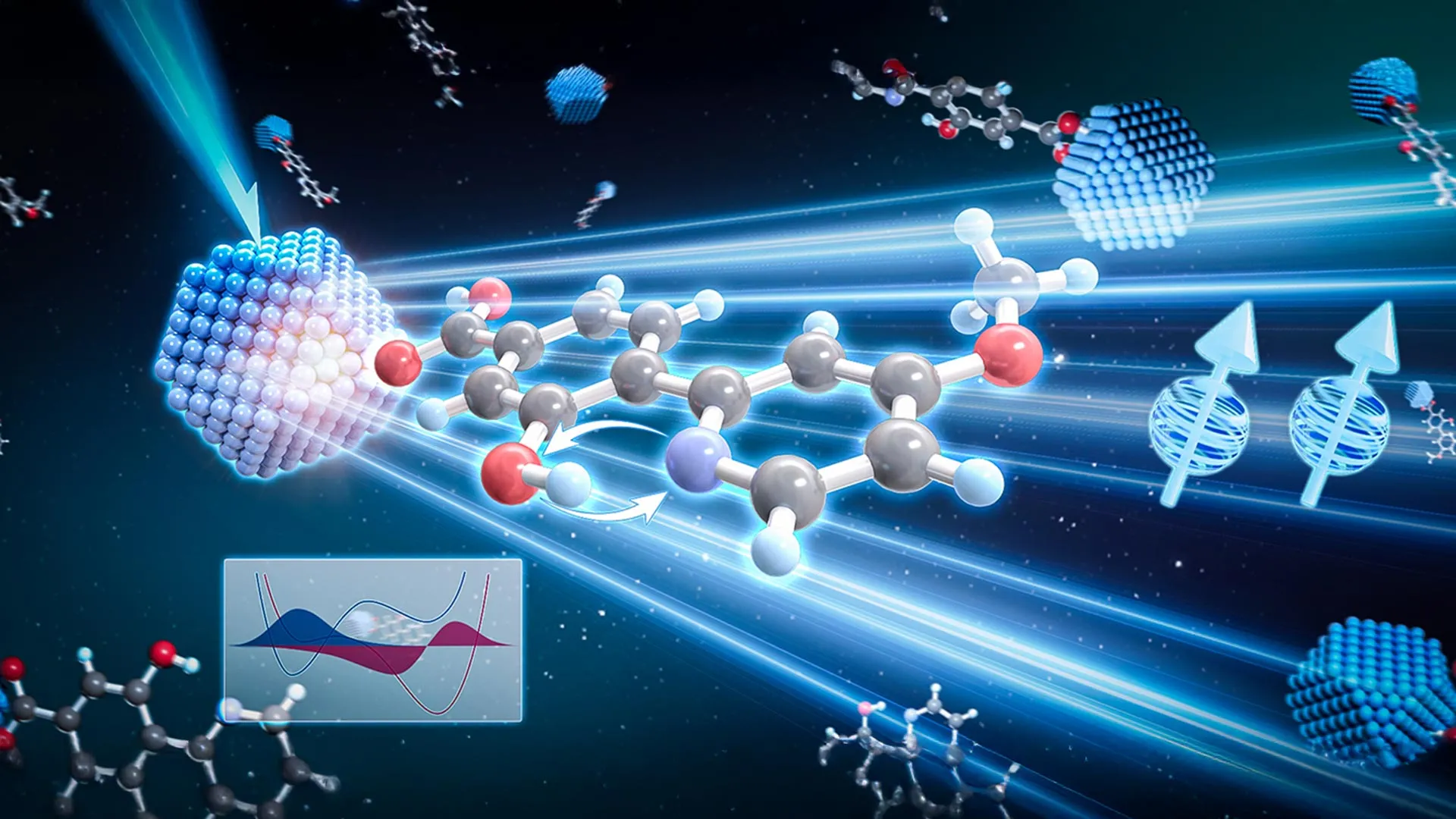
The research team’s pivotal study observed the PS-TET mechanism as energy was transferred from zinc selenide (ZnSe)-based colloidal quantum dots (QDs) to phenol-pyridine dyadic acceptors strategically anchored to their surfaces. The process, when initiated by light absorption by the ZnSe QDs, triggers an excited state. This initial excitation sets in motion a cascade of precisely coordinated molecular events.
The proposed mechanism unfolds in a series of elegant steps:
-
Excited State Formation and Initial Charge/Proton Migration: Upon absorbing light, the ZnSe QDs transition into an excited state. In this energized state, a "hole" – the absence of an electron – begins to migrate from the ZnSe material to the attached phenol molecule. Concurrently, a proton, a positively charged hydrogen ion, undertakes a simultaneous journey, moving from the phenol molecule to the pyridine moiety. This synchronized movement of charge and proton is a critical initial coordination.
-
Electron Transfer and Proton Re-localization: Following the initial migration, an electron is transferred from the ZnSe to the phenol moiety, which has now been transformed into a phenoxyl radical due to the preceding hole migration. In parallel, and with remarkable timing, the proton that had moved to pyridine embarks on its return journey, moving back from the pyridinium ion to its original location, effectively completing a localized shuttle.
-
Triplet Energy Transfer: The culmination of these coordinated electron and proton movements results in the overall transfer of spin-triplet energy from the ZnSe QDs to the phenol-pyridine dyad. While the proton ultimately returns to its starting position, its temporary transit through the shuttle mechanism plays an indispensable role.
Enhanced Efficiency Through Proton Shuttling
The impact of this proton shuttle is nothing short of remarkable. The researchers found that the presence of the proton shuttle dramatically accelerates both the speed and the efficiency of triplet energy transfer. To quantify this enhancement, the team compared the PS-TET process to a control system where the phenol-pyridine dyad was modified with a methyl group instead of the proton-donating and accepting functionalities. This methylated analog, lacking the proton shuttle, exhibited significantly slower and less efficient triplet energy transfer. While specific percentage increases in efficiency were not detailed in the initial release, the qualitative difference observed underscores the profound influence of the proton’s temporary displacement.
Furthermore, the study revealed that the electronic properties of the pyridine component can subtly alter the sequence of these proton-coupled electron and hole transfer events. By introducing a strongly electron-withdrawing trifluoromethyl substituent to the pyridine ring, the researchers observed a shift in the order of proton-coupled electron and hole transfer, highlighting the delicate interplay of electronic and protonic factors in dictating the energy transfer pathway. This level of tunability suggests a sophisticated control mechanism that can be engineered.
Quantum Tunneling at Room Temperature: A Surprising Revelation
A particularly astonishing aspect of the PS-TET mechanism is its temperature independence. The rate at which the proton shuttle operates, and consequently the overall triplet energy transfer, exhibited minimal variation across different temperatures. This observation strongly suggests that the proton’s movement is not governed by a conventional, heat-driven diffusion process. Instead, the evidence points towards a quantum mechanical phenomenon: proton tunneling.
Quantum tunneling allows particles to traverse energy barriers that would be insurmountable according to classical physics. In this context, the proton is theorized to tunnel through the molecular landscape rather than surmounting it via thermal excitation. The research team’s computational analyses provided robust support for this interpretation. Detailed calculations of proton vibrational wavefunction overlap integrals were performed. These integrals are crucial in determining the energetic favorability of different relaxation pathways within the excited state of the molecular system. By steering the system towards pathways with optimal wavefunction overlap, these quantum effects facilitate efficient triplet energy migration.
The implication of quantum tunneling operating efficiently at room temperature is profound. It demonstrates that quantum mechanical phenomena, often relegated to the microscopic or cryogenic realms, can be harnessed to exert precise control over charge and energy transfer dynamics in complex materials under ambient conditions. This opens up a new frontier for designing materials that leverage quantum effects for enhanced functionality.
Chronology of Discovery and Broader Context
The journey to understanding PS-TET is built upon decades of research into coupled electron-proton transfer phenomena. The initial identification of PCET in biological systems, dating back to the mid-20th century, laid the groundwork for understanding how proton and electron movements are intertwined to drive chemical reactions. Landmark discoveries in photosynthesis and cellular respiration elucidated the critical roles of these coupled processes in energy conversion.
The more recent recognition of PCEnT broadened this scope, indicating that proton coupling is not exclusive to electron transfer. This paved the way for investigating similar couplings in other energy transfer mechanisms. The work by Professor Wu’s team represents a significant advancement by focusing on the less understood triplet energy transfer pathway.
The timeline of this specific research can be broadly outlined:
- Pre-2020s: Extensive research into PCET and early investigations into PCEnT.
- Early 2020s: Continued exploration of coupled energy and charge transfer mechanisms.
- ~2022-2023: The Dalian Institute of Chemical Physics team initiates focused investigation into proton-coupled triplet energy transfer.
- Recent Publication (e.g., late 2023/early 2024): The Nature Materials paper detailing the discovery of PS-TET and its quantum tunneling nature.
This research emerges at a time when the demand for efficient and controllable energy technologies is escalating. The ability to precisely manage energy flow at the molecular level is paramount for developing next-generation solar cells, advanced catalysts, and efficient optoelectronic devices.
Potential Applications and Far-Reaching Implications
Professor Wu highlighted the far-reaching implications of the PS-TET mechanism, stating, "The discovery of the PS-TET mechanism has profound implications for many modern molecular technologies involving the spin-triplet excited states of molecules." The ability to manipulate triplet energy transfer opens up a dual-edged sword of possibilities, allowing for both enhancement and suppression of triplet states depending on the desired outcome.
-
Enhanced Catalysis: In photoredox and environmental catalysis, where triplet states often play a crucial role in initiating or mediating reactions, increasing triplet generation efficiency through PS-TET could lead to significantly improved catalytic performance. This could translate to more efficient methods for chemical synthesis, pollutant degradation, and sustainable energy production. For instance, in photocatalytic water splitting or CO2 reduction, more efficient triplet generation could accelerate the reaction kinetics and improve overall yield.
-
Suppression in Optoelectronics: Conversely, in organic optoelectronic devices such as solar cells and organic light-emitting diodes (OLEDs), unwanted triplet states can act as energy sinks, leading to efficiency losses or device degradation. The discovery that the presence of a proton shuttle enhances triplet formation implies that its absence, or modification, could be used to suppress triplet states. This offers a novel strategy for improving the performance and longevity of these vital technologies. For example, in next-generation solar cells, minimizing non-radiative decay pathways, which can involve triplet states, is crucial for maximizing power conversion efficiency.
-
Tunable Energy Flow: The study’s findings suggest a remarkable degree of tunability. By engineering the presence or absence of a proton shuttle, scientists could potentially "tune" triplet formation as needed for specific applications. This level of control at the molecular scale is a significant leap forward in materials design. Imagine developing materials that can actively switch between high and low triplet energy transfer states based on external stimuli, offering unprecedented adaptability.
-
Advancements in Lasers and Imaging: Triplet states are also relevant in the development of certain types of lasers and in fluorescence microscopy techniques. The ability to control triplet energy transfer could lead to more efficient laser designs or novel imaging probes with enhanced sensitivity and specificity.
Future Directions and Scientific Reactions
The discovery of PS-TET is expected to ignite a flurry of further research. Scientists worldwide will likely seek to replicate these findings, explore the mechanism in different material systems, and investigate the precise conditions under which quantum tunneling is most effective.
While direct quotes from external parties were not available at the time of this report, the scientific community’s reaction to such a significant finding in Nature Materials would typically be one of excitement and anticipation. Researchers in quantum chemistry, materials science, and nanotechnology are likely to view this as a pivotal development, potentially opening new avenues for graduate research and postdoctoral studies. Discussions at upcoming international conferences are almost certain to feature PS-TET prominently.
The implications for quantum materials science are particularly noteworthy. The demonstration of room-temperature quantum tunneling playing a direct role in a macroscopic energy transfer process challenges previous assumptions and highlights the potential for exploiting quantum phenomena in practical applications. This research serves as a powerful testament to the ongoing exploration of fundamental physics and chemistry, revealing that nature continues to hold elegant and surprising solutions for complex challenges in energy and materials science. The PS-TET mechanism represents not just a new way energy moves, but a new paradigm for how we can engineer materials to control that movement.

