
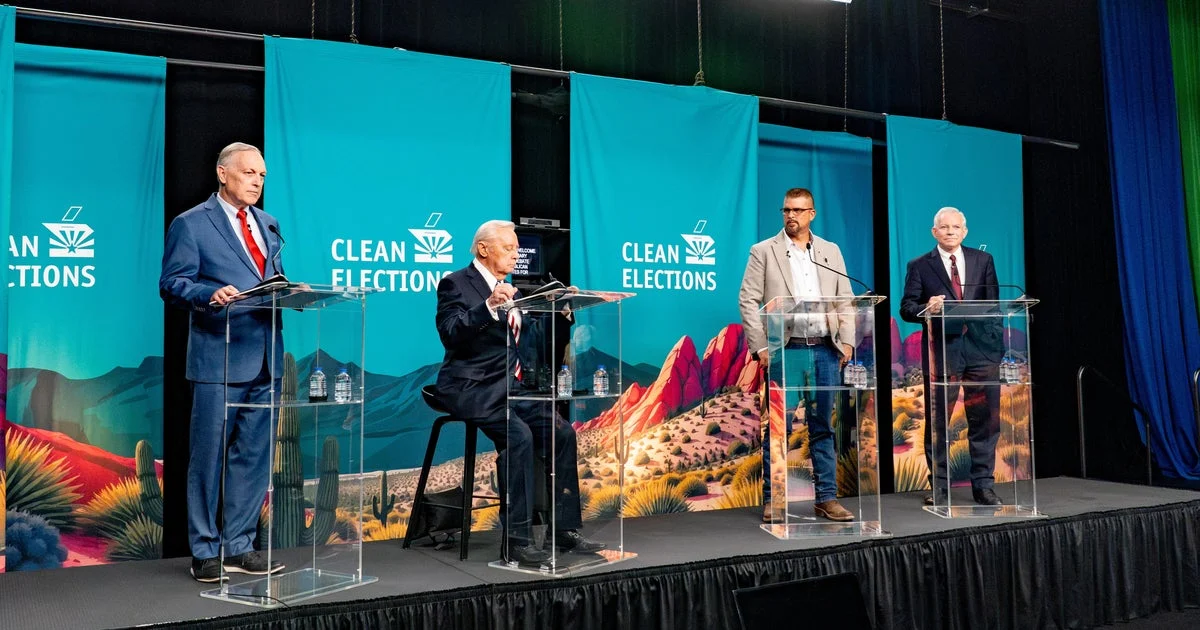
Arizona voters are poised to head to the polls on Tuesday, July 22, 2026, for a series of consequential primary elections that will shape the state’s political landscape and potentially influence the balance of power in Washington. The day’s ballot features a highly anticipated Republican primary to determine who will challenge incumbent Democratic Governor Katie Hobbs, alongside critical congressional district primaries as the heated battle for control of the U.S. House of Representatives continues its relentless march.
Arizona’s Evolving Political Tapestry: From Red to Purple
Arizona, once a reliably conservative stronghold, has undergone a significant political transformation over the past decade, solidifying its status as a crucial swing state. While six of its nine U.S. House representatives are currently Republicans, the state has elected two Democratic U.S. Senators and a Democratic governor. This shift underscores a dynamic and increasingly diverse electorate, influenced by demographic changes, an influx of new residents, and the persistent nationalization of state-level politics.
Historically, Arizona has been a Republican bastion, having voted for every Republican presidential candidate from 1952 to 1992, with the exception of 1964. However, the early 21st century witnessed a gradual erosion of this dominance. The state narrowly voted for Democratic presidential candidate Joe Biden in 2020, a watershed moment that signaled its transition to a true battleground. This was followed by a flip back to former President Donald Trump in the 2024 presidential election, further highlighting the state’s volatile political temperament and its susceptibility to national political tides.
A defining characteristic of Arizona’s recent political history has been the pervasive influence of claims surrounding the 2020 election. Following Mr. Trump’s defeat, Arizona became a focal point for his unsubstantiated allegations of widespread voter fraud, particularly concerning Maricopa County. These claims, amplified by various political figures, have continued to reverberate through the state’s political discourse, shaping voter confidence, campaign messaging, and the platforms of candidates across the spectrum. A 2024 study by Arizona State University’s Center for Latina/os and American Politics Research (CLAPR) revealed that one in three Arizona voters expressed "not that confident" or "not at all confident" sentiments regarding the fair counting of absentee or mail-in ballots, underscoring the enduring impact of these narratives on public trust in electoral systems.
The Gubernatorial Primary: A High-Stakes Republican Showdown
On the Democratic side, Governor Katie Hobbs is running unopposed for her party’s nomination, setting the stage for her re-election bid in November. Hobbs, who narrowly defeated Trump ally Kari Lake in the 2022 gubernatorial race by just over 17,000 votes, has focused her administration and re-election campaign on kitchen-table issues, including affordability, rising costs, and curbing school vouchers. Her campaign has consistently sought to draw a contrast with the more ideologically driven platforms of her potential Republican challengers, emphasizing practical governance over partisan rhetoric.
The Republican primary, however, is a fiercely contested four-way race, with U.S. Representatives Andy Biggs and David Schweikert emerging as the two leading contenders. This primary is not merely a contest for a nomination but a litmus test for the direction of the Arizona Republican Party.
Andy Biggs: The Populist Standard-Bearer
Congressman Andy Biggs, representing Arizona’s 5th District for five terms, has positioned himself as the standard-bearer for the conservative populist wing of the Republican Party. A former chairman of the influential House Freedom Caucus, Biggs is a vocal proponent of limited government, fiscal conservatism, and border security. Crucially, he has been one of the most prominent national figures to champion Mr. Trump’s claims of election fraud following the 2020 election. His involvement in efforts to question the election results and his alleged role in plans preceding the January 6, 2021, Capitol incident led to a subpoena from the now-defunct House Jan. 6 select committee, where his name appeared frequently in the final report detailing efforts to overturn the election.
Biggs has secured the coveted endorsement of former President Donald Trump, a significant factor in a state where Trump continues to hold substantial sway among the Republican base. Early polls suggest Biggs holds a lead in the primary, capitalizing on his strong conservative credentials and his alignment with the former president. Francisco Pedraza, head of ASU’s CLAPR, noted that a Biggs-Hobbs matchup in the general election would likely be a "tight race," dominated by the central theme of election integrity and trust in election systems, contrasting sharply with Hobbs’s focus on economic concerns.
David Schweikert: The Frustrated Moderate-Conservative
In contrast to Biggs, Congressman David Schweikert, first elected in 2010 during the Tea Party wave to represent the Scottsdale area, presents a more traditional conservative profile. His decision to run for governor, rather than seek re-election to his congressional seat, stems from a stated frustration with legislative gridlock in Washington. As he told the Arizona Republic last year, "We have a body that can’t even pass its appropriation bills," signaling a desire to shift focus to state-level governance where he believes more can be accomplished.
Schweikert’s electoral history, including a narrow 3.8-point victory in 2024 in what is now a toss-up district, indicates a candidate who can appeal to a broader, potentially more moderate, segment of the Republican electorate. His campaign has largely focused on his experience as a legislator and his ability to tackle state issues, although he also espouses conservative fiscal principles. While not as closely aligned with the "election integrity" narrative as Biggs, Schweikert’s platform aims to resonate with Republicans seeking pragmatic leadership.
The general election implications of this primary are profound. A Biggs nomination would likely intensify the focus on election integrity and cultural issues, potentially energizing the Democratic base in opposition. A Schweikert nomination might pivot the debate more towards fiscal policy, education, and state administration, potentially appealing to swing voters fatigued by the constant rehashing of past election disputes.
Congressional Battlegrounds: The Fight for the House
Beyond the gubernatorial race, Arizona’s primary elections are vital battlegrounds in the national fight for control of the U.S. House of Representatives. Two districts, in particular, are drawing significant attention: Arizona’s 1st Congressional District and the open seat in Arizona’s 5th Congressional District.
Arizona’s 1st Congressional District: A National Bellwether
With Representative David Schweikert vacating his seat to run for governor, Arizona’s 1st Congressional District has become one of the most closely watched races in the nation. Rated as a "toss-up" by Sabato’s Crystal Ball at the UVA Center for Politics, this district, encompassing parts of Scottsdale and surrounding areas, represents a crucial swing constituency that both parties believe they can win.
On the Republican side, a competitive primary includes former state Representative Joseph Chaplik, former Arizona Cardinals kicker Jay Feely, and businessman John Trobough. Feely has received the endorsement of former President Trump, leveraging his celebrity status and alignment with the Trump movement to garner support among the GOP base. His campaign has emphasized conservative values and economic growth.
The Democratic primary is equally robust, featuring a rematch between former state legislator Amish Shah and former broadcast journalist Marlene Galán-Woods. Shah, who defeated Galán-Woods in the 2024 primary, is attempting to consolidate support. However, Galán-Woods has secured the backing of the Democratic Congressional Campaign Committee (DCCC), signaling the national party’s strategic investment in her candidacy. Galán-Woods has faced criticism for her past Republican affiliation, having been a Republican until 2018 and previously supporting GOP politicians. She has countered these criticisms by stating that "The Republican Party has been driven off a cliff by Donald Trump and people like (incumbent U.S. Rep.) David Schweikert," asserting her commitment to Democratic principles in the face of what she perceives as an extremist shift in the GOP. The winner of this Democratic primary will face a formidable challenge in November, as the district’s swing nature means both parties will pour significant resources into the general election.
Arizona’s 5th Congressional District: A Safe Red Seat Opens Up
The departure of Congressman Andy Biggs from Arizona’s 5th Congressional District to run for governor has opened a reliably Republican seat. Rated "Safe Republican" by Sabato’s Crystal Ball, the primary winner here is almost certain to win in November, making this GOP contest particularly impactful.
The leading Republican candidates are former Pinal County Sheriff Mark Lamb and wealthy construction owner Daniel Keenan. Mark Lamb, who has branded himself "America’s Sheriff," has built a national profile on a platform emphasizing faith, border security, and conservative principles. He, like Biggs, has secured the endorsement of former President Trump, a powerful asset in this deeply conservative district. However, Lamb’s campaign has been rocked by a multi-part investigation published by the Arizona Republic in May, alleging years of sexual misconduct, explicit messages, and abuse of power. The investigation also revealed that Lamb was investigated by the Church of Jesus Christ of Latter-day Saints regarding these claims. Lamb’s campaign has vehemently denied the allegations, with his wife publicly stating on Facebook in May that a "massive smear campaign" would not deter them. Despite the controversies, Mr. Trump reaffirmed his support for Lamb last week, underscoring the enduring power of his endorsement within the GOP base.
Challenging Lamb is Daniel Keenan, a wealthy construction owner who has largely self-funded his campaign, pouring $1.6 million of his own money into the race. Keenan’s campaign has focused on his business acumen and conservative fiscal policies, attempting to present a contrast to Lamb’s more populist and controversial image. A recent poll, backed by Keenan’s campaign and conducted by a GOP polling firm, showed him with a slim lead, indicating that the allegations against Lamb may be impacting voter sentiment despite Trump’s continued backing.
The Democratic primary in AZ-05 features three candidates, but given the district’s strong Republican lean, the winner of the GOP primary will be heavily favored in the general election. The outcome of this Republican primary will not only determine the next representative for the 5th District but also test the limits of Trump’s endorsement power amidst significant personal controversy.
Broader Implications and National Significance
The Arizona primaries are more than just local contests; they are critical indicators of national political trends and will have significant ramifications for both parties. For the Republican Party, these primaries represent a continued internal struggle between the Trump-aligned populist wing and more traditional conservative elements. The outcomes will signal which faction holds greater sway within a key swing state. For Democrats, holding the governorship and making inroads in congressional districts like AZ-01 are crucial steps in solidifying their position in Arizona and bolstering their efforts to maintain or gain control of the U.S. House.
The persistent debate over election integrity, fueled by figures like Andy Biggs and the lingering shadows of the 2020 election, will continue to be a central theme, potentially influencing voter turnout and trust in the electoral process. As voters head to the polls, the results will not only determine who represents them in Phoenix and Washington but also offer a clearer picture of Arizona’s evolving political identity and its pivotal role in the American political landscape. The stakes are undeniably high, and the nation will be watching closely as Arizona casts its ballots.

