
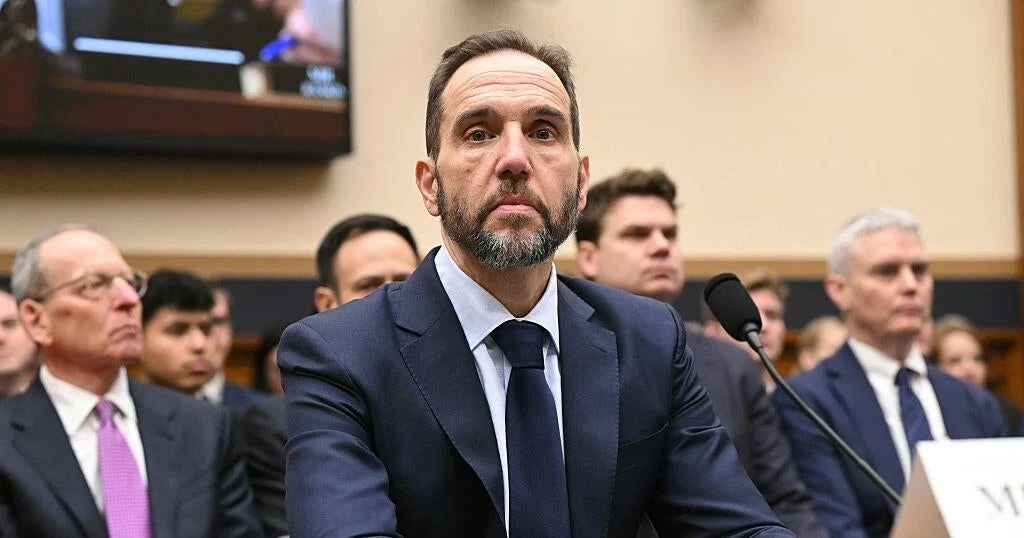
The Republican chair of the House Judiciary Committee, Representative Jim Jordan of Ohio, has formally urged the Justice Department to pursue criminal charges against former Special Counsel Jack Smith. The referral, submitted on Wednesday, alleges that Smith made "materially false statements" to Congress and improperly withheld information during an investigation into the procurement of records related to former President Donald Trump’s actions following the 2020 election. Smith’s legal representatives have vehemently dismissed these allegations as "spurious" and "unimpeachably truthful," defending their client’s conduct throughout his tenure.
The Genesis of the Referral: Allegations of Misleading Congress
The criminal referral from Rep. Jordan centers on discrepancies between Smith’s previous testimony before Congress and subsequent revelations from the Justice Department. Last year, Smith testified that his investigative team, as part of a probe into Mr. Trump’s activities post-2020 election, had obtained "tolling records" from several Republican lawmakers. These records, he explained, included only metadata such as call times and numbers dialed, not the content of any phone calls or text messages. This testimony was given in the context of an inquiry into the FBI’s collection of phone records from GOP lawmakers, a revelation that itself sparked considerable controversy.
However, the situation took a new turn last week when the Justice Department informed lawmakers, including Senator Chuck Grassley of Iowa, that in a separate subpoena to the National Archives and Records Administration (NARA), Smith’s team had obtained text messages. These messages were exchanged between Trump-era White House staffers and dozens of members of Congress, bringing the total number of affected lawmakers to 44, including four Democrats. This disclosure directly contradicted the impression left by Smith’s earlier testimony regarding the nature and scope of records obtained from legislative officials.
Rep. Jordan’s referral asserts that Smith "failed to disclose" the NARA subpoena and its resulting acquisition of text messages, thereby presenting "intentionally false statements designed to obstruct the Committee’s oversight." Jordan emphasized the obligation of all individuals, including former public servants like Smith, to comply truthfully with congressional inquiries. The referral requests Acting Attorney General Todd Blanche to initiate a criminal investigation into Smith.
Chronology of a Contentious Investigation
The events leading to this criminal referral are deeply intertwined with the politically charged investigations into former President Trump, spanning several years:
- November 2020: The 2020 presidential election concludes, with Joe Biden declared the winner. Former President Trump and his allies begin challenging the results, alleging widespread fraud.
- January 6, 2021: A violent mob, fueled by rhetoric from President Trump, storms the U.S. Capitol in an attempt to prevent the certification of the 2020 election results. This event triggers multiple federal investigations.
- Late 2022: Amid escalating investigations into former President Trump’s actions related to the 2020 election and his handling of classified documents after leaving office, Attorney General Merrick Garland appoints Jack Smith as Special Counsel. Smith is tasked with independently overseeing these two high-profile probes.
- 2023: Smith’s office brings indictments against former President Trump in both cases: one related to the classified documents found at his Mar-a-Lago residence, and another concerning his efforts to overturn the 2020 election results, including actions around January 6. These mark the first-ever federal prosecutions of a former U.S. president.
- Late 2023: Revelations surface that federal investigators, as part of the Jan. 6 probe, had obtained "tolling records" (metadata of calls) from several Republican lawmakers. This sparks outrage among some GOP members, who allege "spying" by the FBI.
- Early 2024: Jack Smith provides a deposition to the House Judiciary Committee, testifying that his team had only obtained "tolling records" and not the content of communications from lawmakers in the context of that specific inquiry.
- Mid-2024: Both federal cases against former President Trump conclude without convictions. A federal judge dismisses the classified documents indictment, citing an "invalid appointment" of Special Counsel Smith. Separately, the Supreme Court rules that Mr. Trump is entitled to broad immunity for official acts, significantly complicating the 2020 election interference case. Following his victory in the 2024 presidential election, Smith’s team opts to dismiss the election case, though a final report from Smith asserts that Trump would have been convicted otherwise.
- July 2026 (Last Week): The Justice Department informs Senator Chuck Grassley and other lawmakers that a separate subpoena issued by Smith’s team to the National Archives and Records Administration (NARA) resulted in the acquisition of text messages exchanged between White House staffers and 44 members of Congress. Crucially, these texts were transferred directly to Smith’s investigative team without prior review by a "filter team," raising concerns about privilege.
- July 22, 2026 (Wednesday): Rep. Jim Jordan issues a criminal referral to the Justice Department, accusing Jack Smith of making "materially false statements" and failing to disclose the NARA subpoena for text messages during his earlier testimony.
Jack Smith’s Mandate and the Trump Investigations
Jack Smith’s appointment in November 2022 was a significant move by Attorney General Merrick Garland, intended to insulate the high-stakes investigations into a former president from political interference. Smith, a seasoned prosecutor with a history of tackling complex corruption and war crimes cases, was tasked with navigating the politically treacherous waters of investigating a former commander-in-chief who was also a declared presidential candidate.
His mandate encompassed two primary areas:
- The Classified Documents Case: This investigation focused on allegations that Mr. Trump unlawfully retained national defense information after leaving the White House, storing sensitive government documents at his Mar-a-Lago club in Florida, and obstructing government efforts to retrieve them. The indictment included charges under the Espionage Act and obstruction of justice.
- The 2020 Election Interference Case: This probe examined Mr. Trump’s efforts to overturn the results of the 2020 presidential election, including alleged conspiracies to defraud the United States, obstruct an official proceeding (the certification of electoral votes on January 6, 2021), and subvert the transfer of power.
Both cases, unprecedented in American history, met with fierce resistance from Mr. Trump, who consistently decried them as politically motivated "witch hunts" and examples of the "weaponization" of the Justice Department against a political opponent. The dismissal of both cases in 2024, albeit on procedural and immunity grounds rather than merits, was a significant blow to the Special Counsel’s efforts. The classified documents case was dismissed due to a judicial finding that Smith’s appointment itself was unconstitutional, a legal argument that had been widely debated. The election interference case, meanwhile, foundered after the Supreme Court granted Mr. Trump broad immunity for actions taken while officially in office, necessitating a re-evaluation of the charges. Despite the dismissals, Smith’s final report on the election case maintained that Mr. Trump would have been convicted, underscoring the Special Counsel’s conviction regarding the strength of the evidence.
Legal Arguments and Counterarguments: The Speech or Debate Clause and Filter Teams
At the heart of the current controversy are complex legal issues surrounding congressional privilege and investigative protocols. Senator Grassley, in his initial criticism last week, argued that the unreviewed acquisition of text messages from lawmakers could run "roughshod over the Constitution," potentially violating the Speech or Debate Clause (Article I, Section 6, Clause 1) of the U.S. Constitution. This clause provides legal immunity to members of Congress for actions taken in the course of their legislative duties, significantly limiting criminal prosecutions or investigations into their official conduct. Jordan’s referral echoed this concern, alleging Smith "likely circumvented key constitutional protections."
The Justice Department’s letter to Grassley also highlighted that the texts obtained from NARA were "immediately sent over to Smith’s staff," bypassing the usual review by a "filter team." Filter teams, sometimes called "taint teams," are separate groups of prosecutors or agents responsible for screening evidence that might be privileged (e.g., attorney-client privilege, spousal privilege, or, controversially, legislative privilege) before investigative teams can access it. Their purpose is to prevent the accidental review of protected information and to ensure the integrity of legal proceedings. The absence of such a review in this instance raised red flags for critics.
However, Smith’s attorneys, in their robust defense, challenged these interpretations. They argued that Smith’s earlier testimony was "unimpeachably truthful" because he was specifically asked about the subpoena for GOP lawmakers’ tolling records, not the broader request for records from the National Archives. They also noted that the text messages obtained via NARA had been disclosed to Mr. Trump’s lawyers during discovery, and at that time, Trump’s legal team did not suggest anything "unlawful or improper" had occurred.
Regarding the Speech or Debate Clause, Smith’s lawyers contended that it "does not prevent prosecutors from using or reviewing text messages between Members of Congress and members of the Executive Branch in an investigation and prosecution of an Executive Branch official." They emphasized that the investigation was focused on an Executive Branch official (Mr. Trump), not the lawmakers themselves. Furthermore, they argued that a filter team was unnecessary for the White House records because the primary purpose of such a team is to sort out attorney-client privilege, which they implied was not the central concern for these specific communications between White House staff and Congress in the context of the Trump investigation. They maintained that Smith "faithfully and fearlessly performed his duties by following the facts and the law" and adhering to Department of Justice protocols.
Reactions from Across the Political Spectrum
The criminal referral and its underlying allegations have elicited strong and predictable reactions from key political figures:
- Rep. Jim Jordan (R-OH): As the primary author of the referral, Jordan framed Smith’s alleged actions as a direct obstruction of congressional oversight and a breach of public trust. His language, accusing Smith of "intentionally false statements," underscores the gravity of the charges he wishes the DOJ to pursue. Jordan’s consistent focus on the "weaponization" of federal agencies aligns with a broader Republican narrative.
- Sen. Chuck Grassley (R-IA): Grassley, who brought the NARA text message revelation to light, has been a vocal critic, describing the discovery as "disturbing and outrageous" and alleging that the FBI had "spied" on members of Congress. His rhetoric about investigators running "roughshod over the Constitution" sets the stage for the legal and constitutional challenges now being raised. He also urged his Democratic colleagues, some of whom were among the 44 lawmakers whose texts were swept up, to "finally put partisanship aside and recognize the severity of these actions."
- Former President Donald Trump: Mr. Trump has a long history of calling for the prosecution of officials who investigated him, including former FBI Director James Comey and New York Attorney General Letitia James. The referral against Smith fits squarely into his established pattern of attacking perceived political adversaries within the justice system, often accusing them of political bias and misconduct.
- Jack Smith’s Attorneys: Their response was swift and unequivocal, labeling the referral as "baseless" and a "chilling eagerness to weaponize the justice system." They presented Smith as a "career, nonpartisan public servant" who acted with integrity, emphasizing the distinction between the two types of subpoenas and the focus of Smith’s testimony. Their defense centers on the idea that the referral is a politically motivated attack rather than a legitimate legal complaint.
- Rep. Jamie Raskin (D-MD): As the top Democrat on the House Judiciary Committee, Raskin quickly dismissed the referral as "baseless and vindictive." He argued that the case would be "laughed out of court" and sarcastically noted that "Mr. Smith may be telegenic but he is not telepathic," implying that Smith could not have volunteered information he wasn’t explicitly asked about. Raskin’s statement highlights the deep partisan divide over the issue, characterizing it as a political maneuver rather than a genuine concern about legal impropriety.
The Justice Department’s Stance and Precedent
The Justice Department has confirmed receipt of Jordan’s referral letter, stating that it "will investigate all evidence of criminal conduct." This standard response indicates that the department will review the allegations, but it does not guarantee that charges will be pursued. Congressional criminal referrals are not uncommon, particularly in times of heightened political tension, but they rarely result in prosecutions. The DOJ exercises its independent prosecutorial discretion in deciding whether to act on such referrals, weighing factors such as the strength of the evidence, the intent behind the alleged actions, and the likelihood of securing a conviction.
Historically, the Justice Department has been cautious about prosecuting former government officials for statements made to Congress, particularly when the intent to deceive is difficult to prove definitively. The department also guards its independence from congressional pressure, aiming to avoid the appearance of politically motivated prosecutions or selective enforcement of laws. Any decision to pursue charges against a former Special Counsel would be extraordinary and would likely ignite a firestorm of political and legal debate, further exacerbating concerns about the politicization of the justice system.
Broader Implications for Congressional Oversight and DOJ Independence
This criminal referral against Jack Smith carries significant implications for several fundamental aspects of American governance:
- Congressional Oversight: The dispute highlights the ongoing tension between Congress’s oversight responsibilities and the executive branch’s investigative independence. Lawmakers have a legitimate role in scrutinizing government actions, but the line between legitimate oversight and political harassment can become blurred, especially when investigations target high-profile figures.
- Department of Justice Independence: The referral also tests the perceived independence of the Justice Department. A decision to prosecute Smith would be viewed by many as a concession to political pressure from Congress and former President Trump, potentially undermining public trust in the DOJ’s impartiality. Conversely, a decision not to pursue charges could be criticized by Jordan and his allies as a failure to hold officials accountable.
- "Weaponization" Narrative: The incident further fuels the narrative, often championed by former President Trump and his allies, that federal law enforcement and intelligence agencies are "weaponized" against political opponents. Regardless of the outcome of Jordan’s referral, the public discourse around it reinforces this perception for a segment of the population, potentially eroding faith in democratic institutions.
- Chilling Effect: Such referrals, even if ultimately unsuccessful, can have a chilling effect on government officials, potentially making them more hesitant to conduct thorough investigations or to testify openly before Congress for fear of political retaliation.
In conclusion, Rep. Jim Jordan’s criminal referral against former Special Counsel Jack Smith marks a dramatic new chapter in the ongoing political and legal battles surrounding former President Donald Trump. While the Justice Department reviews the allegations, the core dispute over Smith’s testimony, the acquisition of congressional text messages, and the application of constitutional privileges underscores the deep partisan divisions and the persistent challenges facing the American justice system in an era of intense political polarization. The outcome of this referral will not only determine Smith’s legal future but also send a powerful message about the boundaries of congressional oversight, prosecutorial independence, and accountability in high-stakes political investigations.

