
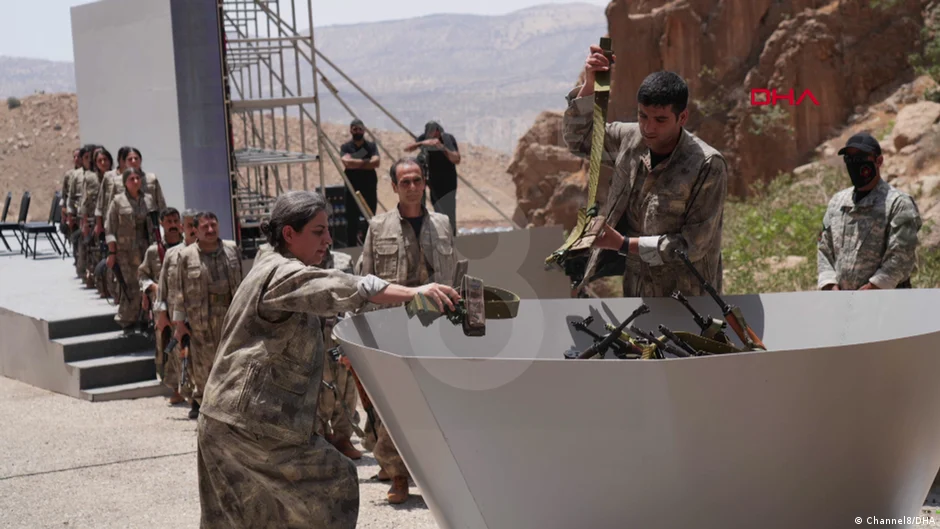
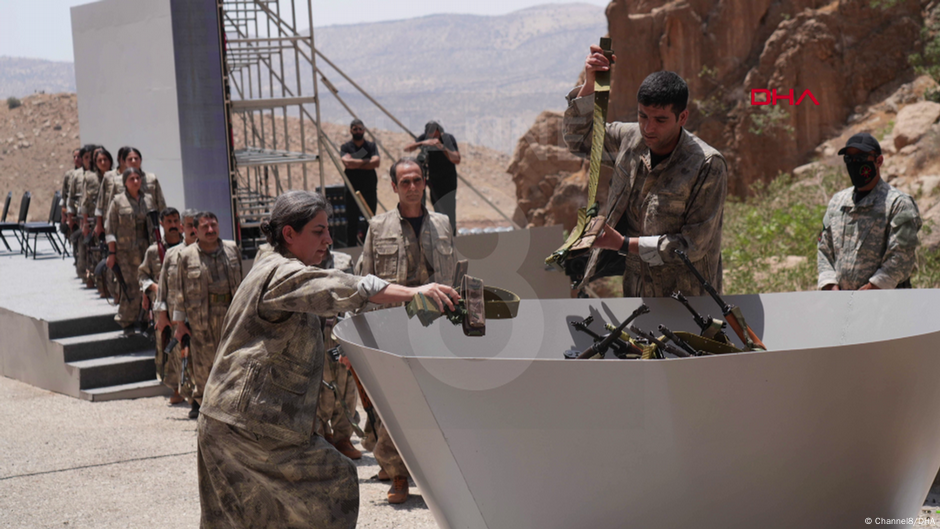
July marks the poignant one-year anniversary since the Kurdistan Workers’ Party (PKK), a Kurdish militant group designated as a terrorist organization by Turkey, the United States, and the European Union, undertook the symbolic act of burning their weapons. This significant gesture, witnessed in northern Iraq, underscored a dramatic shift in the decades-long conflict that has claimed an estimated 40,000 lives and deeply scarred the fabric of Turkish society. The anniversary coincides with renewed efforts by human rights activists, academics, and politicians to assess the delicate progress of an ongoing peace process between the Turkish government and the PKK, emphasizing a cautiously optimistic yet highly fragile path forward.
The journey towards this moment began in earnest last May, when the PKK announced its intention to cease its "work under the name of PKK," signaling a potential end to its armed insurgency for Kurdish rights or independence within Turkey. This declaration was followed on July 11, a year ago, by a symbolic disarmament ceremony where a contingent of approximately 30 PKK fighters publicly burned their arms in northern Iraq. Fast forward to this year, on the same significant date, stakeholders converged in Diyarbakir, the largest city in Turkey’s Kurdish-majority southeast, to convene a conference aimed at evaluating the nascent peace process. Organized by the Diyarbakir administration and the Human Rights Association (IHD), the gathering served as a platform for dialogue and reflection.
A Decades-Long Conflict and the Call for Remembrance
The conflict between the Turkish state and the PKK dates back to 1984, when the group, founded in 1978 by Abdullah Ocalan, launched its armed struggle. Initially advocating for an independent Kurdish state, the PKK later recalibrated its demands to focus on greater autonomy, cultural rights, and self-determination for Kurds within Turkey. The brutal insurgency saw cycles of intense fighting, ceasefires, and renewed violence, leaving a legacy of profound human suffering, displacement, and political instability across the region. The PKK’s designation as a terrorist organization by multiple international bodies further complicated any prospects for peace, framing the conflict primarily as a security issue rather than a political one.
At the Diyarbakir conference, Cihan Aydin, a lawyer and co-chair of the IHD, put forth a compelling proposal: to designate July 11 as an official day of remembrance. Aydin passionately argued that fostering a vibrant culture of remembrance is crucial for society to come to terms with its past traumas and to actively prevent future conflicts. His call extended beyond mere commemoration, advocating for a comprehensive legal solution for all individuals impacted by the peace process. Central to this demand is the fate of Abdullah Ocalan, the PKK leader, who has been incarcerated by Turkey since his capture in 1999. For decades, Ocalan was unequivocally branded a terrorist by the Turkish state. However, at 77 years old, he has emerged as an unexpected focal point of the current peace process, with his directives from prison significantly influencing the PKK’s actions. It was Ocalan who, through ongoing communication, is understood to have initiated the call for the PKK to lay down its arms, with reports indicating a target date for complete disarmament by February 2025, a directive to which members have already begun to respond.
The Evolving Peace Framework and Key Demands
Following these critical developments, the Turkish parliament took a momentous step by establishing a dedicated committee to advance the peace process. This committee meticulously gathered testimony from approximately 140 representatives spanning the political spectrum and civil society, including human rights activists, relatives of soldiers, veterans, and prisoners. Their findings culminated in a series of recommended reforms designed to bolster the peace initiative. These recommendations included pathways for the reintegration into society of PKK members who formally renounce violence, alongside stringent verification by state security institutions to ensure the PKK’s genuine and complete relinquishment of weapons.
The ongoing talks are complex, focusing on intricate legal and practical frameworks. Discussions revolve around the precise rules governing the return or potential prosecution of former PKK members, as well as their possible integration into civilian and political life. A core demand from the Kurdish side is the release of Abdullah Ocalan from prison, coupled with a broader amnesty for other political prisoners. The Turkish government, while signaling a newfound willingness to engage, has maintained a cautious stance on a general amnesty, indicating openness only to a partial one. Critically, there has been no concrete commitment regarding Ocalan’s status. However, recent shifts within the ruling Justice and Development Party (AKP) suggest a more moderate and accommodating tone, hinting at a potential softening of previously unyielding positions.
Expert Perspectives on a Fragile Optimism
Aret Demirci, who heads the Istanbul office of Germany’s Friedrich Naumann Foundation, views these developments with "cautiously positive" optimism. He emphasizes the "historic turning point" represented by the PKK’s symbolic burning of weapons, noting a crucial difference from past attempts: "Unlike previous peace initiatives, the process has not collapsed at an early stage." This resilience, he suggests, offers a glimmer of hope.
However, Demirci also provides a sobering assessment of the significant hurdles that remain. He cautions that many of the central political questions have, thus far, largely been sidestepped. The fundamental divergence in expectations between the two sides presents the biggest challenge: the Turkish government is steadfastly pushing for the PKK’s complete and unconditional disarmament, while the Kurdish side demands substantial political and legal guarantees before such a comprehensive step can be fully realized. "The parties’ differing expectations are likely to be the biggest challenge in coming months," Demirci warns, highlighting the potential for impasse.
Recent statements from key figures underscore both the complexity and the determined spirit of the process. Following a meeting with Ocalan and other prisoners earlier this week, the pro-Kurdish political party DEM released a statement conveying Ocalan’s renewed call for a robust legal framework to drive the peace process forward. In a notable articulation of his vision, Ocalan stressed that "the Kurdish-Turkish alliance is the cornerstone of Anatolia’s shared future," signaling a desire for reconciliation and a common destiny. This sentiment of optimism is echoed within the PKK’s own leadership. Duran Kalkan, one of the PKK’s co-founders, expressed confidence in a recent interview that the peace process would not fail this time, attributing this conviction to the profoundly altered security landscape of the region.
Geopolitical Undercurrents Driving Dialogue
Indeed, many observers concur with Kalkan’s analysis, recognizing that the current geopolitical environment in the Middle East is fundamentally different from previous periods of attempted dialogue. Regional conflicts have intensified, particularly due to heightened tensions involving Israel, Iran, and the United States, creating a volatile backdrop. The evolving situation in Syria also plays a critical, multifaceted role in shaping Turkey’s security calculus and its approach to the Kurdish question.
Turkey’s security situation today is markedly distinct from a decade ago, when informal talks between Turkish intelligence agencies and the PKK, which began in 2009, escalated into more formal negotiations between 2013 and 2015. Although Ocalan declared a ceasefire in March 2013 during that period, it ultimately proved unsustainable. Demirci posits that these profound geopolitical shifts are now exerting an irresistible pressure, compelling both the PKK and Turkey towards sustained dialogue.
The new political landscape in Syria is a particularly potent factor. A more constructive relationship with Kurds inside Turkey could significantly bolster the Turkish government’s leverage regarding both Syrian and Iraqi Kurdish entities. Previously, during the Syrian civil war, Syrian Kurdish groups, widely alleged to be associated with the PKK and supported by the United States, established semi-independent control over a substantial area directly bordering Turkey. This development was a source of immense concern for Turkish security agencies, who viewed it as a direct threat. However, the dynamics have since shifted; Syria’s Kurds have been compelled to seek accommodation with the new Syrian government, relinquishing complete charge of these strategic border territories. Furthermore, Turkey has expressed anxieties that PKK members might join Iranian-Kurdish militias across the border, adding another layer of regional complexity to its security concerns.
Beyond Arms: The Path to Sustainable Peace
Ultimately, the long-term success of this peace process, Demirci emphasized to DW, will transcend the mere cessation of violence. True and sustainable peace, he argues, hinges on the emergence of a robust political dialogue that comprehensively addresses democratic reforms, upholds the rule of law, and grapples with broader, fundamental questions concerning Kurdish identity within Turkey.
Current political realities in Turkey pose significant challenges to this holistic vision. As long as opposition politicians face arrests, democratically elected Kurdish mayors are removed from office, and political freedoms remain restricted, the cessation of armed conflict alone will not suffice to usher in genuine, lasting peace. This inherent "ambivalence," Demirci concludes, currently defines the debate in Turkey, rendering the entire process both historically significant and extraordinarily fragile.
Adding to the precariousness is a pervasive lack of transparency. "There is hardly any public information about which agreements have actually been reached and what steps are planned," Demirci noted. This opacity is a critical impediment, making it exceedingly difficult to cultivate and sustain public trust, which is vital for any enduring peace initiative. The road ahead remains fraught with complex negotiations, deep-seated historical grievances, and the ever-present influence of a volatile regional landscape, demanding unprecedented political will and a genuine commitment to comprehensive reforms from all parties involved.
With additional reporting by Gülşen Solaker.

