
At the heart of the rapidly accelerating artificial intelligence revolution, chipmaking titan AMD has launched a formidable new weapon in its escalating rivalry with industry leader Nvidia. The company unveiled Helios, a groundbreaking rack-scale system meticulously engineered to cater to the immense computational demands of the world’s most advanced AI laboratories. The announcement, made at AMD’s highly anticipated and sold-out Advancing AI conference in San Francisco, signals a bold strategic maneuver to capture a significant share of the burgeoning AI infrastructure market.
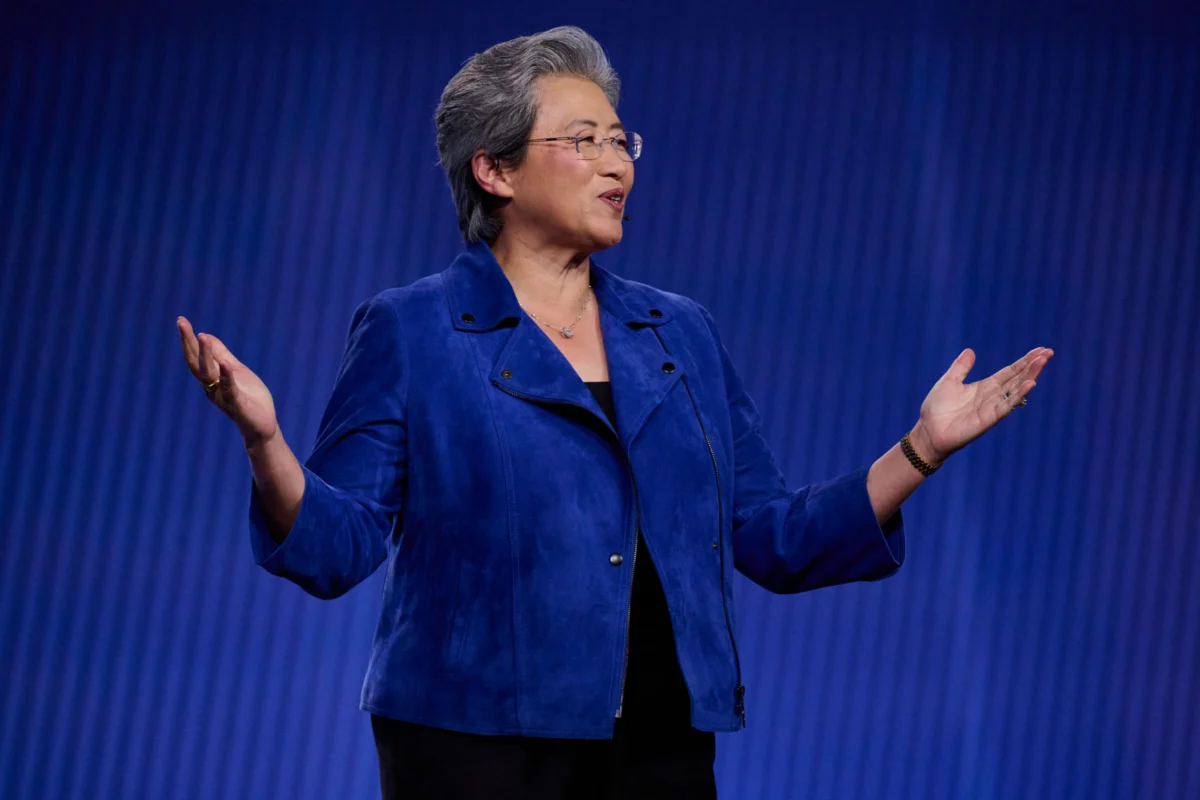
AMD Chair and CEO Dr. Lisa Su, a prominent figure in the semiconductor industry, personally championed Helios, underscoring its potential to redefine AI development. The system, slated for shipment later this year, has already garnered a prestigious roster of early adopters, including tech behemoth Microsoft. Alongside Helios, AMD also showcased its latest generation of specialized chips, designed to fuel the insatiable appetite of the AI industry for raw processing power.
The Rise of Rack-Scale Computing for AI
Rack systems represent a pivotal evolution in high-performance computing, consolidating numerous powerful processors into a single, cohesive, and exceptionally potent unit. These systems are the workhorses of modern data centers, serving as the foundational architecture for training and deploying sophisticated AI models, as well as handling other computationally intensive workloads that push the boundaries of conventional computing.
Dr. Su articulated the significance of Helios, branding it the "highest-performance AI rack" in the tech industry. She emphasized its design to "train and run the most demanding frontier models in the world at massive scale." The company further revealed that Helios will be deployed by leading AI enterprises at a colossal "gigawatt-scale," a testament to the sheer power and volume of computing required for cutting-edge AI research and application.
Challenging the Incumbent: AMD’s Offensive Against Nvidia
Nvidia has long held a near-monopoly in the AI rack-scale system market, primarily through its influential Vera Rubin and Grace Blackwell platforms. AMD’s introduction of Helios is a direct and aggressive challenge to this established order. Performance benchmarks, as reported by The Register, suggest that Helios possesses the capability to rival, and in some key metrics, even surpass the performance of Nvidia’s Vera Rubin systems, positioning AMD as a serious contender in this high-stakes arena.
Helios, first previewed in 2025 and publicly demonstrated in January at CES 2026, has already secured commitments from a formidable lineup of AI innovators. These include OpenAI, Meta, Oracle, Anthropic, and Microsoft, all of whom have articulated plans for the widespread deployment of the system. Notably, Microsoft CEO Satya Nadella confirmed on Monday that the company intends to significantly expand its Azure cloud infrastructure by integrating Helios. In parallel, Anthropic and AMD announced a strategic partnership on Wednesday to deploy up to two gigawatts of AMD Instinct MI450 series GPUs, facilitated by the new Helios rack system. This collaboration underscores the growing demand for AMD’s specialized AI hardware and the strategic importance of its rack-scale solutions.
A Glimpse into the Future: AMD’s Venice-X CPU
Complementing the launch of Helios, AMD also introduced its Venice-X CPU on Thursday. This new processor is specifically engineered for data center environments and is designed to excel at handling exceptionally high-computing workloads. The Venice-X CPU is anticipated to enter the market in 2027, further bolstering AMD’s portfolio of AI-centric hardware.
The Accelerating Trajectory of AI Compute Demand
During her keynote address, Dr. Su provided a compelling perspective on the trajectory of the chip industry, forecasting that AI-powered chips will constitute a monumental segment of the overall computing market by the year 2030. This projection is driven by what she described as a "step change in compute demand," a phenomenon largely fueled by the burgeoning field of agentic AI.
"When you ask the agent to do something, it actually has dozens of steps, and it has to reason, and it has to call tools, and it has to access data, and it has to keep doing it over and over until it solves the problem, and so you need lots of GPUs to do all that," explained Dr. Su, illustrating the complex computational requirements of advanced AI agents.
The economic implications of this demand surge are staggering. "We do expect that by 2030, the AI accelerator market is going to reach about $1.4 trillion," Su projected. She further elaborated on the scale of this market, stating, "What that means is, by the end of the decade, the AI accelerator market is going to approach the size of the entire semiconductor market today."
The Dominance of GPUs in the AI Accelerator Market
Dr. Su also addressed the specific role of GPUs within this rapidly expanding AI accelerator market. "We do expect that GPUs are going to make up the vast majority of that market because the algorithms are still very much in their infancy, and we’re still continuing to see the workloads change, and that favors programmability in the overall silicon ecosystem," she concluded. This statement highlights the continued importance of the flexible and programmable nature of GPUs in accommodating the evolving landscape of AI algorithms and workloads.
Broader Implications for the AI Ecosystem
The introduction of AMD’s Helios system and its aggressive market positioning carry significant implications for the broader AI ecosystem. Firstly, it intensifies competition, which historically drives innovation and can lead to more competitive pricing for AI infrastructure. This is particularly beneficial for AI labs and enterprises that require vast computational resources.
Secondly, the increasing availability of high-performance, rack-scale AI systems signifies a maturation of the AI hardware market. This allows for more ambitious AI research and development, potentially accelerating breakthroughs in areas such as natural language processing, scientific discovery, and advanced robotics.
Thirdly, AMD’s strategic focus on AI infrastructure, exemplified by Helios and its specialized chips, suggests a long-term commitment to challenging Nvidia’s dominance. This sustained competition is likely to spur further advancements in GPU architecture, interconnect technologies, and overall system design, benefiting the entire industry.
The gigawatt-scale deployment plans mentioned by AMD and its partners point towards a future where AI infrastructure is not just a component of data centers but a primary driver of energy consumption and technological advancement. This also raises important considerations regarding power efficiency, cooling, and the sustainability of AI computing at such massive scales.
The Advancing AI conference itself served as a crucial platform for AMD to not only unveil its new hardware but also to articulate its vision for the future of AI. By bringing together key players from leading AI organizations, AMD fostered an environment for collaboration and demonstrated its commitment to supporting the entire AI development lifecycle, from foundational hardware to cutting-edge software and services. The event underscored the company’s ambition to be a central pillar in the ongoing AI revolution.
The detailed specifications and performance metrics of Helios, though not exhaustively detailed in the initial announcement, are expected to be closely scrutinized by industry analysts and competitors. The success of Helios will hinge not only on its raw performance but also on factors such as power efficiency, cost-effectiveness, ease of integration, and the robustness of AMD’s software ecosystem for AI development.
In conclusion, AMD’s launch of Helios represents a pivotal moment in the competitive landscape of AI hardware. By directly challenging Nvidia’s established stronghold with a powerful and scalable rack-scale system, AMD is signaling its intent to be a major force in powering the next generation of artificial intelligence. The coming months and years will reveal the extent to which Helios can reshape the market and accelerate the pace of AI innovation worldwide.

