
For nearly a decade, Georgia has positioned itself as the preeminent hub for the burgeoning electric vehicle (EV) and clean energy manufacturing sector in the American South. Under the administration of Governor Brian Kemp, the state launched an aggressive economic development strategy predicated on tax incentives, workforce development programs, and the strategic recruitment of global automotive giants. This initiative was designed to transform the Peach State into a cornerstone of the national transition toward sustainable transportation and energy storage. However, as the geopolitical and regulatory landscape shifts at the federal level, the state’s ambitious blueprint is encountering significant friction, forcing manufacturers to recalibrate their production strategies to survive in a more volatile market.
A Chronology of Industrial Ambition
The foundation of Georgia’s clean energy push was laid in the mid-2010s, with a significant acceleration beginning in 2018. That year, Macon-based bus manufacturer Blue Bird achieved a milestone by launching a commercial line of electric school buses, eventually expanding its manufacturing capacity in 2023 to meet rising demand.
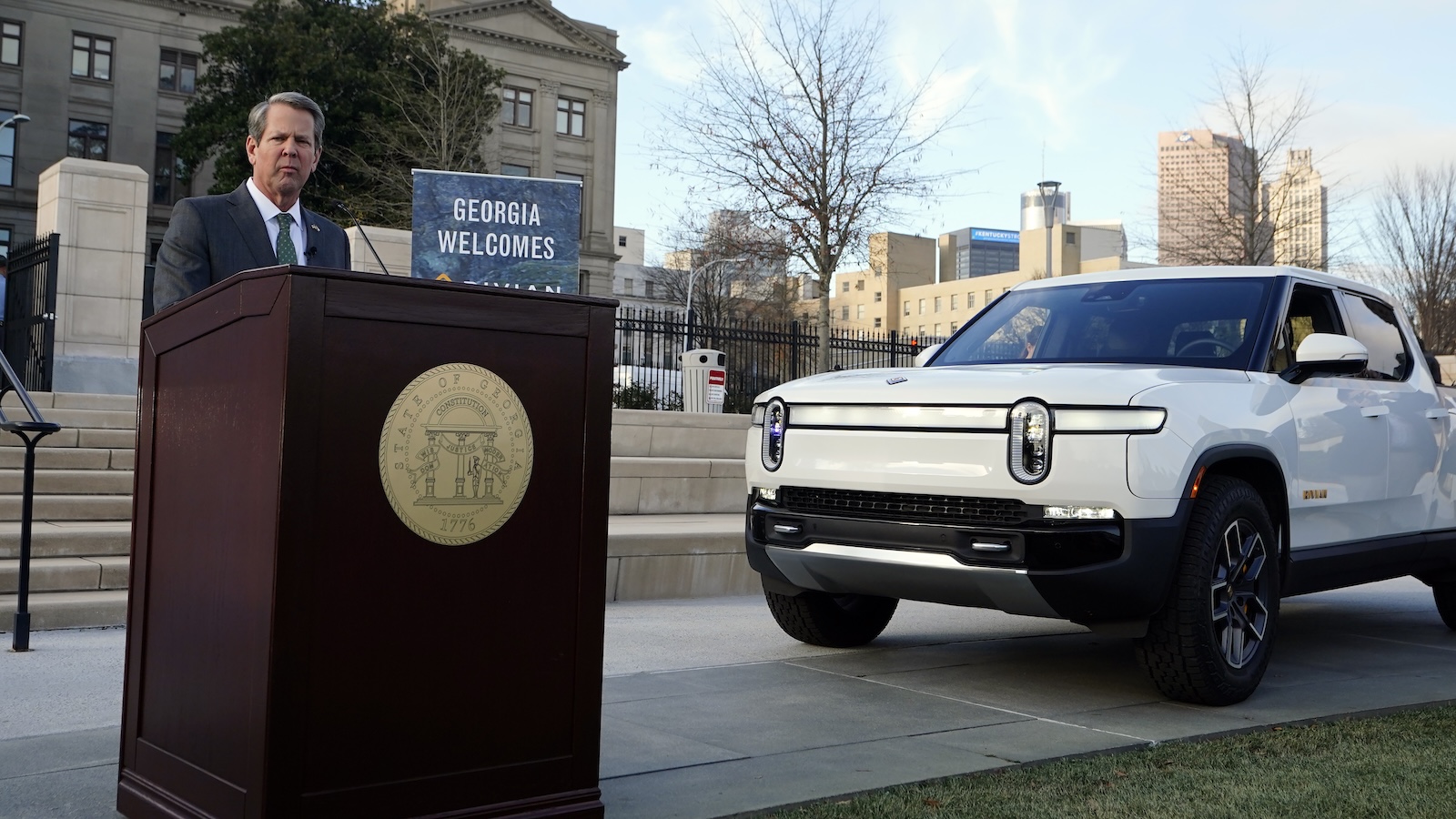
The state’s industrial profile shifted dramatically in 2022 when Hyundai Motor Group announced a massive investment in a dedicated EV assembly facility near Savannah. This project, alongside Rivian’s decision to establish a manufacturing plant near Atlanta—for which ground was broken in 2025—represents two of the largest capital investments in Georgia’s economic history. Kia, meanwhile, integrated EV production into its existing facility in West Point in 2024, signaling a broader diversification of the state’s manufacturing base to include battery production, recycling, and solar panel fabrication.
The Impact of Federal Policy Shifts
The current climate of uncertainty stems from a pivot in federal policy under the second Trump administration. The administration’s recent actions have created a "whiplash" effect for manufacturers who had invested billions under the assumption of continued federal support. Key policy reversals include the repeal of federal EV tax credits, the imposition of new tariffs on essential components—such as battery packs and charging hardware—and a rollback of emissions standards for internal combustion engine vehicles.
Furthermore, the cessation of the previous administration’s mandate to transition federal vehicle fleets to electric power has removed a significant guaranteed market for EV producers. Compounding these structural challenges are geopolitical tensions and immigration enforcement actions, such as the widely publicized raid on an EV battery plant a year ago, which resulted in the detention of over 400 workers, many of whom were skilled South Korean specialists essential to the plant’s operational startup.
Adapting to a Hybrid Reality
Facing a cooling market and the absence of federal subsidies, major manufacturers in Georgia have shifted their tactical approach. The Kia facility in West Point serves as a primary example of this "short-order cook" manufacturing strategy. Rather than committing exclusively to high-volume, uniform production of pure electric models, the plant has been re-engineered to facilitate flexible production lines. This allows the facility to adjust output based on real-time market signals, switching between gas-powered, hybrid, and electric configurations on the same line.
Stuart Countess, CEO of the Kia factory, emphasized that while the long-term vision remains focused on electrification, the immediate economic reality is defined by consumer caution. "What we’ve seen is a transition back away from maybe full EV vehicle building to this kind of a middle-of-the-road opportunity," Countess noted. The removal of tax incentives has fundamentally altered the price sensitivity of the consumer base, forcing firms to lean into hybrids as a bridge technology. This trend is mirrored at the Hyundai Savannah facility, which, despite its original design as an EV-exclusive hub, has recently integrated hybrid production to ensure operational viability.
Data and Economic Implications
The Southern Alliance for Clean Energy (SACE) reports that while the Southeast has seen roughly $4 billion in planned EV-related investment canceled or scaled back over the past year, this figure is largely offset by a robust pipeline of $74 billion in active, ongoing projects. Despite this, the sector is experiencing undeniable growing pains. Layoffs at SK Battery earlier this year served as a stark indicator of the volatility within the supply chain.
The regional market is currently caught in a transition period. Stephanie Valdez-Streaty, director of industry insights at Cox Automotive, describes the current environment as "messy" but emphasizes that manufacturers are demonstrating significant resilience. By diversifying their product lines and pivoting toward battery storage solutions for the broader electrical grid, these companies are mitigating risks associated with passenger vehicle sales.
The Policy Void and Regulatory Outlook
A significant challenge remains the disconnect between Georgia’s industrial recruitment successes and its internal legislative environment. Unlike states that actively subsidize EV adoption through rebates or infrastructure grants, Georgia has maintained policies that can be viewed as disincentives, including additional registration fees for electric vehicles designed to recoup lost motor fuel tax revenue.
Stan Cross, a representative for SACE, points out that the political narrative surrounding EVs in Georgia remains fragmented. "When it comes to electric vehicles, Georgia politics remains utterly confused," Cross stated. While the legislative path is currently stalled, there is an increasing reliance on regulatory action and private-sector initiative to fill the vacuum.
For instance, the IONNA consortium—a partnership between major automakers including Kia and Hyundai—is actively developing a high-speed charging network across the state. Simultaneously, public utilities are stepping into the breach; investment in charging infrastructure by regional utility providers increased by 14 percent over the past year. Analysts suggest that Georgia Power and other regional utilities are poised to play a critical role in stabilizing the ecosystem, potentially serving as the primary drivers of infrastructure growth in the absence of state-level legislative mandates.
Future Outlook: Familiarity and Adoption
Despite the short-term stabilization of the EV market, the path forward is tied to consumer adoption rates. A critical factor in overcoming skepticism is the "familiarity effect." As more Georgians are employed by these manufacturing facilities and interact with the technology on a daily basis, the cultural and economic barriers to EV ownership may lower.
"People have jobs at those companies and familiarity with those products," Valdez-Streaty observed. This localized integration of the workforce into the green energy economy is expected to create a long-term feedback loop that benefits the state’s manufacturing sector. While the rapid expansion of the last 18 months has faced a period of consolidation, industry observers maintain that the transition to electric mobility is not a question of "if," but "when." The infrastructure being built today—from battery plants to charging networks—is designed for a multi-decade horizon, ensuring that Georgia remains a key player in the global automotive evolution, even as the industry navigates the complexities of the current political and economic cycle.
Ultimately, the resilience of Georgia’s clean energy sector will be tested by its ability to remain adaptable. By focusing on hybrid versatility and expanding into grid-scale storage, the state’s manufacturers are demonstrating that they can survive, and perhaps eventually thrive, despite the erosion of federal support and the ongoing political uncertainty that characterizes the current American energy landscape. The transition may be slower than initially projected, but the industrial architecture for a post-combustion economy is firmly rooted in the state’s soil.

