
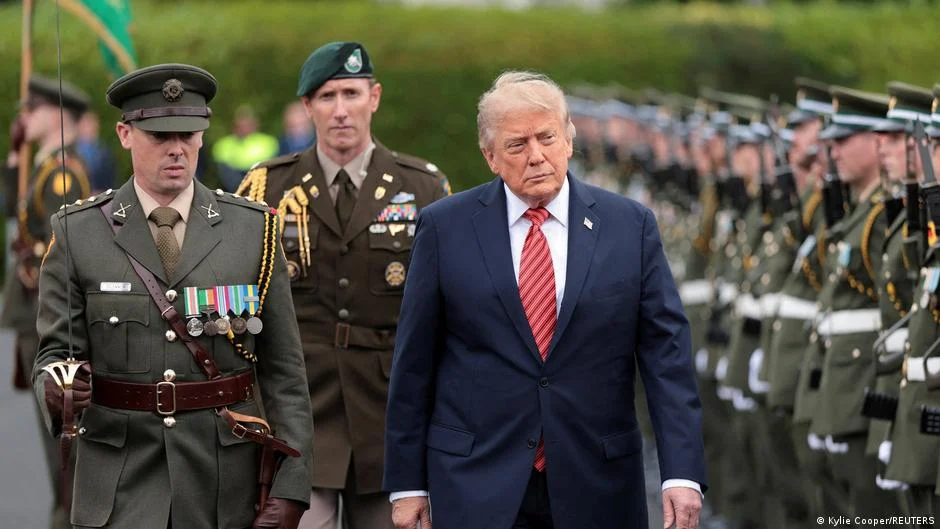
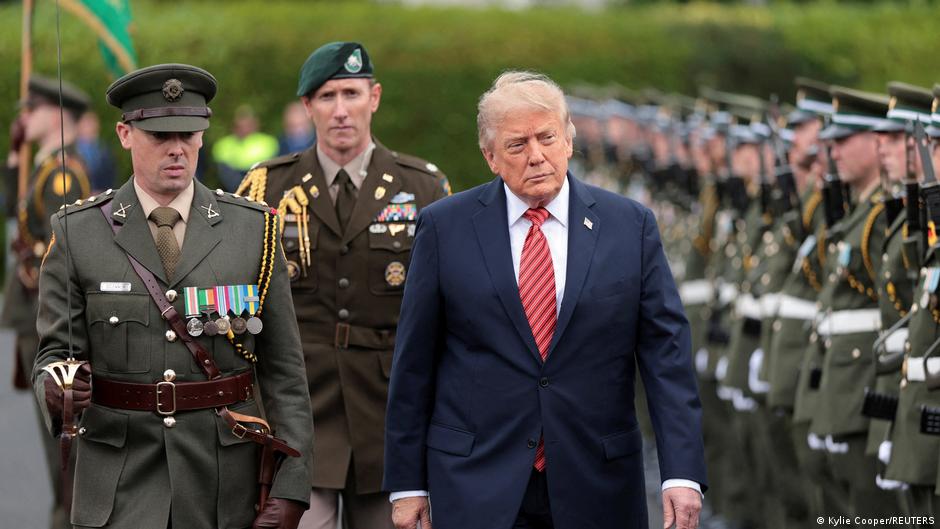
US President Donald Trump has publicly endorsed the concept of a united Ireland, suggesting that the integration of the Republic of Ireland and Northern Ireland would be a “fantastic thing.” The remarks, delivered during a high-profile diplomatic visit to Dublin on Saturday, represent a notable departure from the traditional neutrality historically maintained by American administrations regarding the constitutional status of Northern Ireland. The President’s comments were made following a series of bilateral meetings with Irish Prime Minister Micheal Martin at Farmleigh House, situated within the expansive grounds of Phoenix Park.
The President’s visit to Ireland, which coincides with his attendance at the Irish Open golf tournament held on his privately owned course along the Atlantic coast, has served as a platform for addressing a diverse array of international policy challenges. Beyond the sensitive topic of Irish sovereignty, President Trump utilized the opportunity to discuss the ongoing military conflict with Iran and the intensifying trade dispute with Canada, providing updates that reflect his administration’s current geopolitical priorities.
Historical Context and the Delicate Balance of Irish Sovereignty
The question of Irish unity is rooted in a complex history of political, religious, and social divisions. Northern Ireland remains part of the United Kingdom, a status reaffirmed by the 1998 Good Friday Agreement, which ended decades of sectarian violence known as “The Troubles.” This period of conflict resulted in more than 3,500 deaths and left a legacy of deep-seated distrust that required decades of diplomatic labor to stabilize.
For many years, US policy toward Ireland has been defined by a commitment to the preservation of peace and the implementation of the Good Friday Agreement. Previous American presidents, including Bill Clinton and Barack Obama, typically avoided taking a definitive stance on the constitutional status of the island, focusing instead on supporting the power-sharing institutions established by the peace process. President Trump’s recent endorsement marks a significant pivot, as he characterized the eventual unification of the island as an inevitability. “I don’t want to cause any problems, but I will tell you, I’d love to see it unified,” Trump told reporters. “The way I look at it, it’s going to happen eventually… I think it would be a fantastic thing.”
Official Responses and the British Perspective
The British government, led by Prime Minister Andy Burham, responded with immediate caution to the President’s remarks. In a statement released shortly after the comments circulated, Downing Street reiterated that the constitutional position of Northern Ireland is governed strictly by the consent of its people. The British government emphasized that there is currently no evidence of a majority public desire for a border poll—the prerequisite for such a transition—and maintained that no such referendum would be scheduled unless clear, democratic evidence of public support emerged.
Analysts note that the British government’s swift reaction is designed to mitigate any potential destabilization in Northern Ireland. Any perception that the United States is actively lobbying for a change in the status quo could potentially alienate Unionist communities, who remain firmly committed to the region’s status as part of the United Kingdom.
The Conflict with Iran: A Diplomatic and Military Standoff
The President’s visit also provided a venue for him to address the ongoing war between the United States and Iran, which commenced on February 28. President Trump expressed optimism regarding the duration of the conflict, reiterating his belief that the military campaign would reach a conclusion “very soon.” This assessment, however, remains subject to intense scrutiny from military analysts and international observers who point to the lack of a clear exit strategy.
Defending the necessity of the military engagement, President Trump cited urgent intelligence regarding Iran’s nuclear program. “They were two weeks away from having a nuclear weapon,” the President stated. He argued that the intervention was a preventative measure intended to forestall an existential threat to regional stability, specifically referencing the security of Israel and the potential for a catastrophic escalation in the Middle East. “If they had it, they would have blown up Israel, they would have blown up the Middle East, and they would have hit some of Europe’s cities and beyond,” he asserted.
Despite the administration’s focus on the nuclear threat, the domestic political landscape in the United States remains divided. Many critics point to the President’s previous campaign promises to curtail “forever wars” as evidence of a shift in his foreign policy doctrine. Public opinion polling in the US has consistently shown that a majority of the electorate is skeptical of extended military commitments in the Middle East, placing the President’s current strategy at odds with broader domestic sentiment.

Trade Tensions: The US-Canada Economic Dispute
Shifting to economic policy, President Trump addressed the escalating trade conflict with Canada, maintaining a confident tone regarding the prospect of a new agreement. The dispute, which has seen the implementation of import bans and substantial tariffs, has strained relations between the two North American neighbors. The President specifically highlighted his concerns regarding the treatment of American agricultural interests, accusing Canada of unfair trade practices.
“Canada wants to make a deal very badly,” the President stated during his briefing. “They have to treat our farmers better. They can’t charge our farmers tariffs.” His comments suggest that the administration is leveraging the ongoing trade pressures to extract concessions that would favor domestic agricultural producers. While Canadian officials have remained largely tight-lipped, trade experts suggest that the economic integration of the two nations makes a prolonged trade war unsustainable for both parties. The President’s assertion that a deal could be reached “fairly soon” serves as a signal to markets that the administration is seeking to move toward a negotiated settlement.
Broader Implications and Future Outlook
The breadth of topics covered by President Trump during his visit to Ireland underscores the multifaceted nature of current American foreign policy. From the delicate, historical complexities of the Irish border to the high-stakes military engagement in the Persian Gulf and the economic maneuvering of North American trade, the administration is navigating a series of critical inflection points.
The potential long-term implications of these developments are significant. Should the US continue to advocate for a change in the status of Northern Ireland, it risks upsetting the delicate diplomatic balance that has underpinned regional peace for over twenty-five years. Simultaneously, the success or failure of the military operation in Iran will likely define the administration’s legacy regarding non-proliferation and Middle Eastern security.
As the President concludes his visit to the Irish Open, the international community remains focused on the tangible results of these diplomatic exchanges. Whether the optimism expressed by President Trump in Dublin translates into concrete policy shifts remains to be seen. For now, the administration’s focus appears to be on maintaining a public narrative of progress across multiple fronts, even as the complexities of these geopolitical issues continue to pose significant challenges to global stability. The coming months will be critical in determining whether these proclamations of success and optimism manifest in the stable, peaceful, and prosperous outcomes the President has described.

