
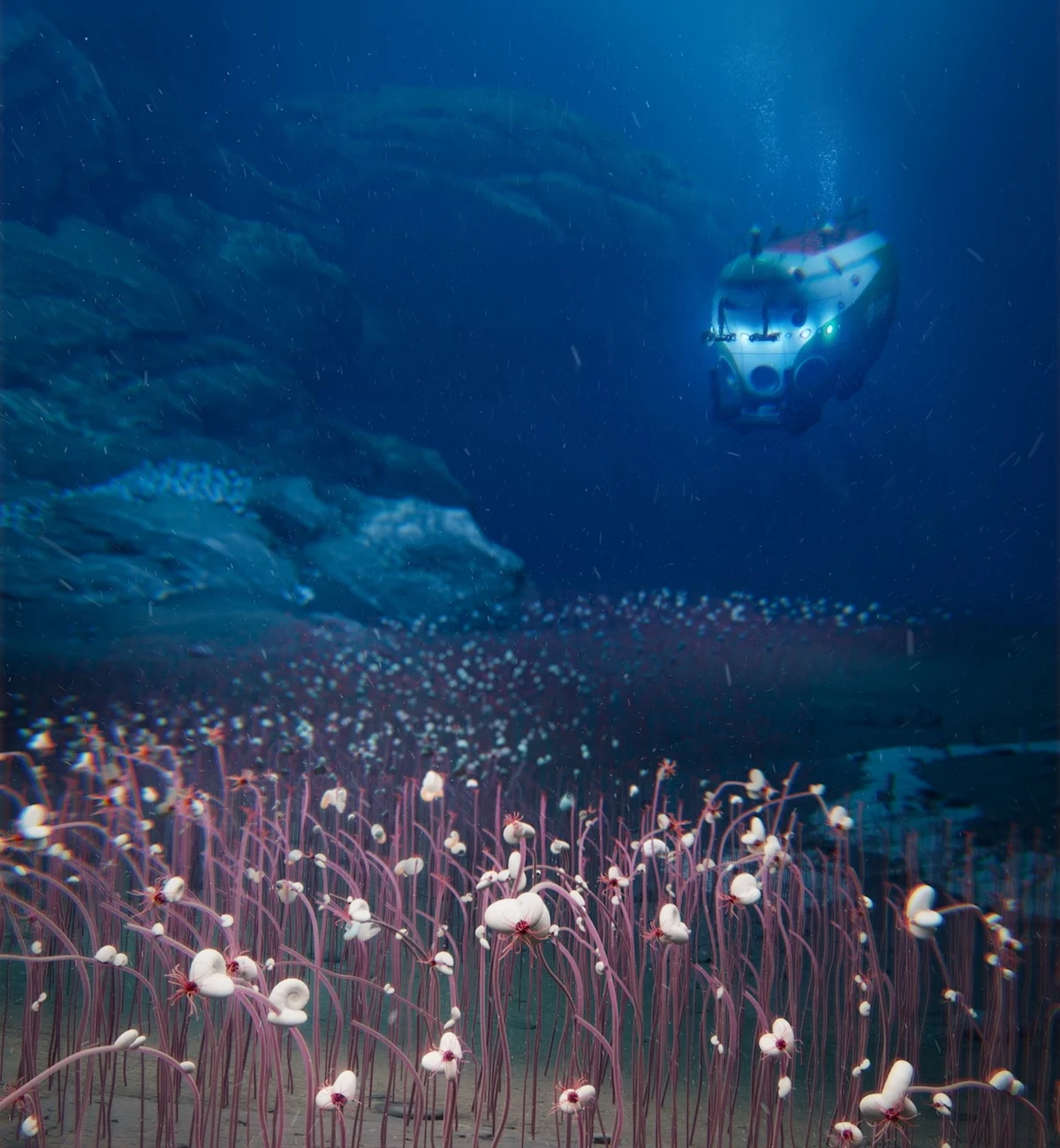
The discovery of a sprawling, complex ecosystem nearly six miles beneath the surface of the Pacific Ocean has fundamentally altered the scientific understanding of life in Earth’s most extreme environments. A team of researchers from the Chinese Academy of Sciences, utilizing the manned submersible Fendouzhe, has documented the deepest and most extensive chemosynthesis-based community ever observed. Located within the Hadal zone—the deepest reaches of the ocean—this vibrant collection of mollusks, tubeworms, and crustaceans challenges long-standing models of deep-ocean carbon cycling and the physiological limits of complex life.
Unveiling the Hadal Frontier
The Hadal trenches, which include the Mariana, Kuril-Kamchatka, and western Aleutian trenches, represent some of the most inaccessible regions on the planet. For decades, these abyssal valleys were considered biological deserts, characterized by crushing pressure, absolute darkness, and freezing temperatures. While scientists had previously identified single-celled microbes living on the seafloor, the discovery of large, diverse animal colonies at depths ranging from 3.6 to 5.92 miles marks a major milestone in marine biology.
The expedition, which conducted 23 dives into the Mariana Trench alone over the course of the previous year, utilized the advanced capabilities of the Fendouzhe. Unlike earlier, remotely operated vehicles that were restricted to shorter mission durations, the Fendouzhe allowed researchers to observe these ecosystems in situ for extended periods, capturing high-definition video of a landscape teeming with life that defies the traditional reliance on sunlight.
The Mechanics of Chemosynthesis
At such extreme depths, the biological necessity for photosynthesis—the process by which plants and algae convert sunlight into energy—is impossible. Instead, the organisms observed by the research team rely entirely on chemosynthesis. This process allows life to thrive by deriving energy from the chemical oxidation of inorganic compounds.
The study, published in the journal Nature, confirms that these communities are sustained by fluids rich in hydrogen sulfide and methane. These fluids are transported along active geological faults that traverse deep sediment layers within the trenches. Isotopic analysis conducted by the team indicates that the methane fueling this ecosystem is produced microbially from deposited organic matter, creating a localized energy source that supports a surprisingly high density of fauna.
The observations revealed massive fields of siboglinid Polychaeta (tubeworms) reaching lengths of up to one foot, alongside dense aggregations of Bivalvia (clams and mussels). These animals were frequently found clustered around "snow-like" microbial mats, which act as the foundational layer of the food web. Beyond these primary inhabitants, the submersibles recorded an array of invertebrates, including sea lilies, sea cucumbers, spiky crustaceans, and free-floating marine worms, illustrating a complex trophic structure that mirrors shallower, sun-lit reefs.
A Chronology of Deep-Sea Exploration
The history of exploring the Mariana Trench is characterized by technological leaps that have incrementally pushed the boundaries of human reach.

- 1960: The first human descent into the Challenger Deep, the deepest point of the Mariana Trench, was achieved by Jacques Piccard and Don Walsh aboard the bathyscaphe Trieste. Their brief visit provided the first confirmation that life could exist at such depths.
- 2012: Hollywood director James Cameron completed a solo dive to the trench, describing the environment as "desolate" and "alien," a sentiment that reinforced the prevailing view that the area was largely devoid of complex life.
- 2020: The Fendouzhe submersible, developed by the Institute of Deep-sea Science and Engineering, successfully reached the bottom of the Mariana Trench, marking a significant advancement in Chinese deep-sea exploration capabilities.
- 2024–2025: A series of 23 systematic dives by the Fendouzhe provided the detailed mapping and biological sampling necessary to identify the extensive chemosynthetic colonies described in the recent study.
Scientific Implications and Data Analysis
The discovery spans a distance of approximately 1,553 miles, suggesting that these chemosynthetic oases are not anomalous pockets of life but are potentially widespread across the global network of Hadal trenches. Lead author Xiatong Peng noted that the geological similarities between the trenches where these communities were found and other unexplored deep-sea valleys imply that the total biomass of the deep ocean may have been significantly underestimated.
The implications for carbon cycling are particularly profound. If these communities are as widespread as the data suggests, they may play a much larger role in sequestering carbon on the seafloor than previously accounted for in global climate models. By bypassing the need for atmospheric interaction, these ecosystems represent a self-contained biological engine that has functioned independently for millions of years.
Official Responses and the Ethics of Extraction
The publication of these findings coincides with an intensifying global debate regarding deep-sea mining. The International Seabed Authority (ISA) is currently under pressure to finalize regulations that would govern the extraction of minerals, such as cobalt and nickel, from the abyssal plains.
Marine scientists, including those involved in the recent study, have issued warnings that the fragile nature of these Hadal ecosystems makes them exceptionally vulnerable to human interference. The sediment-heavy environment, which serves as the foundation for microbial mats and, by extension, the tubeworms and mollusks, could be irrevocably disrupted by the industrial activity associated with seabed mining.
"What makes our discovery groundbreaking is not just its greater depth—it’s the astonishing abundance and diversity of chemosynthetic life we observed," said study co-author Mengran Du. "Unlike isolated pockets of organisms, this community thrives like a vibrant oasis in the vast desert of the deep sea."
Broader Impact on Planetary Science
The discovery of a "vibrant oasis" at the bottom of the world has implications that extend beyond Earth. Astrobiologists have long looked to the deep-sea hydrothermal and cold-seep environments of Earth as analogs for potential life on icy moons, such as Jupiter’s Europa or Saturn’s Enceladus. Both bodies are believed to harbor liquid water oceans beneath thick icy crusts, where light is non-existent, but chemical energy from the core may be abundant.
By confirming that complex, multicellular organisms can thrive in the complete absence of sunlight at the deepest points of our own planet, the research provides a stronger theoretical basis for the search for extraterrestrial life. If life can adapt to the crushing pressures of the Mariana Trench by harnessing chemical energy, it increases the probability that similar biological processes could be occurring in the dark, pressurized oceans of other worlds.
As the scientific community continues to analyze the samples and data collected by the Fendouzhe, the focus is shifting toward the preservation of these sites. The research underscores the necessity of a precautionary approach to deep-sea exploration and development, ensuring that these "last wild zones" remain intact for future study. The findings have effectively closed the book on the idea that the deepest parts of the ocean are barren, replacing it with a new, more complex vision of a planet where life finds a way to flourish, even under the most extreme conditions imaginable.

